Whew,fellow readers. The more I blog the more I realize just how much is going on in the world of publishing and good books. The world of reading is busy, and while sometimes I have to dive a little deep to find info about diverse books, it’s out there for the finding.
If you don’t have time to deep dive for yourself, check out what we have from last week starting with…
Season 2 of The Umbrella Academy is out and it’s goooood…so far.(I’m only 4 episodes deep.) Admittedly, the Gerard Way/Gabriel Ba penned graphic novel that the show is based on didn’t keep my attention for too long but this is a case where all the right changes were made to make an adaptation really sparkle. [via Netflix]
Amrou Al-Kadhiis a gay, non-binary Arab Muslim, and a drag queen. Even if drag had not had such a profound effect on my personal life and aesthetic preferences, I’d find their memoir Life As A Unicornabsolutely fascinating. (Here’s hoping it doesn’t suffer from the Fairesteffect…). I say all of that to point out this excellent article in which Al-Kadhi schools us on books about drag from an expert perspective. [via LitHub]
A little throwback for you…I promise there’s a reason.
Music critic Maria Sherman has written an extensive history and analysis of the phenomenon that is boy bands, titled Larger Than Life: A History of Boy Bands From NKOTB to BTS.While I didn’t have high hopes given the BTS-spangled cover, Sherman offers up this thoughtful tidbit in her NPR interview that made me curious. When asked about boy bands and their relationship to Black music, her response is;
Boy band music, like all popular music, is founded in Black music — it’s sort of a throughline throughout all popular music history. There’s a reason Backstreet Boys’ “I’ll Never Break Your Heart” sounds exactly like Boyz II Men‘s “End of the Road.” It’s pretty egregious. And yet for many people, myself included, I don’t really see Boyz II Men as a boy band. There are a variety of reasons for that, but the obvious one is that it wasn’t presented as a boy band and so much of what a boy band identity is is how it’s marketed and sold to you. Boyz II Men are seen as a sexier R&B male vocal group and the Backstreet Boys are a little bit more innocent. There’s something to that image of chastity, even if it is alluding to something PG-13. I also think that perhaps because Black and brown youth are typically sexualized at a younger age, they’re not afforded the same privileges of a white boy band. And that’s why you can have the Backstreet Boys, who are around the same age doing something similar, but sold to tweens, whereas Boyz II Men is for a more mature audience.
Hmm. Definitely makes me sit up and pay attention to the rest of what she has to say. [via NPR.]
Let’s swing into more serious territory for these last few…
After more than 80 authors and publishers signed an angry letter decrying their human rights abuses, Saudi Arabia will officially not host the World Science Fiction Convention , aka WorldCon 2022. Chicago will instead. [via Tor, The Guardian]
Zimbabwean authorTsitsi Dangarembga,who wrote the Booker Prize-shortlisted novel This Mournable Body was arrested and jailed during a peaceful protest on Saturday, then subsequently released on bail. While I’m glad to hear she was released, I’m also extremely upset that she was even arrested to begin with. The woman is 61, a international treasure, and it was a peaceful protest. [via RFI]
I’ve been judicious but not shy about voicing my criticism of Robin DiAngelo’s hit non-fiction anti-racismbookWhite Fragility. Surprise surprise, DiAngelo herself is getting rich and fragile as her academic celebrity grows. Don’t say I never told you. [via Free Beacon]
There’s other news this week, about the Eisner Awards,George R.R. Martin messing up again, and why I should probably not make jibes at Martin, or any other author, really. To get updates on bookish news in real time throughout the week, follow me on Facebook. To get book reviews and pretty pictures, follow me on Instagram. Finally, if you want to support this blog and fill your life with even more books, check out my Bookshop affiliate store, or click and purchase from any link in a blog or review on this site. Thanks as always for your read, and peace!
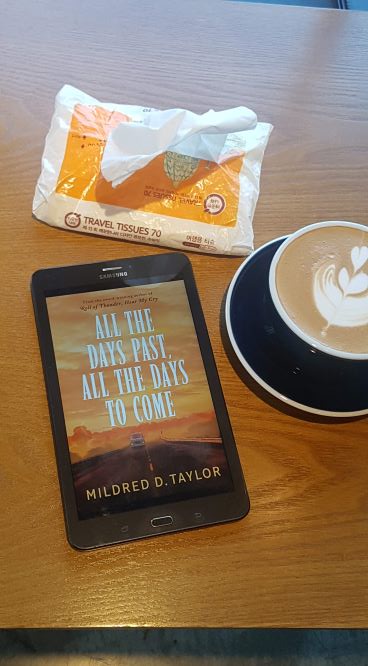
When I bought this book, I immediately told myself I was going to cry buckets over it. I lied. I cried rivers. Seas. OCEANS, even.
None of the reviews on this site are objective(how could they be?) but this one is a little less objective than usual. The family in this book andthe nine preceding it have been a part of my life for too long and echo my own family experience too closely. I took this book personally, and it didn’t disappoint at all.
Our protagonist, Cassie Logan, returns to narrate this book as she has most of the others in the series. After growing up in the Jim Crow South, she heads North with her brother Stacey to pursue an education and better employment opportunities. At the start of the book, she’s an educated young Black woman in Ohio, just as mouthy and independent as ever. She maintains a connection to her Mississippi roots, however, and soon finds herself a leading-edge civil rights revolutionary while her brothers head off to fight in WWII. Without giving away too much of the story from there, I can tell you that Cassie travels the world, loves hard, and fights injustice, although not always in that order. Accompanying her in spirit, if not always in presence, are her parents, grandmother, three brothers and temperamental Uncle Hammer, as well as all her friends from back home (Ey, Moe!) and plenty of new people Cassie meets as she finds her way.
These characters feel like old friends, but I don’t think you need to read the previous books to enjoy this one. The story of living in an unjust world that isn’t changing fast enough holds up on its own, and in these times, revisiting the history of great social change is cathartic and inspiring.
Life is a path that often winds its way to unexpected destinations. Not everyone makes great choices and not everyone has a happy ending.(There’s one character, present in many of the previous novels, whose story ends with one brief, sad mention–and it tore me up). As Cassie’s path winds into the late 1960’s, it can be hard to watch where her choices take her–but that’s life. So is the pride when she decides to stand up for what’s right and do her bit to change an unjust world, knowing it echoes the real life decisions of all those who have gone before us, and many of those who are to come. It’s a bit bittersweet, but this novel is a fitting end to the saga of a beautiful family. I highly recommend it and the previous 9 in the series–there’s nothing like them in American fiction.
Thank you, Ms. Taylor, for such a heartfelt and emotional ending to an unparalleled series integral to the Black American literary canon. 5 stars to All The Days Past, All The Days To Come.
Find this book HERE or check out the entire series HERE.
(This blog is an affiliate of Bookshop and any clicks and purchases will result in a commission earned. Thanks!)
“The question is: Who gets to be an American? What does an American look like?“~Willis Wu, Interior Chinatown⠀ 🥋⠀ Imagine if Spike Lee was Taiwanese-American and wrote novels in strange, semi-screenplay format. That’s the best way I can think of to describe this book and the way it shifts through unreliable realities while alternating between didacticism, sharp humor and comforting family vignettes.⠀ 🎥⠀ But then I remember that one of the themes explored here is defining Asian-American experiences by their own history, not as reductive comparisons to Black and White, and I want to take it all back. Despite that, while reading I kept thinking of Spike and Paul Beatty’s brilliant Black satire, The Sellout. There’s something in Yu’s low-key furious, high-key funny approach to the puzzle of Asian-American visibility that is very reminiscent of those two yet also not like them at all. ⠀ 🎬⠀ Willis Wu is an actor based in LA Chinatown. Despite a lifetime of working hard at being the best bit player possible on the hit TV drama Black and White, his dream of being Kung Fu Guy–the highest an Asian actor can go–seems like it will never be fulfilled. While the SRO that he, his aging actor parents and all the other Chinese actors live in crumbles into poverty around them and his most promising speaking role ends on a deadly note, Willis finds himself asking questions like, “What is all this really for? Why is Black so cool? Is White really on my side? Is Kung Fu guy all there is? Where has the mysterious, stereotype-defying Older Brother gone?” ⠀ 🏮⠀ This book is clever, funny and its statements about identity, race and assimilation hit quite hard. Yu is a skilled writer who’ll have you lost in nostalgia on one page and gasping for breath from laughter on the next. But the format, while creative, made it really hard to get into the book at first. It’s a well-written screenplay with chunks of surrealist novel strewn through it, and until the characters are established and the dialogue begins to flow, keeping track of everyone and everything is a stilted, confusing affair. I appreciate the creativity but it made for slow going at the start. 🍲⠀ Still, I enjoyed this enormously and will definitely be looking up more of Yu’s books in the future. 4 stars and a leading role to Interior Chinatown.
(Thanks for reading, beautiful people. As always, I need to tell you that this blog is an affiliate of Bookshopand any clicks and purchases you make result in a commission being earned by yours truly. Also, not to belabor the point or anything, but this book, unlike the last few I’ve reviewed, is one you should really consider buying. It’s really good. No, really. Peace!)
Last weekend I racked up my 1000th Instagram follower. For those of you who don’t know, this blog grew out of anInstagram account that became a Facebook page and then expanded to include a blog, all in the space of less than a year. I’m not sure exactly what I did to get this many people paying attention to my bookish thoughts but hey, I’m pretty stoked. Join the party, follow me.
Okay, now on to our weekly roundup of diverse book news(and there is quite a lot, this week)…
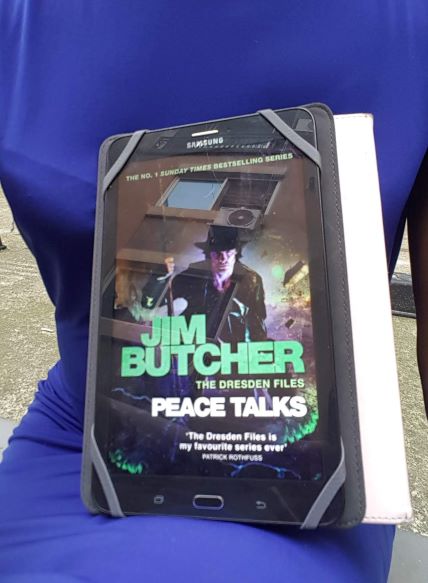
Peace Talks, the much anticipated new installment in Jim Butcher’s Dresden Files series was released after a nearly 5 year wait. I found it underwhelming.I’m not the only one. As much as I love the adventures of Chicago’s only publicly listed wizard and all his paranormal friends, I think the best thing about the new book is that is makes me glad the next oneis coming out in a few months. [via Equal Opportunity Reader]
The Ta-Nehisi Coates best-seller Between The World and Me will be adapted for the screen by HBO. Previously, the book was made into a stage play. I’m not sure how well the content lends itself to performance but I’m still curious enough to give it an eventual watch. [via Black Girl Nerds]
Speaking of adaptations, the graphic novel Paper Girls, by Brian K. Vaughn and Cliff Chiang, is also headed to the screen courtesy of Amazon. I’ve only read a few issues so far but it strikes me very much as Stranger Things-meets-Ghost World-meets-Love And Rockets. In other words, it seems cool, retro/alt/punky, and very feminine. Looking forward to it. [via Tor]
There are some exciting book releases in the cards too. Four year old Nadim Shamma-Sourgen will be the UK’s youngest published poet upon the release of his yet-unnamed poetry collection. Jason Reynolds, the Mr. Congeniality of YA fiction and the best contemporary writer of Black boys, will also be exploring new territory and releasing his first book for adults, entitled The Mouthless God and Jesus Number Two. [via The Guardian, LitHub]
British author Mark Dawson was removed from the best-seller list after revealing he bought hundreds of copies of his own book on his own podcast. Boo hoo. [via The Independent]
My eternal celebrity crush Keanu Reeves has announced that he’s writing his first comic book, an action adventure featuring some guy who looks a lot like Keanu and might be an immortal Charlemagne. You tellin’ on yourself, boo. [via Tor]
According to the Cooperative Children’s Book Center, diversity in children’s book publishing is on a very positive rise. However, “Despite slow progress, the number of books featuring BIPOC protagonists lags far behind the number of books with white main characters–or even those with animal or other characters.” *sigh* [via CCBlogC]
And the last item for this week’s wrap-up…Julia Roberts and Denzel Washington are going to be in another book-adapted movie together. (Last time was 1993’s The Pelican Brief, which was…of its time.) This time they’ll be in the Netflix film version of Rumaan Alam’s Leave The World Behind. The novel won’t be released until October, but it seems to be about two families–one black, one white–sequestered in a vacation house in Long Island during a sudden blackout and the resulting collapse of society. Should be interesting, at the least, considering how much hype it’s getting long before the book is even out. [via LitHub]
That’s it for this week’s news and links, beautiful people. As always, visit the Equal Opportunity Bookshopfor your indie book hookups, and be aware that as an affiliate, any clicks and purchases earn a commission for this site. Peace, beautiful people! Go read something good!
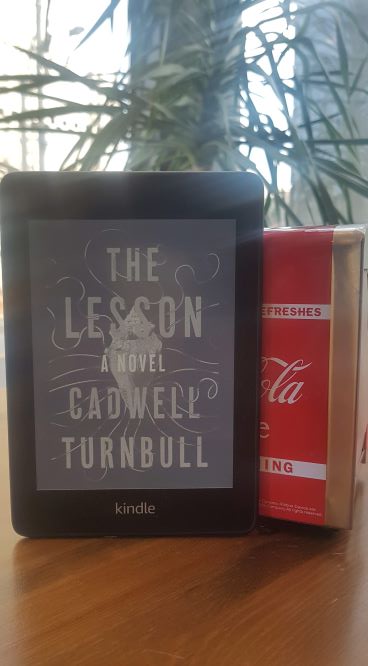
At first this book seems like a simple alien invasion with a little interspecies love gone wrong subplot, set in author Cadwell Turnbull’s native US Virgin Islands. Not an unusual story, but set in an unusual(for sci-fi) place. An alien race called the Ynaa descend on Water Island in a conch-shell shaped ship. They’re not hostile, exactly, but they are touchy in a way that can be dangerous, and they quickly impose a reign of tense, martial superiority over the residents of Charlotte Amalie. The islanders have a variety of reactions, of course. Some love the Ynaa, some hate them, and some maintain a wary, distant tolerance. However, everyone’s life is deeply affected by the aggressive, possessive stance the Ynaa take over their corner of Earth, mitigated only by the presence of a centuries old ambassador who’s been living undercover among the humans as a Black woman and has learned to care for the locals. (One human is affected by this much more…personally, than the rest.) The ambassador’s presence doesn’t stave off violence successfully and the book leads to a devastating, scary conclusion that took me completely by surprise given the slow setup. There’s nothing exactly new about this book–a lot of sci-fi deals with social integration and relationships with alien beings and all the ways first contact could possibly go wrong. My first impressions of this book were that the only thing that made it truly special was the setting.
I’m happy to say my first impressions were wrong. By the time we get to the first big death, a lot of layers have been unrolled and continue to be, making this a remarkably culturally literate bit of speculative fiction. It’s more special than it appears at first glance. Inside this alien invasion are themes of generational and historical trauma, colonialism, gendered violence in African diasporic communities, and some very interesting commentary on what it takes for victims to become conquerors–or if that’s even a thing that can really happen.
Despite all of that the novel never feels too heavy and is as entertaining as it is deep. It’s distinctly Caribbean as well, in a very natural way. I liked it and will definitely keep an eye out for whatever Turnbull writes next.
Okay, all of that and still only 4 stars? I have to be honest and say that the writing never quite did it for me. It’s very much what I like to call “MFA style”–large, self-conscious blocks of very deliberate, laborious action spattered with short paragraphs of weirdly purple descriptive prose. It’s competent and the story is well-crafted enough to make it tolerable, but man, loosen up a little next time, will you? I am here for global science fiction entirely and I want more books from Turnbull, but I also want him to unstarch his collar a little bit next time, let the prose flow and the culture shine through so the themes bubble a little longer in the reader’s spirit.
Overall though, I liked this quite a bit, and I’m excited about the wave of diasporic takes on science fiction it’s riding the crest of. It’d be interesting to see a thematic trilogy of books set in the Virgin Islands from this author, kind of like Tade Thomson’s Rosewater series. (Aliens invade rural Nigeria, fix everything, it doesn’t matter. Great books, go read them.)
Four stars and a universal translation device to The Lesson.
(Thanks for reading, beautiful people. As always, this obligatory disclaimer comes in peace. Until aliens invade, the internet costs money and as a result this blog is an affiliate of Bookshop. Any clicks and purchases will result in a commission being earned.)
Sometimes, I feel like the most revolutionary thing Black people can do is be happy.
At this point, we are 8 weeks deep into some sort of Great Global Awakening, or perhaps just a very long Nap Interruption.(#hashtagwoke) Protests continue worldwide, as do stunning acts of bravery, kindness, and well…fascism, infuriatingly. The world is changing, and once again the flint that sparked the tinder is Black Americans and our constant struggle to rip apart and rebuild the racist, unequal foundations our country was built upon so that we can all thrive in the future.
For those of us who are readers, that means contributing booklists. Oh God, the booklists. The Internet of Books is currently under a six inch deep layer of booklists, whether we like it or not, and many of them are focused on Black people and anti-racism.
I’ve already ranted and raved about why I’m not making an official anti-racist booklist, so I won’t do it again now. But I will say that it surprises me how absent Black joy, happiness, and family are from most of these lists. Instead there’s a lot of talk and overtalk about Black pain, anger, and suffering, as though that is the sum total of our existence and therefore the only reason it is important to pay attention to us now. What I think a lot of us don’t realize is that many people who are not Black and aren’t close to Black people have been conditioned to see us and our culture as sources of entertainment, primarily. Here we are, with all our pain and anger on display, not realizing that negative emotions can be very entertaining when they aren’t yours–and entertainment does not necessarily lead to empathy or understanding.
In other words, I’m not sure that a constant display of Black pain in art and media is an effective way to encourage anti-racism or build ourselves up. We are a people whose culture is often appropriated and commodified while being simultaneously disrespected and invalidated. Our trauma is not exempt from that. We may be feeling all of this in a deep place, but that doesn’t mean the people consuming it are empathizing in a deep way, and that just presses the pain into a deeper place. L.L. McKinney, the author of A Blade So Black(a funky #Blackgirlmagictake on Alice in Wonderland) broke it down very eloquently for Tor recently, saying:
No one stops to consider the effects of repeatedly subjecting Black children to racism, police brutality, and anti-Blackness on the page without something to break it up. Then there’s the exploitative aspect of non-Black readers taking in this story and somehow feeling they’ve accomplished something. They’ve managed activism by bearing witness to the events of the book, but then don’t follow up with seeking change in the real world. Reading then becomes performative.
You should read that whole article because it’s excellent. It’s what got me thinking and searching and realizing that it’s still shockingly hard to find literature that highlights Black success, Black joy, Black power and Black life outside of the crushing existence of systematic racism. I’m sure it’s being written, but it’s hard to find it published.
This is frustrating because obviously, Black people exist outside of constant fear and otherness. We aren’t perpetual victims, despite the existence of a system that seeks to perpetually victimize us. Racism is an ever-present threat and worry in my life, sure. But I have a life, don’t I? Sometimes, it’s quite a happy one. With the rise of recommended anti-racist reading focusing so tightly on pain, trauma and injustice, it seems as though that part–the part about happiness, and the fact that Black people deserve it and experience it and fight for it just like any other group of people–is being minimized.
So, I’ve decided that my contribution to The Great Anti-Racist Booklist Surplus of 2020 will be a collection of books featuring Black joy. Black happiness, Black love and Black peace. Sure, racism and othering exists in these books because like I said before, it’s always there. But Black people are not defined by trauma, only shaped by it. We are more than our collective trauma, we are more than oppression, and all of our stories deserve to be told and heard–not only the ones that speak justice to our mistreatment by those in power. We are all more than our trauma, and deserve to live in a world where we are not subjected to trauma in the first place. That’s why Black joy is revolutionary. To stand in the face of a system that tries to deny you humanity and do the most human things of all–find happiness together–is enough to make the foundations of any oppression crumble.
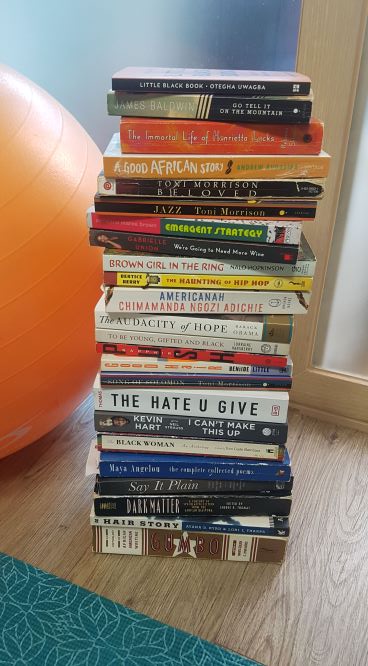
Now, because everybody on the internet is so pedantic these days, I’ll say up front that this list is not exhaustive. I’m not a lit scholar, librarian, or woker-than-thou authoritarian. I’m just a reader, and these are books I’ve read that feature Black folks being joyful and open and free. You can see the entire list here, but I’m only going to talk about half of the entries because I have type-arrhea as it is. Finally, if you have suggestions–share them! Hit the comment section with book love! Let’s be revolutionary together.
Without further ado, here’s a bunch of books about Black people, by Black authors, that focus on joy, humor, family, love and comfort.
All About Love, bell hooks
Let’s start off with the OG of Black healing and community, bell hooks herself. This non-fiction work focuses on love for everyone, in all communities, but has a culturally Black foundation that resonates particularly strongly in these times. I found it inspirational, because it reminded me that while it’s easy to forget the power of love, it’s also easy to be transformed by it, and to transform others. Find it here.
Not Without Laughter, Langston Hughes
Speaking of classic Black American novels, Langston Hughes wrote some great ones, although he’s mostly known for his sweeping poetry. This 1930 novel is a coming of age story, about a young boy in a close and loving family who pin their hopes on his future. Again, racism and oppression are present–how could they not be?–but the novel focuses on the story of the family and their rich internal lives. It’s not a story with a happy ending or a utopian setting but there is something lovely about the gentle humor and closeness portrayed in this book. It’s available here.
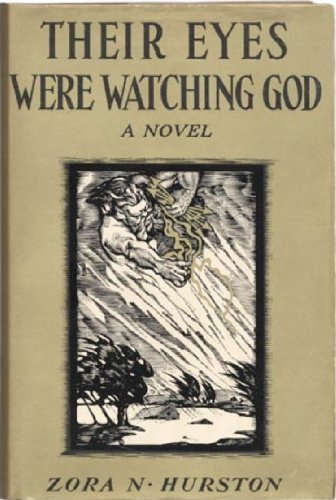
Their Eyes Were Watching God, Zora Neale Hurston
It’s so common for the world to see Black women as mules, fetish objects or opponents that we seem to tell more stories of recovery from objectification than of finding and enjoying ourselves as women. I think that’s why I love this classic 1937 novel so much. It’s not that there isn’t pain and trauma involved–there is, in heaps–but ultimately it’s about Janie Crawford finding and taking joy in being a woman, in having love and in finding friendship. While it takes place in a racist society, it’s not about race–it’s about a Black woman coming of age, moving through the world and finding her place at a time when few people(of any race) were openly expressing that sort of freedom in their inner life. Find it here.
A Day Late and a Dollar Short, Terry McMillan
Family epics are one of my favorite type of book. While this isn’t precisely an epic–it takes place over about a year in the life of a multi-generational Black family in Las Vegas–it is a good family story. While they have their share of ups and downs, the focus of this book is not on the trauma of living in a racist society, but on the critical work of maintaining family love and togetherness despite that. I love every single character in this book, warts and all, and it’s one of the few reads that makes me homesick. (Fun fact: I originally buddy-read this with my grandma.) It’s availablehere.
What Looks Like Crazy On An Ordinary Day, Pearl Cleage
This may seem like an odd choice for a booklist about Black happiness. Ava Johnson contracts HIV and returns to her tiny, all-Black hometown to mentally process her diagnosis and walks into unexpected small town drama. But again, this is a book that is not about Black pain or white racism. It’s about the joy that comes from building Black communities and the safety and stability of good family. It also has a genuinely sweet and redemptive love story at its center. I first read this in my teens and it made me dream of growing up to be free, loving and complete no matter where life took me. Buy ithere.
Let’s Talk About Love, Claire Kann
There’s something really bright and sunny about this unusual romance novel. Alice, the main character, is a biromantic asexual figuring out to to relate to the rest of the world. She comes from a protective middle-class Black family and has friends from lots of different places and cultures. Also, she’s a cheerful, carefree Black girl who makes great decisions and has good relationships. This may be the happiest book on the list and I love that we live in a world where it can be published. Find out more about it here.
335
Opposite of Always, Justin A. Reynolds
I honestly have pretty dark tastes in media, but I’m still a sucker for a sweet love story. This is a tale of two Blerds overcoming literally impossible odds to be together. It features time travel, indie music, corny jokes and SO many bowls of cereal. Again, while racism is there, it’s never the focus, and our hero is a refreshingly non-toxic, boy next door kind of guy–something you rarely see Black men written as. Also, the author is surprisingly a man himself. If he’s any indication, men should really write more romance novels. Find out more about ithere.
The Year of Yes, Shonda Rhimes
“There is no list of rules. There is one rule. The rule is: there are no rules. Happiness comes from living as you need to, as you want to. As your inner voice tells you to. Happiness comes from being who you actually are instead of who you think you are supposed to be. Being traditional is not traditional anymore. It’s funny that we still think of it that way. Normalize your lives, people.“ ~ Shonda Rhimes. This book is part memoir, part humor essay collection, and part inspirational manifesto. Rhimes, creator of half the TV shows you love, decided to agree to everything for a year and the results were delightful and empowering. Check it outhere.
There are so many more books that could be on this list, but these are just a few of my favorites. You can see the full list HERE–it includes some memoirs, a couple more love stories and a book of poetry. Check them out, read a few, and remember that Black people expressing our happiness–and recognizing Black people are not defined by trauma and pain, only oppressed by it–is an anti-racist act.
(This blog has an affiliate relationship withBookshop. Any clicks or purchases will result in a commission being earned.)
🧙🏻♂️⠀ (This is the 16th book in a 20 book series…so here be spoilers, aargh, beware. They’re for the series, not this book. )
Harry Dresden is my problematic fave. I’m well aware that if he were a real, non-magical person the crime-solving, wizard-for-hire hero of the Dresden Files would probably be a creepy neckbeard in the local gaming shop–the one with the “edgy” jokes and wandering eyes. In a lot of ways, Harry is the peak of mediocre white dude wish fulfillment fantasy–a geek with more force than talent, surrounded by better people than him, who is still somehow accorded phenomenal cosmic power and hot babes everywhere he turns. ⠀ 🧛🏻♂️⠀ But man does he have some great stories, some witty comebacks, and an amazing supporting cast. The Dresden Files are action-packed, magical fun, and even though I can see some very real problems with their protagonist, I still drop everything I’m reading whenever we get an new installment and immediately devour it.
Over the course of 16 books and a dozen short stories Harry has endured a lot of pain and done a lot of growing up, so perhaps I’m being a bit unfair. After previously dying, coming back to life, becoming a vassal of the fae, raiding Hades and becoming a full time dad (among other things), Harry has become darker and more complex by the time we get to this book. So has the alternate Chicago he lives in, leading to the titular Peace Talks between two opposing otherworldly alliances–the Unseelie Accords, which includes Harry, the White Council of Wizards, and most of his assorted friends, allies, and enemies vs. the Fomor, an entirely new and otherworldly threat first mentioned in Ghost Storybut as of yet not too terribly fleshed out. ⠀ 🏙⠀ This leads Harry and Co.–well, nowhere, really. After introducing the idea of the talks, the book shifts and suddenly becomes a jailbreak caper, introduces a new big bad villain, and ends on a weird cliffhanger. All our favorite characters show up and quip their way through an action sequence or a pep talk, but plotwise nobody does much and the book doesn’t really seem to go anywhere but in familiar circles. It tries to break away from them with the new villain but it doesn’t really hook the reader in the way it’s meant to. Speaking of which, that villain is an overpowered disappointment. I realize it’s hard to keep upping the stakes consistently throughout a series that is meant to span 20 books, but at the rate it’s going the only thing left for Harry to do in book 20 will be to literally punch out Cthulu.⠀ 👾⠀ While it was nice to see the Dresden gang together again and Butcher is a great storyteller, this is one of the weaker entries in the series. Fans waited for almost 6 years for what feels like half of a book and I was annoyed by its lack of resolution and incompleteness. I’m glad we get the next book in September–hopefully it’ll pack a harder punch.⠀ 🌠⠀ 3 stars and a magic potion to Peace Talks.
(Thanks for reading, beautiful people! Even though this book wasn’t my favorite, the Dresden files series is a lot of fun and you can see the whole thing HERE. Also, this blog is an affiliate of Bookshop and any purchases made from clicks will result in a commission being earned. Go forth, buy books, and be happy.)
🌟🌟🌟🌟 This book sat on my Kindle at 35% for months, because frankly, the first 3rd of this book is pretty obnoxious. It starts as a whimsical love story between two privileged elites playing at revolution in Bautista-era Cuba in order to relieve themselves of their pampered boredom and exercise their intellectual pretensions. It’s written so fluffily and in such self-absorbed, oblivious voices that the backdrop of the Cuban Revolution almost seems inappropriate, while the romance itself is rather dull.
However, at around the halfway mark, things…change. The characters (and readers) slowly begin to ask themselves what happens when revolution becomes regime, and they begin to make decisions based on the answers they find. What happens when naive idealists don’t love the new reality that they helped create? I went from thoroughly loathing these characters to reading the conclusion with my heart in my mouth, hoping for the best but knowing that the worst could be just around the corner. I wasn’t expecting to, but I really enjoyed this book by the end. The last page was thoroughly satisfying.
Side note: I read this in English, translated from the original Spanish. While there are a few moments where it reads like a translation (“his masculine index fingers stroked my sternum”—yeah, that sounds soooo natural 😂😂😂) for the most part, it’s pretty smooth. I do wonder how it reads in Spanish, though–there are characters from a variety of hispanohablante countries in the book, and references to their accents, but none of that really comes across in the English dialogue. Has anybody read this in Spanish?
Four out of 5 stars.
(Beautiful people! Thanks for reading and please know that I am an affiliate of Bookshop any click/purchases made from this site to that one earn a commission.)
🔥⠀ I’m usually pretty indifferent when it comes to YA fantasy. The genre is over-saturated and usually far too full of belabored love triangles and incompetent parents for me. I boughtAn Ember In The Ashes not knowing that it was young adult fiction–once I realized, I instantly lowered my expectations. However, there was no need for my snobbishness because…⠀ 🌠⠀ THIS BOOK IS GOOD! It’s one of the most entertaining things I’ve read this year. It’s not deep, it’s not emotionally transporting or socially incisive but it does suck you in and drag you from front cover to back cover with your eyes wide open and your heart in your throat. Sabaa Tahir knows the right way to use YA tropes and conventions to tell a fast-moving, action packed story and I’ll definitely be reading the rest of the series. ⠀ 🧕🏽⠀ So what’s it about? Shy, scholarly peasant girl Laia is pressed into service as a spy for the Resistance after tragedy befalls her family. Elias is a military trainee in the elite Masks, only a few days away from graduating into full service. After an unexpected announcement, he finds himself in a brutal competition to be the next Emperor while he and Laia orbit around each other mysteriously. ⠀ 🕯⠀ Emperor of what? Resistance against who? Mysterious orbit? What does that even mean? Who cares? If you’ve ever read fantasy before there’s nothing foundationally new here. Emberis billed as a take on the Roman Empire, and in some ways it is, but the magic and mystery are far more North African and South Asian in origin. Our heroes go up against djinns, efrits and ghuls, and the story sometimes has a folkloric ring to it. It’s all done very well, even when the plot dips into old YA saws to gain momentum. There are love triangles and clueless adults galore, but there are also heart-in-your-mouth action scenes, terrifying villains, and genuinely sweet romances that capture all the confusion and newness of teenage feelings in a way that feels authentic to the story. My only quibble is that even though it’s fun to get there, the ending is WAY too convenient. Still planning to read the next book, though.😁⠀ 🔱⠀ 4.5 stars and a war cry to An Ember In The Ashes.
(Thanks for reading as always, beautiful people. This blog has an affiliate relationship with Bookshop, so any clicks and purchases you make result in commission being earned. Peace!)
(This book is also published under the title Apples Are From Kazakhstan).
⭐ star out of 5. ⠀ 🗺⠀ This is a weird one. I appreciatedthis book–it’s a travelogue of two years spent exploring Kazakhstan–but I didn’t like it at all. It did a great job selling me on how fascinating Kazakhstan and its history are, but it didn’t tell me much about them at all. Also, while there’s thankfully only oneBorat reference in the whole book (I had forgotten he was even supposed to be from there) there are still only a few fleshed out portrayals of actual Kazakh people in the book.⠀ 🏕⠀ The problem is the author’s tone. Robbins(R.I.P.) was a very good British writer who unfortunately seemed to harbor a rather old school colonial explorer mentality despite having done the bulk of his work in the 2000s. This leads to some rather unfortunate contradictions in this book. While he acknowledges the pain and cultural erasure in Central Asia caused by Russian occupation and Sovietization, half of book’s 8 chapters focus on famous Russians who lived in Kazakhstan, rather than Kazakhs themselves or any of the other ethnic groups that make up the country. Robbins was invited to spend a lot of time interviewing and traveling with Nursultan Nazarbayev, who was the president of the country until 2019. If you believe the accounts in the book, Robbins and President Nazarbayev got quite friendly. This means the author had all sorts of priceless opportunities to dig deeper into Kazakhstan than Russophilia, but he doesn’t often. Most of his sensibly described friends seem to be ethnic Russians. His ethnically Kazakh friends are all described with overtones of noble savage or quirky eccentric, and the Kazakh women he encounters are all “harridans” or literal prostitutes. It’s telling that the last chapter is a conversation between Robbins and a (Kazakh) friend who calls him out for tromping through the streets of Almaty dressed like an old Soviet officer and focusing his research heavily on gulags, nuclear testing sites and industrial slums instead of the beautiful countryside and ancient history of the country. Robbins counters with a weak argument about wanting to show the true Kazakh spirit but in the end, I agree with his friend. Robbins makes Kazakhstan seem foreign and exotic, full of old monuments to oppressive regimes and strange, unappetizing food, but he rarely gives us glimpses into the Kazakh people, art, culture, or current issues except for in largely unflattering, “look at the funny foreigners” ways.
This book leaves me in search of better books about Kazakhstan because I don’t trust anything I found in its pages. I’ve heard very good things about The Silent Steppe, by Kazakh nomad writer Mukhamet Shakaykhmetov–perhaps I’ll give that a try. ⠀ 📚⠀ One star with a vodka chaser to In Search of Kazakhstan. ⠀ 😁⠀
(Quick reminder, fellow readers. This blog has an affiliate relationship with Bookshop, and clicks and purchases result in a commission being earned. Peace!)










 Equal Opportunity Reader