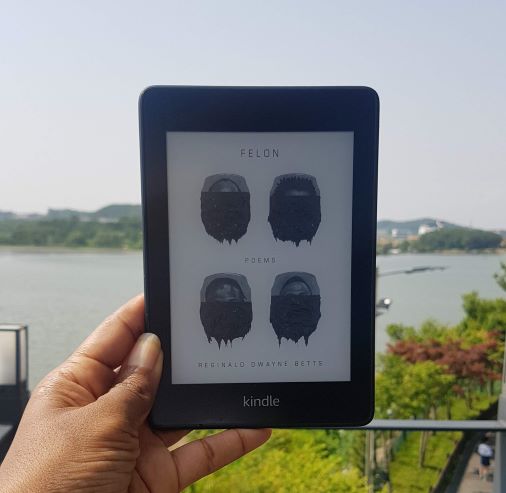
🚔⠀ I am a father driving/his Black sons to school & the death/of a Black boy rides shotgun &this/could be a funeral procession⠀~from “When I Think of Tamir Rice While Driving”⠀ ✊🏿⠀ When it’s difficult for me to focus, I tend to read poetry. This short collection surprisingly filled an empathetic void in me I didn’t know I had. Its focus on the emotional experience and effects of incarceration is both eerily timely and educational without being didactic. I mean, I know the stats. I’ve seen Ava Duvernay’s excellent documentary 13th. But I’ve never thought deeply on the heart of someone who has been incarcerated. I know incarceration marks a person indelibly. I had some dim idea of how. But this book made me think of what those marks look like in daily living, and what it takes to heal, or to try to.⠀ ⛓⠀ One day I watched him, full of fear for/my own fragility & wondered how he dared/own so much of himself, openly. For all/I know every minute in those cells/was safe for the kid whose name/I cannot recall. But how can a man ever be safe like that, when you are so/beautiful the straight ones believe it &…. ~from “Temptation of the Rope”⠀ 🔗⠀ One more thing I want to mention–although Betts is not queer himself, he writes about queer men in prison in a way I’ve rarely seen–tenderly, with respect, and sometimes with a sort of awe. While only a few poems feature people who aren’t straight, the reverence is noticeable. He doesn’t make mean dehumanizing soap jokes or rely on clichés at all, and the result is quite beautiful. It’s Pride month now and everyone is an ally on the internet–Betts provides a model for how to write about LGBTQIA+ people as an ally without condescending or being performative, and I love to see it.
📝⠀ 5 stars and a reformed American justice system to Betts’ Felon.⠀
(Thanks for reading! If you want to read this book, consider purchasing it HEREfrom Bookshop, the online portal for indie bookstores. I am an affiliate of Bookshop and will earn a commission if you click and purchase from any links on this site. )
⠀⠀ 💧Wow, where do I even begin? I don’t think I’ve ever read anything quite like this before, even though all of the elements of it are familiar. There’s a misfit princess, warring nations, a beautiful foreign slave girl, and strange visitors from a faraway land. Characters struggle with unrequited love, confusing sexuality, and mismatched marriages. There are power struggles–both political and personal. There are side characters and historical references galore–I spent a lot of time flipping back and forth to remind myself who a minor character was, and took lots of pauses to look up cultural and historical things mentioned briefly in the text. ⠀⠀⠀⠀⠀⠀⠀⠀⠀ ⠀⠀⠀⠀⠀⠀⠀⠀⠀ . 📚 If The Hundred Wells of Salagawas about China or England or colonial America, I wouldn’t be surprised at all. But instead, it’s about a very real historical period and royal conflict in 1860’s West Africa (but it is emphatically not about the Transatlantic slave trade).
I love that this book was written. Too often, books about African people are published as a memorial of oppression or injustice rather than out of a sense of history, but this book is firmly the latter. It’s character-driven historical fiction set among the various African nations that eventually became modern-day Ghana. It’s interesting, entertaining and treats its subject matter with the same legitimacy than people use when writing about Anne Boleynor Catherine The Great, with the same expectation that the reader should be passing familiar with the context and just enjoy the royal drama. There should be more books like this. ⠀⠀⠀⠀⠀⠀⠀⠀⠀ ⠀⠀⠀⠀⠀⠀⠀⠀⠀
📖 It doesn’t get the full 5 stars because while it’s good, it’s not a masterpiece. Notice I haven’t given you a lot of name and place details–it’s because despite the fact that I enjoyed this book, none of it really stayed with me. I also found most of the main characters extremely unlikable. They were interesting, but it was hard to figure out who to root for. Still, 4 stars and a pleasantly surprised nod to The Hundred Wells of Salaga.
(As always, thanks for reading and this is the usual legally required notice that if you click on any links in this post or on this blog and make a purchase, I’ll earn a commission from Bookshop.orgbecause I am an affliate. Peace! )⠀⠀⠀⠀⠀⠀⠀⠀
This book is easily my second favorite read of the year so far after Girl, Woman, Other. It’s funny, touching, warm-hearted, and surprisingly deep. It’s also ferociously well-written. (One chapter made me close the book, say WOW, & sit for a while with the words.) I can’t believe I’ve never heard of Satyal before–I’ll be reading as much of his other work as I can get my hands on. ⠀ 🧛🏾♂️⠀ The book follows a brief period in the lives of a handful of Indian-Americans in Cleveland. All of them wink & smile up at you from the pages, beckoning you into their intertwined lives. There’s empty-nester Ranjana (pronounced RUN-juh-nuh), a budding romance writer, and her fussy, tedious husband Mohan. After immigrating to the US together in the 90s, the two of them are trying to rediscover life after raising their son, Princeton student Prashant. There’s sad, lonely Harit and his senile mother Parvati, both consumed with grief & confusion. There are all their friends–campy Teddy, snotty Seema, needy Achyut, ditzy Cheryl & the very unfortunately named Dr. Butt. Together they do what people always do–form bonds, work on their relationships, & try to create spaces where they feel loved and accepted. Ranjana, settled comfortably into the groove between her birth country & her adopted one, is the heart of the book and its intersecting social circles. By the end, I felt her triumphs and revelations like they were my own. ⠀ 👩🏾💻⠀ What I love most about this book is how ordinary and bizarre it is all at the same time. These are very normal people continually pushed into abnormal circumstances by emotion–not by being Indians in America. Satyal writes the line between cultural authenticity & representation very well, so while these characters are thoroughly Indian, nobody is trying to define the experience. They’re just living their lives and taking us along. If you don’t get all the cultural references, that’s fine. Neither do they, sometimes. 👔 ⠀ So to recap; excellent writing, characters I’d want to hang out with in real life, cultural realness & a plot that left me with a sigh in my heart and a smile on my face. 5 stars & a heaping dish of assorted barfi to No One Can Pronounce My Name.
If you’d like to read this book, consider purchasing it HEREfrom Bookshop.org, an alternative to Amazon. I am an affiliate of Bookshop and will earn a commission if you click and purchase from any link on this page. As always…thanks for reading.
(This post is an edited Facebookpost. Follow EQR on FB blah blah etc.)
If you haven’t gathered from the About Mepage or some of my posts, I’m a Black American, living abroad. This blog is about books, not me, so I don’t talk about my own experiences often. My day job and life also consist of quite a lot of talk about race and social justice, but I try to avoid internet activism and grandiosity for the most part.
This is because I realize the internet is largely overwhelmed with bad news, fear, pain, anger, and uncertainty these days. As a result, I’ve made it a point to keep things light and literary. Books and reading have always been a haven for me, and a website about books and the love we all have for reading should be no different, I think. The written word at its best is a gateway to engage with the painful spaces in the world and wring from them the joy of understanding and the will to improve. I strongly believe that, and so, I’ve largely avoided reactive anger porn and always try to tease out a positive action to take or a voice of truth when I do post something here about the ways in which the world sucks. That will continue, going forward.
But today, I’m sad. The past few weeks have been brutal for the Black American community. Nationwide lockdowns and precautions meant to stem the spread of a global pandemic have had no nullifying effect on continued police and community brutality, systemic racism and the outright murders of people who look like myself, my brothers, my family.
Fellow readers, I’m sad. So sad. And I’m tired–exhausted, even. Not because of my own Blackness (don’t get it twisted), but by the world’s response to it, in myself and in others.
Several well-meaning folks who are not Black have reached out and asked what they can do. Whatever I tell you, it’s not enough. This is not a momentary issue. This is a lifelong issue. This is an issue of history, an issue that defines our country and shapes our culture. This is something we have been shouting about forever. You are upset today, but we’ve been upset for years and it’s *exhausting*. If you want to help, you take up this baton and run with it for a while. Let me, let us, REST.
When I heard the news of George Floyd, the 46-year-old Black security guard in Minneapolis who was restrained with cruel, unnecessary brute force by a police officer despite his pleas and those of onlookers, and died of his injuries the same day, I was reminded of the writer Henry Dumas. You’ve probably never heard of him, although he was a graduate of Rutgers, an early voice in the Black Arts Movement, and a prolific short story writer and poet who influenced no less a luminary than Toni Morrison, who called his work “some of the most beautiful, moving and profound poetry and fiction that I have ever in my life read.”
You’ve never heard of him because in 1968, at the age of thirty-three, Dumas was shot and killed by a New York City transit cop in a subway station. No-one was charged in his death. Had it not been for Morrison’s discovery of his only published collection in a university library, his voice would have entirely disappeared from the world.
How many of our voices have disappeared from the world, due to injustice and cruelty?
Did I say the past few weeks have been brutal for the Black American community? Because I meant to say the past 400 years.
If you want to find out more about Dumas, this NPR article is excellent.
“Who will be lost in the story we tell ourselves? Who will be lost in ourselves?”
This is a messy book. There’s a lot going on between its covers–PTSD, emerging sexuality, poverty, war, immigration, mental illness, class, race, abuse, art, gender performance. There’s a lot going on, but it all seems to add up to love, albeit a wistful imperfect love shared out between a half-dozen very broken, emotionally malnourished people, all set to an unlikely soundtrack of 50 Cent and Chopin.
You really can find almost anything on the Internet, even if it’s not exactly what you want.
The story explores the life of Little Dog, a Vietnamese-American immigrant raised by his mother and grandmother in Hartford, Connecticut. As he grows up, he gets into a tentative relationship with a local boy named Trevor, who slowly declines due to addiction just as Little Dog’s star begins rising.
“Whether we want to or not, we are traveling in a spiral, we are creating something new from what is gone.”
This book is a LOT. It’s a slow, sad, beautiful read, a spiritual successor to Morrison, Angelouand other narrative greats who explore cultural pain. It’s also achingly familiar. It’s rare that I see what I think of as my America represented in print, but this is a literary sketch of the America I know and love in absentia. Little Dog lives in a neighborhood made grim and intense and very multicultural by poverty and the social failure-to-thrive syndrome that comes from personal and cultural trauma and oppression. I get it. I really do. Little Dog and Trevor could have been any one of a dozen lonely boys I knew growing up. As sad as this book was, there was also a sweetness in seeing another Child of the Secretdo good despite the pain, as Charles De Lintmight say.
I liked it a lot. It has about fifteen different endings and the pace is imperfect but it’s a marvelously affecting read, nonetheless.
So here we are in the last full week of May, beautiful people. It seems like just yesterday it was the 78th day of March, but we’ve made it all the way to the beginning of summer and hopefully no-one’s broken their glasses yet.
This week sees sea creatures, fictionalized president’s wives, and a very puzzling and sad revelation on the life of a critically acclaimed writer…
A new novel called Rodham was published last week as well, and everything about it seems, well, rather weird. It’s a fictionalized account of the life of Hilary Rodham Clinton if she had never married former President Bill. Aside from being supremely bizarre timing, the concept seems fetish-y and irreverent in such a way that keeps me from wanting to read it any time soon. This NPR review captures a lot of my feelings, only they’ve already read the book.
Okay so for this next bit of news, you’ll need to sit down…
The late author H.G. Carrillo, who succumbed to COVID-19 complications on April 20th. Rest in power and peace, sir.
The above video is the Philip Freund Prize Alumni Reading being given by Cuban-American writer H. G. Carrillo, one of the more critically acclaimed Cubano writers of recent years. On April 20th, the artist passed away due to combined complications from prostate cancer and COVID-19. I can’t say I was a huge fan but I remember skimming through his 2005 novel Loosing My Espanish, and thinking how incisive and unique (to me) the voices of the characters were. As you can see from the video reading above, the late Carrillo and his work had quite a presence and soft humility to them, and I always found him an interesting voice from a community that often does not get to tell their own stories in English fiction.
However, the author H.G. Carrillo was never Cuban at all. He was a Black American Detroit native born Herman Glenn Carroll, and perpetuated a 30-year facade of Latinidad forreasons that unfortunately, have passed on with him.
It’s always a little ghoulish to discuss someone’s seemingly transgressive behavior so soon after they’ve left us, but this Washington Post obituary does a very kind and compassionate job of memorializing the man that Carrillo/Carroll is remembered as both before and after his writing career. I’m sure there will be a lot more discussion of this in coming days, but for now, all I can say is that I hope his soul is resting well and in respite from the lifelong stress of maintaining this persona.
This is a bit of a sad note to end on, but an intriguing one, I think. I’m going to try to do a weekly recap of bookish news every week so here’s hoping for good things.
(As always, this blog contains affiliate links to my Bookshop, the bookseller’s website that supports indie bookshops and the addictions of bibliophiles like me! If you click and purchase anything through a link on this site, I will earn a commission.)
First of all, yes, I know that’s not a poppy in the picture. There aren’t any growing in my neighborhood this year, unfortunately.⠀
Secondly, this review is a little spoiler-y. I won’t give away any major character-based plot points, but I will allude to a major event in the plot without giving any details. I’m sorry, but I just couldn’t think of a way to talk about the book without giving away a little something. Proceed at your own risk. ⠀
⠀So, The Poppy War. This massively popular, award-winning epic fantasy series based on Chinese history has launched a thousand fandoms and a thousand and one trigger warnings. I had no idea what I was in for when I opened this book but the tale of brilliant orphan girl Rin, who aces a national exam and escapes a life of indenture by going to the nation’s most elite military academy and winning over her spoiled new peers, did not disappoint me at all. I’m a sucker for homely woman, crouching badass stories in fantasy fiction and Rin’s stubbornness, intelligence and drive kept me immersed in the story until the last page. ⠀
However, I also had no idea that the book is a fantasy retelling(and moral re-examining) of the Sino-Japanese Wars, specifically the Nanking Massacre. Yep, you read that right. If you’re not familar with that episode of history, just focus on the word “massacre” and you’ll have enough of the general idea. Rin’s studies are cut short by invaders from a nearby island nation, and she, her friends and their teachers are all sent off to fight in a terrible war. This is where all those trigger warnings come in. This book gets dark. Pitch-black. Jet. Inky. Our characters are confronted by greater and greater atrocities, and there are enough references to reality sprinkled into the text to make me think I might feel quite differently about this book if I were Chinese or Japanese.
⠀⠀Add to that the fact that our heroes spend most of the time after they leave school literally getting high before battles and things get really dark. I won’t spoil the reason for you but Rin does a lot of drugs and so do all her friends. What starts as a seemingly inspiring tale of an underdog rising through the ranks of society quickly turns into a violent tale of an elite martial artist drug addict breaking bones and cutting throats in order to root out treachery. Ip Man, eat your heart out.⠀
⠀Having said all that, I’m not sure how I enjoyed this book but I really did. The plotting and worldbuilding are so crisp and use tropes so innovatively that I was riveted despite some of the more horrifying moments. The magic system is really unique and draws on inspiration from Chinese mythology very well. Kuang knows how to tell a story by endearing you to her characters even at their most unlikable, and there are some unexpected twists and turns that have me excited to read the next book. ⠀
⠀If I have one real criticism of this book, it’s the prose. This is emphatically NOT YA fiction due to its grim and graphic content, but the prose isn’t very sophisticated and sometimes is oddly juvenile and light, given the immensity of the concepts and events being described.⠀
⠀Four and a half stars and some intense trauma counseling to The Poppy War.
If you want to read this book, click HEREand buy it from Bookshop.org, an alternative to Amazon that supports indie booksellers and affiliates like me (yes, that means I earn a commission if you click any links on this site and make a purchase.)
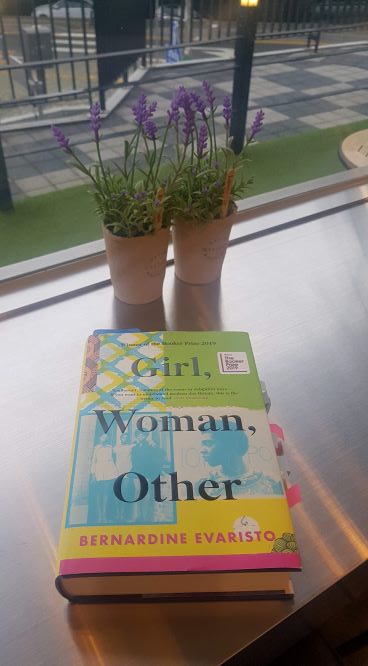
I have no idea what you’re doing messing around with me on the internet when you could be somewhere reading this Booker-prize winning masterpiece. Hurry up and log off so you can get into this ASAP. (Just hit like before you go, ok? 😜 )
Seriously, this is genius, real life made art and set out in deliciously prose-y poetry. Or is it poetic prose? Not sure, but it’s deeply descriptive, unconventional and an absolute joy to read.
Girl, Woman, Other is a journey through Blackness, Britishness, womanhood, queerness and all manner of other things told through the voices of twelve very different people. Most of them are black, most of them are women, many of them are LGBTQIA+ family. They may not all think of themselves with the definitions we might assign while looking at their pages, but they do think of themselves, others and the world they live in with joy, with pain, with resilience, with resentment, with hope, with defeat and most importantly, with nuance.
And you know what? I know these women. In this book I see echoes of conversations and interactions I’ve had with sistahfriends, acquaintances, elders and enemies. I see people who I am very familiar with and sometimes belong to, but rarely have their interiority immortalized on the page in such an accurate, loving and unprejudiced way.
READ THIS. The characters are loving, detailed sketches of people we all know but rarely see. The language is gorgeous and tightly wrapped around the story’s complexities. And the story? Well, all of these people are connected, and realizing how is absolutely delightful (and also quite emotional, in a few cases).
I could go on and on about this book–it’s not only a favorite 2020 read but a favorite lifetime one, I think, and it deserved to win the Booker Prize all on its own instead of being overshadowed by Margaret Atwood’s tepid Testaments–but instead I’ll just tell you again to read it. I won’t even leave you with a quote–you deserve to experience all of these wonderful words fresh and new just like I did. Go. Read. Enjoy.😍
If you want to purchase a copy of this book, consider clicking HEREand purchasing it from Bookshop.org, an online bookseller that supports indie booksellers, writers, and content creators. I’m an affiliate of Bookshop and will earn a commission if you click and purchase through any of the links on this blog.
Back in 2019, long before COVID-19 roamed the earth and drove us all inside brandishing cans of Lysol, the bookish internet was abuzz with news of Tomi Adeyemi’s Children of Virtue and Vengeance. I couldn’t check social media without seeing 50-11 posts anticipating the book and after putting a poll up on the Equal OpportunityFacebookpage, I decided to board the hype train and read it myself.
I didn’t enjoy it. But I struggled through and read it anyway, much the same way I’ll occasionally eat a hog maw or listen to a trap song–for the culture. I’ll get more into that later, but what I thought about the book itself doesn’t matter. Children of Virtue and Vengeance, the Legacy of Orisha, and Tomi Adeyemi herself are actually great things for the state of Black speculative fiction in 2020 and beyond, and perhaps not in the way that you think. They’re good in a way that transcends presence, representation, and diversity. They’re good precisely because they’re not that good, and I’m here to tell you why.
First, a bit of background. Children of Virtue and Vengeance–let’s just call it CVV or we’ll be here all day–is the second book in a YA fantasy series called Legacy of Orisha. The first book was Children of Blood and Bone(which we’ll call CBB, same reason). The third book is as of yet untitled and has no release date but there is a series-themed affirmation journal calledAwaken the Magicthat was released in April 2020.
The series is about a fictional kingdom(Orisha) that is an analog of pre-colonial Nigeria. There’s magic and ancestral clashes between magic users and mundanes that push the plot along. I’ll try to avoid spoilers, but even with them there’s not a lot of surprises, in my opinion. If you’ve ever read a fantasy novel, particularly a YA fantasy novel, you know what’s coming from the first page. The main characters are teenagers. Some of them are royal, some of them are magic users, and some of them are both. The magic users form kind of an oppressed underclass (despite having magic powers), and there’s lots of teenage angst and romance with problematic overtones and NO ADULTS INVOLVED EVER despite this being a whole kingdom with serious political problems and military conflicts going on. In my less charitable moments, I’ve described it to people as Twilight in magic Nigeria.
The books themselves have been very well received so far. The first book debuted at number one on the New York Times bestseller list, won the Andre Norton award for YA Sci-Fi and Fantasy in 2018, the Lodestar Award in 2019, and was a Kirkus Prize finalist. The second book didn’t fare quite as well but was still a best-seller. The series has been optioned for film/television development by Disney and I think it’s pretty safe to say it’s a pop culture phenomenon, taking fantasy even farther into the mainstream and putting an African cultural spin on it.
But, as I said before, I didn’t enjoy reading either book.
I feel guilty saying that. It’s like I’m betraying the culture, the saints and the ancestors. To be honest, even I’m confused by the way I feel about these–I should love them. They’re sword and sorcery fantasy outside of the played-out hyper-European foundation that dominates the genre. Fantasy as a story-telling genre has long been assumed to start from a European cultural basis–think Game of Thrones, the Witcher, The Wheel of Time, and of course the classic Tolkien–so it’s really exciting to see someone create a fantasy world from a different foundation. It’s also a pleasantly feminine series–there are women in this book with agency and character and personalities of their own. They’re not big-breasted murderbots, sex objects, or saintly rewards that only show up at the end of the heroes’ epic quest. They’re young women–how fully realized they are is up for debate–but still, this is a world that contains and recognizes women as people, at last.
Isn’t she darling?
Speaking of women, Tomi Adeyemi herself is somebody I really want to root for. She’s a Harvard-educated Nigerian American who grew up in Chicago and worked in film production in California before writing these books. At the tender age of 26 she’s got a multi-book, film-optioned deal. She’s created a whole world that’s been published and millions of people have read, and she actually got her book deal by winning a pitch competition. I’ve watched a few of her interviews and she’s bubbly, personable, has gorgeous locs, and seems like a really generally cool person. I’m not a hater. I want to love her work. It doesn’t matter if I do or not because she’s a lovely published bazillionaire but there are some public figures whose stories make you want to love everything they make, and she’s one of them.
But her writing just doesn’t do it for me. I am on team Tomi but the land of Orisha is never going to have the same place in my heart as Middle-Earth, Arrakis, Earthsea or the Realm of the Elderlings. It’s certainly not as interesting as post-apocalyptic Jarret-ite California or future Sudan. (If you get any of those references, then you probably know where I’m going with this, but if you don’t, hang in there.)
I’ve already reviewed CVV and I was pretty harsh. There’s not a lot that I liked about it, but as I said, that doesn’t matter. Adeyemi was apparently very methodical about the way that she wrote the book–she scrapped another novel that she had been working on to move on to this series, she worked as a writing coach, and her degree focused on West African mythology and myth-making in general. She’s very clearly studied the craft. The craft ain’t studying her back. You can tell she really plotted and formatted this story meticulously but didn’t go back and erase her literary pencil lines, so ultimately the book didn’t seem very organic to me. Also, it’s the kind of story that really needs the reader to love or at least like the characters and be invested in their relationships but that never happened for me. You don’t even get the sense that the author likes them much. Sometimes that can work. I read an essay by Octavia Butler stating that she really didn’t like the protagonist of the Parablesseries by the time she got to the end of the story, which is why so much of the second book is told through the eyes of her daughter. I’ve read that series probably a dozen times and I’m not sure I like Olamina either, but the difference is that she seems like a living breathing person who really embodies not only an idea or a role in a story but a whole personality and being. I feel like I could see and understand a person like that whether or not I care for her personally. Olamina stays with you as a fully realized person, but our POV characters in CBB and CVV don’t really have that much substance, to the point where I don’t really remember their names and couldn’t be bothered looking them up for this blog post.
I realize that it’s not very fair to compare CVV to Octavia Butler’s Parables series. Butler is the OG Grande Dame of Black speculative fiction, she wrote for adults on arguably far more serious and dark subject matter, and she was more on the sci-fi side of speculative fiction than fantasy, of course. But that brings me to my over-arching point–I’m not writing this just to poo all over the Legacy of Orisha. I’m fine with it just not being my cup of tea. But I feel as though Adeyemi’s work means something peculiarly good for the state of speculative fiction by Black people in 2020 and beyond.
Before we continue–I’m not an expert, and I realize that. I do write speculative fiction myself but it has yet to be published anywhere(Edit: actually, now it has–check out my short story Dragonflies in the magazine Midnight and Indigo.) I read all over the map but my favorite genres have always been and will always be fantasy and sci-fi–slightly more fantasy than sci-fi. I’ve also always set deliberate intentions regarding seeing myself and people like me as the default experience, to the point where it’s very second nature now. That started with being a selective reader in my childhood. Even before it was popular to do so, I was always in the bookstore and the library looking for books that had Black characters, even if they weren’t always by Black authors. For me, Black characters in speculative fiction took some searching but weren’t entirely unusual because I could find them when I looked. The quality wasn’t always good, but blackness has always been in speculative fiction. It isn’t new. What’s changed is the creators.
Some prominent examples of early Black spec-fic characters I enjoyed that come to mind are Steve Perry’s Matadora series–about a pansexual Black woman guerilla mercenary who starts a galactic revolution, which blew my mind when I was 16 and only knew what about two of those words actually meant. I read Ursula K LeGuin’s EarthSea series, which is populated by people of color in a high fantasy setting without being weird about it. (Nobody has chocolate skin, woolly hair, or speaks high court jive.) Glen Cook is another author I read a lot of–people often bring up the Black Company, but for much of the original series they aren’t actually Black. In contrast, his Garrett P.I. series, which is shockingly sexist and homophobic in retrospect, also had one of my favorite Black men in fantasy. I LIVED for the moments when the character of Playmate would show up–he was a happy Black man who took no crap from the main character and just ran his stable, read his books, and knew important things at the right time.
Don’t judge me for this next part…
Speaking of Garrett P.I. though, that brings up something else–as a young Black reader of speculative fiction I often did something strange. I recast book characters to reflect my racial reality in my head despite how they were actually described in the book. A lot of the authors were white, but I wasn’t and neither were most of the people I knew in real life. I saw no reason why I had to envision the characters that way unless it was explicitly necessary that they be so. So Morley from Garrett P.I. was always a very dapper Black man (elf?) in my head when I was reading. I was kind of startled when I was looking at some of the book covers last year and realized that the oily little white guy with big ears on the cover of one of the books is supposed to be Morley because in my mind, Morley was always a cross between Sidney Poitier and Sammy Davis Junior. My imagination didn’t always come up with such cool images–the first time I read Two Towers, Treebeard a.k.a Fangorn ,a.k.a. the oldest of all of the Ents was basically reduced to a green James Earl Jones with some leaves on his head. When I read Anne McCaffrey’s Pernseries–the one about the dragon riders who fight space spores on a crapsack planet with the powers of telepathy and relationship drama–everyone was ambiguously brown and multiracial because even then, in my mind it only stood to reason that far in the future on another planet human beings would mix and remix ad infinitum beyond our current racial notions. I was delighted to find out, by the time McCaffrey wrote the prequel DragonsDawn, that I had guessed entirely right and then horrified to go on the internet in the early days and see folk foaming at the mouth insisting that Pern was white and Irish and that I was ruining it by saying F’lar might have some beadie-bees in his kitchen or at least a really good tan.
I’m digressing, I know, but I’ve always loved speculative fiction and my tastes veer towards the far out and intense. My point is, though, that when I couldn’t find a book with characters that looked like me or the people I know, I had no problem racebending them and I doubt I’m the only one.
In any case, you can imagine how I felt when I finally discovered Octavia Butler, starting with the Parables, then Kindred, then on to her deeper darker stuff like Bloodchild and the Patternist series–and everyone was already someone familar to me. People were Black, they were Latino, they were Asian, they were multiracial and multicultural, and they were often white as well but they didn’t exist in a vacuum of white default. It was such a revelation to find communities that really reflected an aspect of my reality in these very unreal, imaginative situations. I suddenly realized that there were other people of color writing speculative fiction as well, with even more characters that reflected the diversity of my own real life and the way I saw myself. I got into Tananarive Due, Nalo Hopkinson, Steven Barnes, and Walter Mosely (who is mostly known for his detective novels but has also written some really good, socially cutting sci fi). There were authors of other races that I liked as well and I’m just going to be really honest with you and say that finding and loving speculative fiction authors of color didn’t make me stop reading white authors, it just broadened my literary world and made me stop putting leaves on James Earl Jones’ head in my mind. It was really a big deal to have favorites in the genre that reflected speculative understandings of my reality.
I say all of this to point out that despite what you might have heard, we been out here representing in the speculative fiction world. Having Black people, Asians, Latinos, multiracial people, Arabs, Muslims, Jews, and everybody else is not new to sci-fi or fantasy, it’s just never been common. We need more, of course. I’d be a fool if I tried to deny that most fantasy often overwhelmingly assumes a pan-European foundation in the world-building, no matter what the characters look like. I mentioned before that I write speculative fiction. I went to a writing group once and shared a piece set in a world much like Pern–far in the future, the result of ages of interracial mixing, everybody is brownish, but the foundations are emphatically NOT European–and a guy at the meeting told me he didn’t like it because he couldn’t figure out any of the cultural references. Welcome to my childhood world, dude. I was creative enough to stick leaves on James Earl Jones’ head and still enjoy myself but he just rejected the work out of hand because the hero didn’t have a name like Grondnir the Brave and wasn’t chasing after a bosomy blond after fighting a suspiciously ethnic orc for the giant mayonnaise knife of destiny. Heaven forbid you have to read something from a totally different culture and use your imagination or gasp, other books to fill in the gaps.
Anyway, my point is that representation isn’t exactly a new thing in the world of speculative fiction books (although there could always be more). Black speculative fiction fans aren’t new either. We’ve just been recasting classics in our heads and searching deep in the shelves for author photos that look like our family and neighbors.
But that brings us to today, when speculative fiction by Black authors seems to be taking off rapidly and really catching hold globally. The last five years have been incredible for the genre. We’ve seen writers like Nnedi Okorafor, P. Djeli Clarkand the Nouvelle Grande Dame N.K. Jemisinreally take off. There are whole magazines now like Fiyahand Black Girl Magicthat exist to publish the work of Black speculative fiction writers and they do it well. There are Black spec-fic writing groups and book clubs, and there is writing set in all facets of global Blackness, from writers all across the diaspora, like Tade Thomson, Cadwell Turnbulland Akwakeke Emezi. We are out here winning awards, topping bestseller lists, bringing up other writers and redefining the speculative imagination so that it has borders beyond romanticized medieval European meatheads walking across kingdoms to smash the heads of ethnically coded villains and the cakes of the bosomy blonde on the book cover who is only wearing armor on her nipples for some reason.
Things are changing for the better across the board. Latinos have had magical realism on lock for decades and Daniel Jose Olderis an author I really enjoy. Asian authors like R.F. Kuang and Ken Liu are also entering our collective speculative imagination. It’s all long overdue.
Into the middle of all of this comes Tomi Adeyemi and Legacy of Orisha and I think I’m being honest, if not polite, in saying that despite the wonder of a fantasy world emphatically filled with Black people, despite its massive success and popularity, despite how lovable and easy to cheer on the author is, the overwhelming contribution of the series to the genre so far is–mediocrity.
BUT–that’s a good thing.
Photo by Retha Ferguson on Pexels.com This is what I get when I type “black fantasy” into WordPress’ image search engine. Perhaps I spoke too soon.
Listen, there’s a reason why genre fiction is often not respected as true literature. A lot of it is pulp. A lot of it is crap. A lot of is just kinda there. Frankly, the things are just kinda there are often the most accessible and popular. Let’s be real. A Song of Ice and Fire, aka Game of Thrones is not great writing. I picked the first one up in my late teens, thought it was awful and was bewildered when it became a huge HBO hit series. But I also watched the whole show and enjoyed it up until season 7. I went back and read the books and didn’t enjoy them as much but I love fantasy worlds and will read almost anything that builds a new universe out of whole cloth even if I don’t love it. I’m picking on GOT but there are lots of huge breakaway fantasy hits that aren’t particularly great writing but are popular and have been or will become TV shows. The Wheel of Time, based on the popular 14 book series, is in production now and those books are so bad that as much I love fantasy I issued a moratorium to myself about 6 books in that if one more female character sniffed I was gonna quit. I gave it three chances. I still quit. In my opinion a lot of fantasy books are tedious, mediocre, and not very well written but they’re massively popular and often do better as a presence beyond the pages of the novels where they got their start. There are other multi-book series that come to mind that are examples of this as well — like The Sword of Truth and The Chronicles of Thomas Covenant.
(Put your pitchforks away about Thomas–we all know there’s no way that creepy, lechy, #MeToo nightmare of a series holds up. There’s a lot of stuff I’m willing to handwave due to the ignorance of the times but NOT THAT. Don’t @ me, I will die on the hill of Thomas Covenant being the Robert William Kelly Cosby of fantasy protagonists.)
The thing is, taste is subjective, genre fandom has different levels of depth and at the end of the day, they don’t all have to be deep or brilliant, they just have to BE. Did I like CVV? Nope. Did I think it was as good as promised? NOPE. But will I read the 3rd installment? Yes, probably. I think there’s something promising and weirdly socially accomplished about Black folks having our own mega-successful speculative fiction C student out here building great worlds with basic blocks. It says a lot for how far we’ve come that not everybody has to be Octavia Butler or Walter Mosley to capture the imagination of the world so totally that the book is going to leap off the page and into other media before the series is even finished.
Not every published Black writer of the past or present is a genius and that’s okay. It takes all levels of talent and depth and appeal to expand society’s collective imagination and even though I didn’t like the books, I’m still here for their presence and their impact on the culture. In a weird way it’s a move towards leveling the playing field–collectively Black people have had this weird restriction where we either have to excel in telling stories that are about our relationship to whiteness in the mainstream or we have to make our own self-defined stories with limited resources outside of the mainstream. CVV and the Orisha series are really changing the game in that way. It’s not a slave story, it’s not centered in a white-Black oppression narrative (although there is a metaphor included that I think is problematic but you know what? Whatever. It speaks to somebody, I don’t have to love everything) and the foundational world-building is thoroughly based on West African imagery, They’re also extremely mainstream and popular. All of that is important. I don’t have to like the books to love what they are doing and see how the presence of Adeyemi is expanding opportunities for other writers, other universes and increased representation.
So. That’s what I think. I’m looking forward to the TV show and would probably enjoy a graphic novel version of this too. Ultimately I’m here for all Black writers, including the mediocre ones. I’ll probably buy the next book in the series and complain about it too–just like I did for A Song of Ice and Fire and Wheel of Time.
(If you want to read any of the books I talk about in this post, click on them and visit Bookshop.org, an alternative to Amazon that supports indie booksellers and online book lovers. I’m an affiliate of Bookshop and will earn a commission if you purchase anything from a link you click on this site. Thanks for reading! Peace!)
P.S. DON’T COME AT ME ABOUT THOMAS COVENANT IN THE COMMENTS. I SAID WHAT I SAID, THAT SERIES CAN KICK ROCKS.
This middle-grade book by Newbery-medal-winning Korean-American author Linda Sue Park explores an episode of history that seems curiously underexposed, if my own world history and Asian history classes in school are any indication. When My Name Is Keoko is set during the oppressive Japanese occupation of Korea in the 1940s. Pause for a second. Did you know that had happened? Personally, I had only the vaguest idea of the extent of it before I moved to Korea myself, and I feel like I’m always learning new things about the struggles both Koreas went through to get to their present realities every time I talk to an old person here for more than five minutes.⠀ 👨👩👧👦⠀ This book introduces us to that under-shared time period by telling the stories of Sun-Hee and her older brother Tae-Yul, Korean school kids growing up in their own occupied country. Father is a school teacher, Mother is a housewife, and beloved Uncle is a newspaper printer with a poorly hidden revolutionary streak. As the siblings grow up, the Japanese close their fist ever tighter around Korea, going so far as to forcibly change the family’s Korean names to Japanese ones. Then WWII breaks out, and the family find themselves making difficult decisions that will change not only their home but the future of their country. ⠀ 📰⠀ Oppression weaves tough threads through cultures that can bind them to each other in surprising ways. While reading this there were things–the theft of names and language, enforced systematic inequality, the power of community conspiracy, and the need to fake subservience while revolution bubbles and smokes in your heart–that resonated very strongly with stories from my own Black American background. Other things were wholly new to me and I found the final act of the story equal parts surprising, fascinating and, well…incredibly cheesy. Whatever, it’s a kid’s book so it gets a pass. Overall, it’s a well-written, sympathetic and enlightening read. 🖌
One more thing–this is a bit controversial, but I think it’s worth mentioning here. No matter who is right and wrong in a war, it is always children who suffer most, and I do want to alert you all to another middle-grade children’s novel told from the opposing perspective, that of the children of Japanese imperialists and what happened to them after occupation. That book is Yoko Kawashima Watkins‘ So Far From The Bamboo Grove, and while it is surrounded by a boatload of controversy and backlash , as a complete outsider to the historical conflicts between Japan and Korea, I found it to be an interesting companion volume. Your mileage may vary. I will say that of the two novels, I enjoyed Park’s much more.
(If you want to read this book, consider buying it HEREfrom Bookshop.organd supporting indie bookshops and local art culture. I’m an affiliate of Bookshop and if you click through to a link and make a purchase, I will earn a commission. Thanks for reading! )







 Equal Opportunity Reader