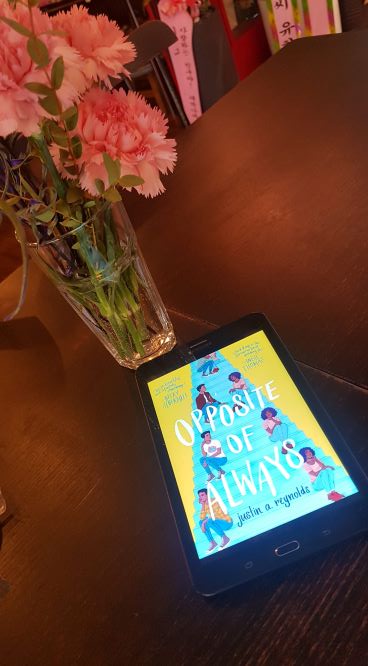
I was expecting this book to be something totally different than what it was. The synopsis led me to believe it was a sci-fi time travel tale focused on fixing sad past mistakes, much like last year’s tear-jerking Netflix original See You Yesterday. And it is all of that, but unlike the film, my main reaction while reading this was… …EWWWWW. ICK. GAG. This book is just so…so SWEET. If See You Yesterday is hot sauce, this book is maple syrup. But gag reflex aside, I liked it. It’s cute. It’s light. It’s funny. It’s totally not what I expected or usually like, but it won me over.
High school senior Jack falls for college freshman Kate and with a little help from his ridiculously loving friends and family woos her in a dozen different cutesy ways that all seem to start with bowls of cereal. Then she dies, and Jack spends the rest of the book inexplicably Groundhog Day-ing his way through the same summer over and over again, trying to help his friends and save his lady love.
**The next paragraph contains mild spoilers**
A few unexpectedly pleasant things occurred to me while reading this. One is that I’m not sure I’ve ever read a book with a main character living with sickle cell anemia before and I appreciated seeing that on the page, even if it was played for narm in the end. The other is that it was really nice to read about a bunch of unapologetic Blerdsin a light, fun happy-ending story where racism is not the center of their lives (except for right near the end and I thought including a shooting was a very well-intentioned misstep on the part of the writer.)
**spoilers over**
It’s not perfect, but it’s way better than a first novel has any right to be and after a slow start before we get into the time travel bits, it’s entirely charming. 4 stars and a delicious bowl of Froot Loops to Opposite of Always.
(Hey, fellow readers. It’s late and I’m tired. This is the part where I give you the spiel about something something affliate, something something Bookshop, something something if you click on any link on this site and make a purchase I will earn and commission and isn’t that just something something? Thanks for reading, now go enjoy a good book. Peace!)
Books of poetry are sometimes navel-gazing, self-absorbed bores but this one is simply amazing. I slurped it down in two short commutes and a stolen hour in a cafe after work because these poems are absolutely mesmerizing. I can’t praise them highly enough.
I love writing that makes me feel like I’ve stepped into another life for a moment and these poems belong to a life heavily lived. There’s such a strong sense of place, character and narrative here, based in Diaz’ Mojave heritage and personal family challenges–specifically her brother’s cycles of addiction and the difficulties that creates within the family. The language, English seasoned liberally with Spanish and Mojave, is absolutely gorgeous. I alternated between being near-tears and making a stank face and saying “Girl you wrote this!” in my head.
I think what I love most about this collection is that there is a balance between the beauty of the language, the technical precision of the craft, and a sense of narrative that places its poems solidly within a very real life and emotions. It reminded me a lot of Yrsa Daley-Ward’s boneor Ocean Vuong’s On Earth We’re Briefly Gorgeous–and like those books, Diaz’s collection is really in a class of its own.
This was one of my favorite reads of 2019, and I can’t recommend it enough. *whew* 5 out of 5 stars. .
(Thanks for reading! This is the part where I tell you that this blog contains affiliate links that lead you to Bookshop, where I will earn a commission if you purchase anything after you click. Peace! )
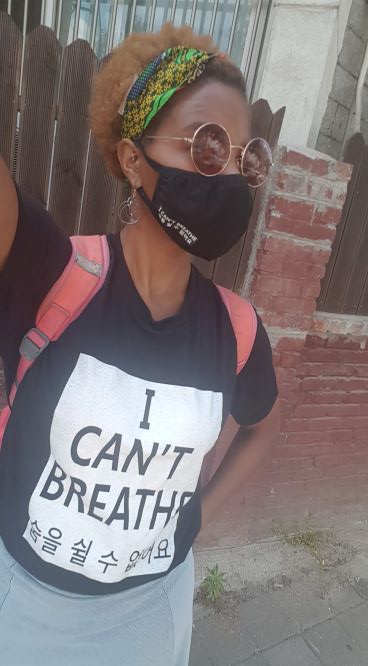
Look. We’re all on the internet right now, so let’s not pretend I need to explain the current atmosphere to you. George Floyd was murdered by a police officer on May 25th and sparked a brushfire that soon roared into a full on inferno, sparking protests and demonstrations across not only the USA but the entire world. The resulting discourse has perhaps permanently changed the temperature of the internet as well, particularly social media.
For Black American people, George Floyd is just one in a long line of brothers and sisters who have lost their lives due to injustice. He’s not even the most recent! We’ve been witnessing this and speaking out about it for years(over 400, if you’re counting) and whole parts of our culture have come from the coping methods we use to handle the pain and risk and fear and inevitable anger that this causes.
So you can imagine the conflicting emotions now, when the whole world recognizes that Black Lives do indeed Matter, and is putting feet to the streets, voices in the wind and laws on the books. Part of me is overjoyed–this time feels different! When the whole world sees your cause, things might actually change, and I am entirely here for that!
Another part of me, though is–well, not skeptical, exactly. Perhaps cautious? There’s something about seeing a cause that you and your ancestors have been pleading for people to hear for a long time suddenly going viral that makes a body careful. While I would never take away from the movement happening now by insinuating that it’s ingenuine, (I don’t believe that), I do worry that the fervor we’re seeing now is rushing at us partly powered by a tidal wave of trendiness.
Case in point–the bookish internet is currently overrun with anti-Racist booklists. Everywhere you go on the bookish web–Instagram, blogs, podcasts, newspapers–has an anti-racist booklist of some sort. The most notable ones come courtesy of Ibram X. Kendi, the man who literally wrote the book on anti-racism. The Harvard Gazette and surprisingly, New Zealand magazine The Spinoff have interesting ones as well. However, some lists seem well-intended, but a bit hastily curated and out of place. (Really, Business Insider?)
In the midst of all this I hear voices. Ok, not voices–let’s say it’s the click of keyboard keys, rushing into my inboxes. “Mel!”, their letters spell, “Why haven’t you posted an anti-racist booklist on your blog? Why aren’t you sharing them on your Facebook page? Where is your book stack and 2000 character anti-racist manifesto on Instagram? Why aren’t you saying more? Where is your voice?”
These are all good questions, and I suppose I can answer them best by giving 5 simple reasons why I’m not posting anti-racist reading lists on the internet right now.
1.This isn’t new to me. I’ll be forty next year. I’ve been thinking intensely about race, racism, and their impacts on the world I live in since I was 4 or 5 and a little girl called me a nigger on the playground. (I didn’t know what it meant. I asked her to write it down, she did, and I took it home to show my mother, who was horrified and refused to let me go play outdoors anymore until we moved a little while later. This was on an overseas military base, and I later found out that one of the reasons she was so nervous is because little Playground Penelope was an officer’s daughter and I…was not. But, I digress…). Talking about race, about racism and about racists is familiar territory for me, and I’ve never held back in conversations where I felt I had a chance of being heard. I’ve also spent a lot of time educating myself on these issues and on all of the little details of history and current events that contribute to the continuance of systemic racism and other injustices. It’s partly curiosity, but also partly about survival.
This is the case for most Black people, and dare I say most “minorities”(I hate that term.) Knowing this, please tell me why I would want to have a whole lot of Race 101 conversations with folks who are just getting hip to this now? I’m not saying you shouldn’t have the conversations and make the lists, I’m just saying I don’t need to be in the room. Talk among yourselves about what to read to learn about race and racism. I’ll be at the bar with a cocktail, hiding behind a romance novel.
One more thing here–I think it’s important to think about who these booklists are often centering. *drum roll* That’s right! White people! While I have nothing against white people or books written by white people and in fact have a lot of love for the aforementioned things (you may have heard I will cut somebody over my creepy literary uncle Stephen King), centering dialogues and reading for/by/about white people is exactly what I created Equal Opportunity Reader to NOT do. Nothing personal, that’s just not my ministry. White people and books written for or about the white gaze are part of a whole world of literature and are never my main focal point. 99% of these anti-racist booklists out here are focused on white people, and y’all don’t need me for that. That’s a conversation that I feel needs to be largely internal, held among white people in the amorphous, inaccurately hyper-reductive, pseudo-cultural blob we are referring to when we say white culture. Whatever that is, and whatever the conversation is–good for you. Enjoy it, but like I said, I’ll be in the bar. Come get me when you’re ready to go somewhere else.
There’s also a greater question to be asked about how much impact reading lists can actually have on racism, but I said this was a list of 5 simple reasons and I’m sticking to it. The Guardian has done a nice job covering that issue, though.
Despite how specialized this looks, it’s actually one of the better lists…
2. All these lists are the same. Speaking of amorphous cultural blobs, all of these lists–and at this point, I’ve looked at over 50–seem to run together. By that, I mean that they all seem to include the same 10 or 15 titles, with a little wiggle room on the edges.(One of the reasons I enjoyed The Spinoff’s list so much is that it’s almost entirely texts by Maori writers.) I mean, what are the standard entries in the average anti-racism list? Kendi’s book, White Fragility, Ijeoma Oluo’s So You Want To Talk About Race, maybe The Autobiography of Malcolm X if you’re lucky and–gaaah. Am I actually making an anti-racist booklist in a discussion of why I’m not making anti-racist booklists? Gaaah. NEXT!
3. Not everything should be for profit. Art is not free, knowledge is not free, and social justice is not free. We know these things. On a far less lofty note, even this blog is not free, which is why I am an affiliate of Bookshop and if you click on a link in this blog or anywhere on this site and make a purchase, I will earn a commission. (Colgate smile, sell out dance.)
But that said, I feel some type of way seeing mainstream media outlets who have traditionally under-reported on issues of racist violence, who have perpetuated inequity by choosing to share very different facts and photos of Black victims than white ones, who have dismal track records when it comes to the hiring and treatment of BIPOC staff and talent–it’s a little strange to see these same media outlets suddenly share long lists of books about anti-racism chock full of ads and affiliate links. Anyone can change, atone and move forward, but nothing says anti-racism is a trend more than corporate sponsorship. I certainly want the writers and creators of these books to get paid, but I don’t know if I want to jump on the bandwagon of profiteering from this sort of content myself.(Although I sort of am anyway, by writing and posting this, and that’s a conversation I’m having with myself constantly these days.)
4. Google exists. Even though I said earlier that I’ve been thinking about race since I was a child, there is a lot of historical and social material to be learned about the way that America (and by extension, large parts of the world) work with the topic and how it has affected myself, my family and my culture historically. I have to learn and unlearn a lot just like everyone else, and I certainly hope I never posit myself as some sort of extreme expert because the subject is too deep and twisty for that to ever be the case for anyone.
Still, I first started reading intensely about race, class, social justice and what is now called anti-racism when I was in my teens. For those of you keeping score, that’s pre-Google. So, how did I begin to learn?
Well, I certainly didn’t run up to the nearest cranky nearly forty year old Black lady I knew and ask her to curate an exhaustive list of materials for me, that’s for sure. I took my curious self to libraries and bookstores, dove into catalogs and directories, went to seminars, speeches, readings, and exhibits. I also spent a lot of time listening to people who were more knowledgeable than me, taking notes, looking things up and asking well thought out, polite questions. Through all of this, I developed an organic relationship with the material and with my own history and culture and several of the ones that intersect with it. I made friends who augmented my own growing knowledge with their own and gifted me with books and long conversations and introductions to other knowledgeable friends. I had discussions and arguments that sharpened my thinking, and that in turn led me to discover deeper knowledge.
Think how much easier it is to do all of that now that Google exists. And there are already at least 50 anti-racist booklists in existence to help you get started if you’re really stuck!
5. I don’t want to. Fellow readers? Lean in real quick, I want you to really hear what I have to say for this one.
I.
AM.
TIRED.
Do I really have to tell how emotionally exhausting 2020 has been? Of course not, because you’re exhausted too. This is an ordeal that many of us have both personal and political stakes in, and let us not forget there is still a pandemic going on, and a garbage fire of a presidential election cycle in progress in the US, and hey look! North Korea is threatening South Korea again and guess where I live? What I’m trying to say is that as much as I love books and reading and gaining knowledge through the written word, I feel like now more than ever is a good time to stick to my sleepy little egalitarian praxis-based mission. I want to enjoy writing by, for and about the world–the whole world, not just the parts that ruled colonies and imposed educational systems. I want to read truly diverse books and share them with diverse readers. For me, that means not centering whiteness in literature and only partly giving the spotlight to books explicitly about anti-racism. It means continuing to read books by people from as many possible communities in the world being their own normal and defining themselves–and that includes Black people worldwide obviously, since I am one and that’s admittedly who I read about the most.
In other words, I’m doing my part, I think. I’m just doing it a bit differently.
As always,visit the shop, hit me in the comments or on socials, and go read something great. Peace, fellow readers.
Raymond Tyler Jr. is Black, middle-class, and upwardly mobile. He has a job at a hot law firm in NYC, a loving Southern family, a supportive friend group and a really nice apartment. He’s a catch on the dating market, and everyone wants to know when he’ll get married.
He’s also in the closet. It’s the early 90s, and Black American culture is abuzz with tales of the “down-low”– a descriptive term for Black men who date and marry women but have affairs with other men. Raymond struggles to accept himself and be accepted by others in a hostile world–and manages to fall in love a couple of times along the way.
(Side note: Do y’all remember when Oprah did a show about this every other week?)
Teenage me read this and somehow remembered it as a romance. It’s really not. This is actually a remarkably lonely story when seen through adult eyes–a tragedy about people struggling to connect with others and themselves without ever really being able to be honest. Living in the closet makes a person invisible in large segments of society, and the resulting tension ruins lives. The premise is great, but the story relies on some pretty hokey cliches and moralizing, to be honest. African-American fiction from the late 80’s and 90’s has such a distinctive style (think Waiting to Exhale or Sister, Sister), but here it hasn’t aged particularly well. Also, the way we speak about race and sexuality has evolved so drastically and so much for the better since 1991 that the book feels very dated.
Still, Invisible Life and the series of books it began were truly groundbreaking. The story of successful gay black men and their inner lives isn’t told often now and was virtually taboo then, especially when told by a Black gay author to the larger Black community. Harris really opened my teenage eyes and dispelled the stereotypes of gay men that I had learned (while implanting entirely new ones, lol)
3 stars and a Pride flag wave to Invisible Life.
(Happy Pride and thanks for reading, beautiful people. This blog contains affiliate links leading to Bookshop, and if you click and purchase anything from those links, I will earn a commission. Peace!)
Time? What is time? What did I really mean when I said I would do a news post every week? The world may never know…
A biopic about Shirley Jackson, author of The Lottery(aka that creepy short story in everyone’s English textbook) was released last week,with Scientologist Handmaid Elisabeth Moss playing the writer. It’s a dud. Shocker!
“The Good Place”, “Frozen” and “Bad Moms” star Kristen Bell released a children’s book about similarities and differences called “The World Needs More Purple People” and ok, look. You know where this is going. How are these folks getting movie budgets, publishing contracts and sales? Support indie creators!
Speaking of indie creators, this is not really news, but lately I’ve discovered the far out space opera webcomic Galanthus. It’s full of queer themes and representation, which makes it a perfect read for Pride month. Bonus: it’s free. What are you waiting for?
Portuguese poet Fernando Pessoawas born on June 13th, 1888. He was a polyglot, a traveler and a philosopher who wrote a remarkable number of good poems, one of which you can listen to in English here;
Of course, there’s more news but I’ll leave it here for the week. Have you read any of the books mentioned? Any thoughts on publishing duds or anti-racist books?
This blog contains affiliate links to Bookshop.org. If you click and purchase anything from a link on this site, I will earn a commission.
⭐⭐⭐⭐/5⠀ 💕⠀ Ok so first of all, isn’t that a *gorgeous* book cover? Second – good grief. When was the last time I actually read an ink and paper book? The Kindle is getting a workout lately! ⠀ 💑⠀ It’s rare that a book completely surprises me, but this one did. After all, who expects an asexual YA romance novel? Yet that’s exactly what this is. The gorgeous girl depicted on the cover above is Alice, a biromantic, asexual college sophomore working hard to figure out how to navigate life. I love when books depict relationships well and diversely and this one definitely does. Alice not only has a love interest but families of blood AND of choice, and Kann does a great job giving all of them adequate page time. The love interest, Takumi, is maybe a little too perfect and communicative but this is a romance novel, after all. Including Alice’s loving relationships of all types does a great job of busting the myth that asexual people are by default lonely and unfulfilled and in general, the subject of asexuality is well handled, with more of a focus on the feelings and thoughts of an asexual person than an “Asexuality 101” course in YA novel form. One quote in particular stood out to me as an example of this…
“…If I tell anyone I’m asexual, they’re going to look at me like there’s something wrong. They’re going to tell me to go to a doctor. They’re going to tell me I’m too young to know what I want or I’m still developing. Or they’ll tell me how important sex is to finding a good man. Or they’ll think they can fix me, that I’m lying because I don’t want to sleep with them. It’s hard enough trying to explain that word, so how in the hell am I going to explain I’m biromantic asexual? They’re really going to think I’m making this shit up.” 💘⠀ If I have one criticism of this novel, it’s that the writing and the dialogue are a little too simple. I know this is YA but there are times when Alice and company seem more like middle schoolers than the college-aged adults that they are. There’s no graphic sex (of course) but there are frank discussions of sexual expression and sexuality and sometimes that doesn’t mesh well with the very simple text. ⠀ 🏳️🌈⠀ One more notable thing about this book–the characters rest in this multicultural sweet spot that current times make it easy to forget can even exist in America. Alice is Black, Takumi is Japanese-American, her best friends are Filipino-American and (presumably) White and all of the characters have families. However, the book is about Alice and how she navigates relationships asexually, so while race, class and gender naturally come up, it’s just that–natural. It’s not diversity-by-numbers or lesson time, they just live in a city in California where diverse social circles are normal. I always appreciate depictions of what I think of as “my America” in books and it works well here. ⠀
💖⠀ 4 stars and a solid Orange on the Cutie-Code(read the book to find out what that means) to Let’s Talk About Love.
(Y’all know what time it is! Thanks for reading and if you want to read this book, check your local libraryor consider purchasing HEREfrom Bookshop, an indie, community based alternative to Amazon. I am an affiliate of Bookshop and will earn a commission if you click and purchase anything from links on this site.)
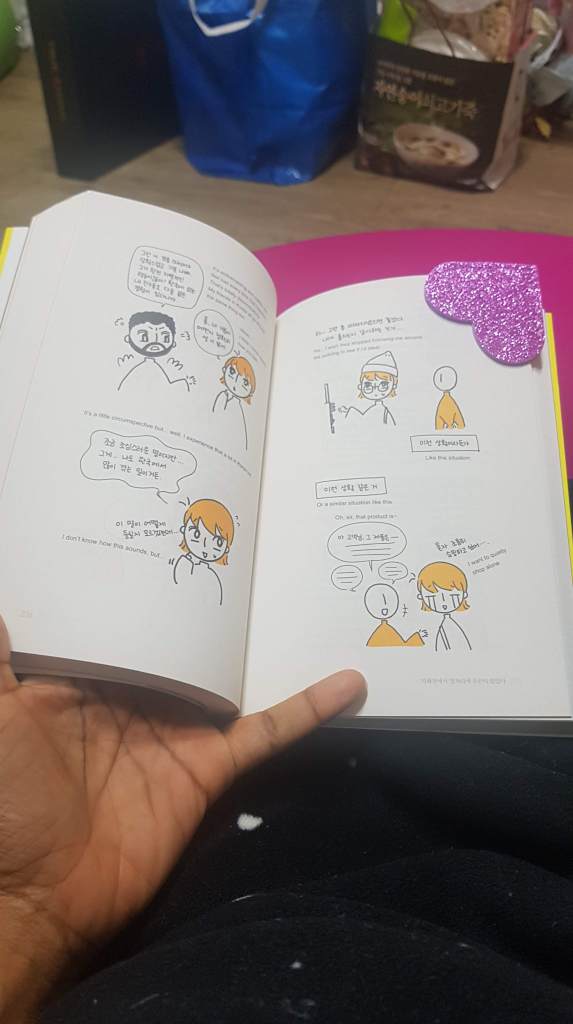
Yerong is a South Korean kindergarten teacher– sweet, intelligent, creative and reasonably aware of social issues. One day she meets Ghanaian scientist Manni and her eyes are opened to the realities of being an immigrant and a black person in a society that values conformity and often puts white Europeans on a pedestal above other non-Koreans.
A Black Guy…is thoughtfully composed of real life anecdotes about racism, sexism, and all forms of discrimination from a Korean point of view. The simple line drawings keep it from feeling too heavy and the cute foundational romance adds sweetness to some moments that would otherwise be pretty sour. Personally I really appreciated the chapters that deal with the intersectionality of being Black and a woman in Korea, because I am both of those things–though it’s mostly alright, there are days when it’s on a whole other level, y’all. It’s nice to have that seen by someone with a different lived experience. I’m also surprised at how deeply Yerong is able to dive into some pretty controversial subjects and shocking incidents without leaving the reader depressed. She writes about racism, sexism and other forms of discrimination in Korean society with light humor and deep sincerity. Ultimately, her message is one of hope–hope that we can all learn to respect and understand each other, regardless of origin, physicality or circumstance.
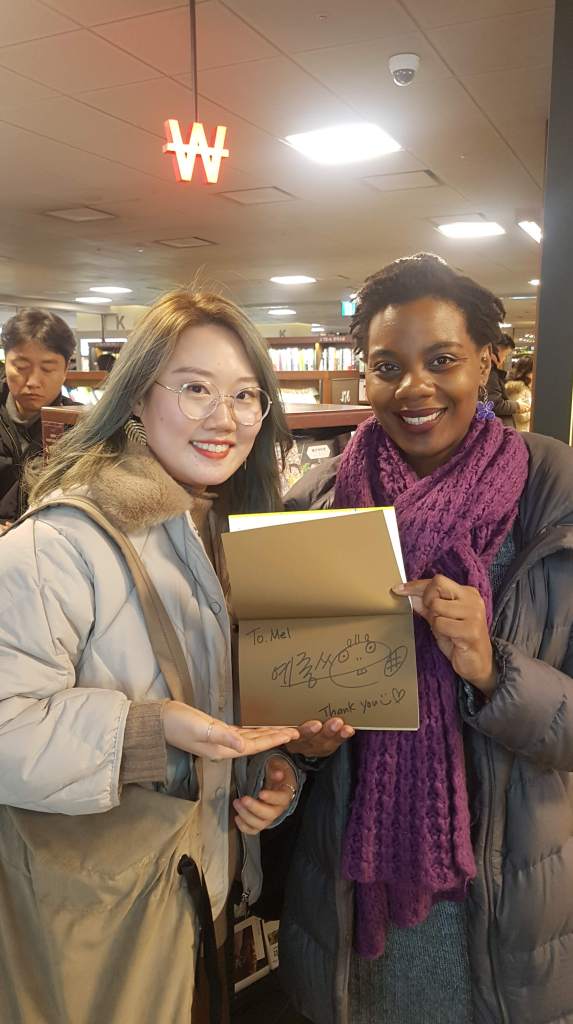
It’za me! (And famous author Yerong!)
I feel like I had a relationship with this bilingually written graphic novel long before I ever opened it–I’ve been a fan of the simple line comics posted at @yerongss since the beginning. Back in January I was even part of a news panel discussion on racism that included the author. (The original comics have been revamped and expanded for print.) If I have one quibble with this book it’s that as a Black American woman, some of the topics in this book are approached from angles that I wouldn’t necessarily come from, and reach conclusions that I might not. However, this is where I have take a step back and realize that I am not the target audience or culture for every part of this book. As I said, it’s primarily written from and to a Korean point of view, and succeeds at that, IMO.
In case you were wondering, this book is fully bilingual–English translations of Korean text are present in every panel.
5 stars and a rush hour subway seat to Yerong’s A Black Guy Was Sitting Next To Me On The Subway.
(Thanks for reading! There are no affiliate links in this review, but as always, please visit my Bookshop to browse other titles like this–for example, check out this booklist of graphic novels for adults.)
I think I was 14 or 15 the day a male relative(I honestly don’t even remember who) peered at me and said, “You know, you’re not light enough to be really beautiful, but you’re not too dark, either.”
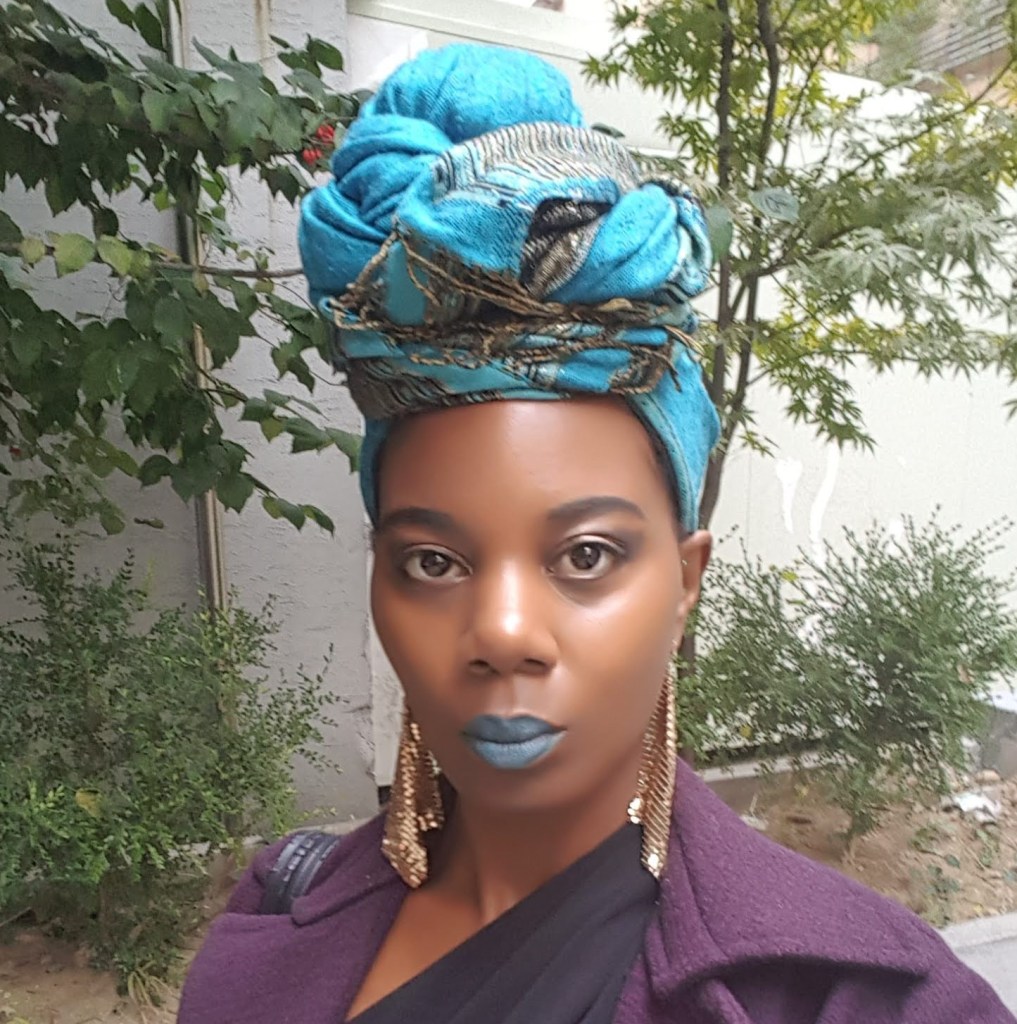
This is me:
I come in peace.
Now, granted, this is a remarkably good selfie with remarkably good lighting taken while I was remarkably made up for a remarkable party but I post it here to demonstrate one thing: I am a regular everyday brown-skinned Black chick. I describe myself as dark. Nobody has ever asked me what I’m mixed with. (Where I’m really from, yes. But what I’m mixed with? Clearly just Black.) Makeup in my shade is hard to find. But I was also born in the very early 80’s (hello readers of my midlife crisis blog!). Social media wasn’t a thing during my impressionable teen years, although racism was, and I was far more worried about being Black, period than about how acceptable my degree of Blackness was. I also lived a very boring lower-middle-class suburban life and had no aspirations of grandeur–I just wanted to get a job that would let me read books and crack jokes, eventually. (Mission achieved!) My skin tone didn’t render me beautiful or reviled–it made me mostly invisible. Nobody ever remarked on it except to be dismissive or to tell me I was…fine. Not great but not bad. If anything, I wanted to be darker–I was briefly obsessed with Alek Wek and spent a whole summer vacation laying out slathered in coconut oil trying to reach her velvety shade. (It didn’t work.)
I think it also helped that I was often reminded that the great beauties in the family were my cousins, who were darker-skinned than I was but had finer features and longer, bouncin’ and behavin’ hair. My grandmother never hurt my feelings by comparing me to Halle Berry, but she did pinch me in the heart a few times by telling me how sorry she was that I didn’t look more like my more beautiful cousins or aunt, who were all dark and lovely. But ultimately, I grew up, I traveled the world, I studied things, got jobs and real problems that left me little time to worry about my looks. Then I discovered that men are much more interesting when they’re not hung up on your looks. I faced, and still face, continual problems because of racism. But colorism? I knew it existed, but it never really affected me personally in any way that mattered in the long term. It was something I read about more than I felt.
Then I moved to Asia. Korea, to be exact. While most people didn’t have much to say about my skin tone (except for a few old ladies who took it upon themselves one day to tell me that my skin was “disgusting” and I should wash more) it is glaringly obvious how much people here don’t like their own skin unless it’s unnaturally pale. My first job here was at an elementary school. Working with kids makes it obvious that naturally, Korean people come in a variety of skin tones, from porcelain white(rare) to a light cocoa brown(also rare). Most of the kids, though, were sort of a golden tan color that got lighter and darker with the seasons because you know, human skin works that way. Still, it didn’t take me long to realize that although I had a few dark little girls in my class, I couldn’t recall seeing a dark-skinned adult woman in Korea ever. One of my coworkers would chase me around on school trips with a tube of chalky white 100 SPF sunscreen. When I waved her away, she told me she was trying to help me become beautiful. When I told her I thought dark skin was the most beautiful and she would look nice tan, she stared at me, mystified, then poured a dollop of cream on her hands and rubbed fervently.
Big brand beauty billboards here almost exclusively feature European white women. Several skincare brands here employ women who would be stunningly average or outright unattractive in Europe or North America simply because they have very pale skin. If I had a dollar for every time I met a very average white woman here who proudly informed me that she “meets Asia’s beauty standards” I would be able to send every reader of this blog a free library. Beauty salons have photos of fair-skinned, blue-eyed Nordic blondes staring down at their dark-eyed, honey-skinned customers while they get facials. Makeup stores sell two foundation shades–“pale” and “paler”, neither of which seem to match any human skin tone on earth, let alone in Korea. When I began to teach in universities, I noticed that my female students often were three or four shades browner at their hairlines and necks–but their faces were all the same uniform pancake white shade, purchased at the little cosmetics shop at the edge of campus. When I go biking or hiking on high heat days, I’m often the only person out not wearing long sleeves and a giant visor to protect my skin from browning. I do wear sunscreen, but it’s for health reasons–it’s a reasonable SPF 30, with no zinc oxide in it to make me look ashy whiter. I’ve lived here seven years now, and if anything, the fervor for whiter, lighter skin has intensified as Kpop takes over the world and Asian beauty standards are more heavily promoted and appropriated.
I just…don’t get it. Like everyone, I’m sure I have internalized bits of colonial, racist thinking, but skin isn’t one of those bits. I have no particular appreciation for light skin, and if anything I’m slightly more partial to dark. (“You mean, you burn? In the sun? All the time? You’re burning right now? But it’s cloudy! Yeah, we can’t be together.”) Yet I know that colorism exists, and it is a source of great pain and insecurity for a lot of women globally, in my own culture and across the melanin-bearing world. If anything, I find the obsession with skin tone over everything, and the stranglehold that whiteness has over femininity a little distasteful. I get a little judgy about it, to be frank–I think it’s really gross that perfectly beautiful women with normal skin use bleach and ashy looking products to look aesthetically worse but socially more acceptable. I can’t be complicit with it at all, but there are millions of folks who really don’t care what I think, so…I guess whiter is righter is the (aesthetic) law of the land.
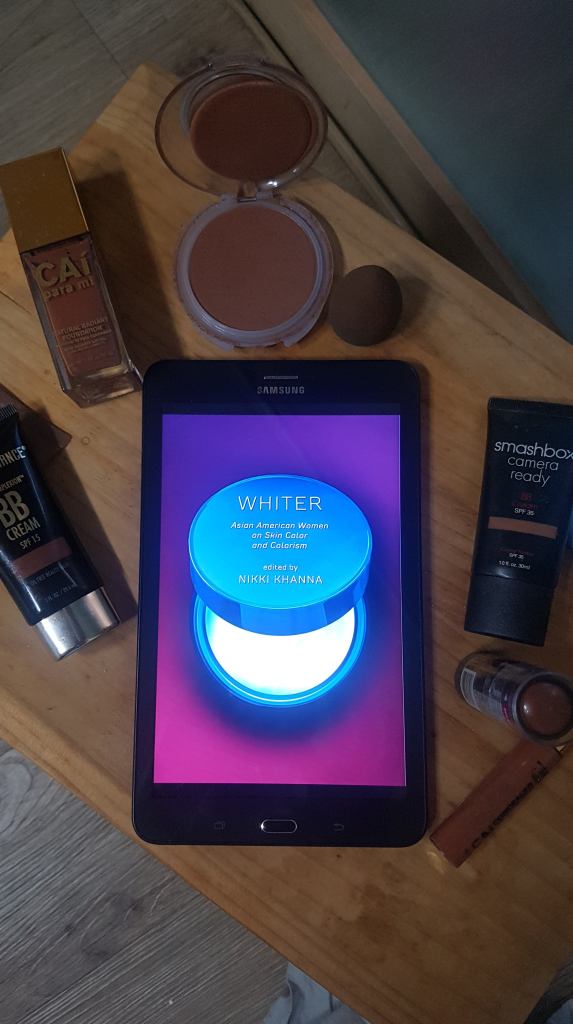
Look at all my lovely makeup in multi-season shades of brown…
This is one of those works that I appreciate and see the importance of without necessarily enjoying much. I read it to gain greater empathy and understanding of Asian(-American) attitudes towards skin color and cultural understandings of colorism. I got that, to some extent, but I also noticed a lot of complicity with white supremacy and anti-Blackness that bothered me, although I did appreciate the honesty of the feelings shared(and there is a very introspective section of the book about anti-Blackness’s role in Asian-American colorism.)
I applaud Khanna for the diversity of the women she’s included–she has women of Southeastern, Northeastern and mixed-race Asian descent all included, and it’s interesting to see where the differences and similarities in their experiences lie. (By default this favors groups of people that have high migration to the US so there’s not much from Central Asian women here at all, which would be interesting because many of them read as visually “white”. ) There are essays from Indian women with lighter skin who understand that it confers privilege and from dark-skinned Filipinas who struggle with feeling fat and dark even though in the US the metrics shift and they’re small and fashionably tanned. There’s a particularly gloomy essay from a mixed-race white and Korean woman entitled “The Abominable Honhyeol” that expresses the loneliness of being seen as other due to your ancestry, even if your skin is considered exceptionally pale and beautiful. There’s an Indian woman with albinism who expresses much of the same predicament, being 100% culturally and ethnically Indian but often mistaken for white by other Indians due to her pigment-free hair and skin. There’s a letter from a Vietnamese woman to her half-white baby daughter, describing the things she might have to deal with in America as an Asian, but also the things she won’t, due to her lighter skin and more European features. There’s a piece by a Black and Chinese woman which held the potential to be interesting but unfortunately takes the “I am Blaaaaaack because of the sun my Black husband loves me my mocha chocolate skin so much darker than my mother and sister but I love myself because I am strong and Black and WoMan. snapsnapsnapsnap” performative self-love route–I felt a little cold at the end, realizing that she simply shifted her lack of acceptance as a dark-skinned Asian woman into privilege as a light-skinned mixed woman in Black American culture. While she’s aware of this and advocates for her darker sisters, something about that essay didn’t sit right with me. The experience of gaining privilege by shifting communities is a recurring theme in many of the essays and while I can’t judge–after all, what am I doing, as an American in Asia?–the bald way in which this was acknowledged and embraced never really sat well with me in any of the essays that expressed this.
Overall, while all of the essays were interesting, there was only one that I really loved–“Teeth” by Betty Ming Liu, a 62-year old dark-skinned Chinese woman with a Black and Chinese daughter. Liu’s essay is the only one out of the collection that left me with a smile on my face–while most of the essays seem to be written out of a sense of insecurity and sadness, Mama Betty has embraced herself, her daughter, her daughter’s Black father and the idea of reshaping the world to be fairer rather than being complicit with harmful norms so thoroughly that I wanted to cheer a little bit at the end of her essay. She gets what no-one else in the collection, including the editor, seems to–we shape the world just as much as it shapes us, and stepping to the side of an expectation meant to flatten you is better than laying down in a puddle of bleaching cream and crying. Betty is my kind of people, and I think her blog is one of my new favorite things on the internet.
So, do I have a greater empathy for Asian and Asian American people who believe in and practice colorism? No, not really. It still grosses me out, and now it makes me a little angry, too. I understand it marginally more but I don’t think colorism, whether Asian, Latinx or Black, is something I’ll ever feel any better than “sick” about when it’s openly expressed and accepted. But I still found these women interesting, and I could see some of the essays resonating with other women as strongly as Betty Ming Liu’s did with me. I may keep a copy on the student borrow shelf in my office and see if anyone takes the bait.
Four stars and a day in the sun with no protection but a big smile to Whiter.
(Thanks for reading! If you want to read this book, consider purchasing it HERE from Bookshop, the online portal for indie bookstores. I am an affiliate of Bookshop and will earn a commission if you click and purchase from any links on this site. )
A quick note: I’m Mel, the author of 99% of the reviews on this site. I’m a straight cis woman who firmly believes in equality and equity for LGBTQIA+ people. While I’ve been doing targeted reading for Pride Month, I haven’t really read a lot of queer books in any genre and I’m aware my reviews are coming from a rather narrow, albeit well-intentioned place. I thought I’d reach out to my global community and get a few guest reviews in to help us all out. On that note, I’m very excited to post my very first guest review from my good friend Rogene. I’ll let him introduce himself here, and then share his insightful review of a Pride Month read. Take it away Rogene!
Rogene Carter is a literature and Spanish teacher at an American high school in Shanghai, China. He enjoys literature of all sorts with a propensity for contemporary fiction and autobiographical works and is an avid reader. He also enjoys film, art, and traveling in his spare time.
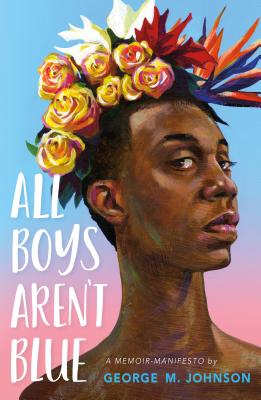
At face value, All Boys Aren’t Blue definitely seemed like it would be right up my alley. I was completely enamored with the introduction of this memoir that was aptly entitled “Black. Queer. Here.” Unfortunately, my affection stops there. Johnson himself pledged quite a hefty package in his introduction, which dealt with everything from gendered norms to homosexuality to the plight of the Black American man within the United States. Johnson also promised to address the intersectionality of oppression that many of us marginalized groups experience as a result of belonging to more than one type of oppressed group—in his case being black and gay in a society that often unfairly treats individuals from either group as other or simply undeserving of the rights and privileges that are often associated with whiteness and heterosexuality or as extraneous to their idea of the “American dream” and thus dispensable. Navigating both of these spaces is a complex and often confounding tightrope walk that requires not only finesse but the understanding that one may fall short in one way or another.
While I am very proud to live in a world in which such a title could be published by a major publishing house(Farrar, Strauss and Giroux, a YA imprint of MacMillan Publishers), I am generally unimpressed by this work. Johnson did mention a lot of hot topics that are very of the moment but he did so in a very generalized manner. I found myself repeating the same mantra to myself while reading this book, “…this cannot possibly be it.” There must be more substance to the narrative than simply the trials of coming out, navigating dating, and dealing with the demands of heteronormative ideals as a black, self-identified queer man. The major qualm I have with this work is that it promised to be informative and to shed light on so many topics and I found myself simply reading about his daily life, relationships, and feelings about his oppression. I wanted more. I wanted more research, more stories, more focus. Perhaps it was too much to ask for but I expected something amazing and was more than slightly disappointed and frankly offended to find mediocrity after a very long introduction with lots of grandiose and unfulfilled assurances.
Having said that, there were some standout chapters within this work such as “Nanny: The Caregiver, the Hustler, My Best Friend” which was a perfect homage to his grandmother and the impact that she had upon him. I also enjoyed the chapters dedicated to a relative of the author who was an out and proud transgendered woman but overall the enjoyment was limited, to say the least. Sexual molestation was also tackled in this memoir in the form of a letter delivered to the abuser who has since passed away and I thought it was powerfully written but also abrupt. Everything felt abrupt. I could feel the author’s trepidation to explore topics deeply within the writing and it made me wonder why he decided to wite the memoir that he claimed to be writing.
In summation, there was a lot of meat to this memoir but I wish that it was more finely tuned and included more substantive and academic influence to round out some of the sharp edges. I would have loved for Johnson to include more statistics or narratives outside of his own experience that could give the reader more foundational knowledge of the topics explored here as well as a meta-view of how these topics influence everyone, not just Johnson himself. Doing so perhaps would have made the memoir feel more academic and well-researched instead of personal and surface-level.
Perhaps that is too much to ask for from a memoir about the author’s personal experience or perhaps I am simply too discerning as both the target demographic of this work as well as a marginalized gay man, myself, but I simply wanted more to sink my teeth into. There are plethora of amazing memoirs, fiction and nonfiction titles that do a wonderful job of not only voicing the opinions and experiences of the author but also attempting to truly educate the reader on the experience detailed. A list of recommended titles will be included below. In all, I found George M. Johnson’s freshman attempt to be admirably intentioned but poorly researched and executed as well as a little lazy.
Mel here again! Many thanks to Rogene for the review and to you for reading it! If you want to read this book, consider purchasing it HERE from Bookshop, the online portal for indie bookstores. I am an affiliate of Bookshop and will earn a commission if you click and purchase from any links on this site.
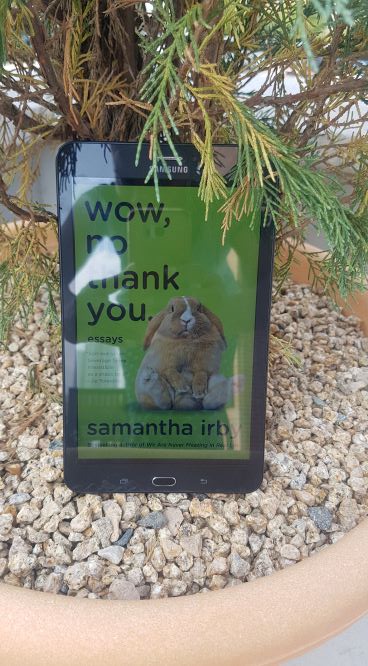
Wow, No Thank You by Samantha Irby⠀(Buy it HERE.) ⭐⭐⭐⭐1/2 out of 5 stars.⠀
Yes, this is a toilet. Read the book to understand why.
“I can’t watch This Is Us because even though the brothers are hot and the dad is a smoke show, in the first couple of episodes the fat girl doesn’t get to be much more than “fat”, and wow, no thank you!” ~ Samantha Irby
What I love most about Samantha Irby’s essays (aside from the humor) is how normal she is. By that, I mean that through a certain lens, she’s decidedly counter-cultural. She’s Black. Fat. Poor. A “casual bisexual” married to a white lady in MAGA country. She has chronic illnesses, a string of hilarious failed past situationships, a sad family story, and the grouchiest, most ungrateful pets ever. But despite–or perhaps because of all of this, Irby seems to really see herself as her own default, which I am a big fan of. It’s not vulnerability for likes or tokenism or proclamative self-othering. Irby just is who she is and that’s normal, relatable, and often very funny. Even when the jokes are at her expense they’re not mocking any of the things that identify her–but she can and does poke fun at all the weird behaviors she’s picked up in order to survive in this weird world. Standout pieces include “Love and Marriage”, a surprisingly sensible, gentle advice column on practical romance and “Hollywood Summer” detailing the time Irby wrote an episode of the hit show Shrill.
This is the 4th collection of funny, sincere, honest essays by the writer of the blog “bitches gotta eat”and the 3rd that I’ve read. I hope it’s not her last, but there is a feeling of coming full circle in this one that makes me wonder. In her first collection, Meaty, Irby was an hourly employee at an animal hospital living in the weird socioeconomic no man’s land people who are very smart and very poor but also have decent taste often wind up in. (Been there myself, still there, do not recommend.) Her second, We Are Never Meeting In Real Life, finds her settling down with her wife in the suburbs, dealing more fully with her parent’s early deaths and her own childhood poverty, and coming to terms with her health. This third book dips into familiar former territory but now, instead of fantasizing about writing TV shows Irby is actually being flown out to LA and rubbing elbows with showrunners for months at a time, renting office space to write full time in, giving humorous advice on how to get published by accident and what it’s like to be a middle-aged married lady who still doesn’t know anything. I feel like after this book, Irby will have grown too big for essays and memoirs, and I hope we see a show or film as her next project. I’ll miss her essays though.
While it’s not as edgy and hilarious as Meaty, it’s also not as sad as We Are Never Meeting In Real Life and it really made me happy to see someone whose poorly formatted blog posts I used to send to my friends on work breaks now writing about creating whole TV scripts and giving self-deprecating advice on how to make friends as an adult.
4 and a half stars, a handful of Immodium, and a gold star for adulting to Wow, No Thank You.
(Thanks for reading! If you want to read this book, consider purchasing it HEREfrom Bookshop, the online portal for indie bookstores. I am an affiliate of Bookshop and will earn a commission if you click and purchase from any links on this site. )






 Equal Opportunity Reader