[REVIEW] When Stars Are Scattered, by Omar Mohammed and Victoria Jamieson

(Buy this book here)

Take a look at that book cover for a moment. It’s cute, right? Two little button-nosed Black boys taking in the night sky without a care in the world, right?

Not quite. Omar and Hassan are Somalians living in a refugee camp in Kenya. Their parents are presumed dead and their guardian is an elderly refugee who’s lost her family as well. Hassan is developmentally disabled and requires a lot of care. Omar, though bright, struggles to go to school while feeling so deeply(and solely) responsible for what remains of his family. His main hope is that his UN application for asylum will be accepted–but that’s a long and stressful process with many unexpected pitfalls.

This cutely illustrated graphic novel is based on the real-life experiences of Mohammed, who arrived in Dadaab refugee camp when he was 4 and was resettled in Arizona when he was 19. It’s an honest portrayal of a refugee childhood and as you’d expect, life in a camp can be quite harsh.

It can also be quite beautiful, and that’s what makes this book such a work of art. Displacement and tragedy do not disrupt the human need for deep bonds of friendship, love, and community. Like any other kid, Omar has a best friend, crushes, and a school bully. He feuds with his brother and takes his growing pains out on his guardian Fatuma. He plays after school, studies for tests, and tests his boundaries. He’s a very normal, imperfect kid growing up as best as he can, which is what makes the specters of hunger, displacement, abandonment, injustice, and being at the endless mercy of politics and policy seem all the worse. Omar really could be any kid–but he isn’t. He’s a refugee, and that means that all of this normality is filtered through stifled circumstances. Given his lack of mobility and resources, the focus of his life is entirely on his relationships, and how they thrive and grow even in such terrible circumstances.

I started this book not really knowing what it was about. By the time I got to the ending– built around a poem by a very special woman that Mohamed was wise and loyal to include–I was in tears. The heart of Dadaab camp is beating on every page of this book, and it feels like an honor to have felt its rhythm.

Plenty of goat feed, more space for girls in school, and peace to When Stars Are Scattered.

INTERESTING UPDATE: I’ve never thought of graphic novels lending themselves particularly well to the audiobook format, but apparently, they do! For a review of how this book plays out in audio, check out fellow blogger Empish J Thomas’ review.

(Fellow readers and beautiful people – this is a book I recommend buying, not just borrowing. This has been a year of graphic novels for me, it seems–and this book is my second favorite of the year so far, right after Shubeik Lubeik. For more graphic novels by diverse writers and artists, check out the Great Graphic Novels booklist at the Equal Opportunity Bookshop. We have an affiliate relationship with Bookshop and will get a commission if you buy anything from a link on this page. Now, go read something good! Peace!)

[REVIEW] Gender Queer: A Memoir, by Maia Kobabe

(Buy this book here.)

I’m back after a bit of unexpected hiatus. It’s Pride Month, and while I read queer stories whenever I want and not just in certain months, I think now is a good time to talk about this book.

(I do have a sensitivity issue/unpopular opinion about some things in these pages, and because I wished I had had a content warning, I’ll put those thoughts at the end of the review as an FYI.)

Gender Queer is the most challenged book of 2021 and 2022. If you search the weird parts of the internet for “books that should be banned” this one is at the top of a lot of lists.

And I kinda get why. When it comes to the gender spectrum, non-binary-ness was harder than I thought it would be for me to understand. I sit so comfortably within my half of the gender binary l (internally, anyway–there’s a different conversation about gender presentation and how Black women are often perceived) that when the idea of being nonbinary was first explained to me, I wasn’t a jerk about it but I did feel pretty uncomfortable contemplating the idea because I just didn’t get it.

A version of that discomfort must have been what Kobabe( who uses the Spivak pronouns e, em and eir) felt, growing up in a world that demanded a gender expression and presentation that e just didn’t get and didn’t want to. Gender Queer is a well-told graphic novelization about eir experiences figuring out life, love, and expression as neither man nor woman, but a very different, very whole person.

There’s a lot here, and it’s all very frank, although not all that graphic–discussions of awkward puberty, discovering one’s asexuality through exploring sexual situations, family responses, and medical prejudice and insensitivity. There are illustrations of naked bodies, gross hygiene situations, and a few instances of body fluids, but it all comes across as quite clinical, not erotic or filthy, which has been a common accusation.

This is a vulnerable, candid memoir. It’s introspective, informative, and challenges norms that many people never really have to think about, drawn in a soft, sweet, accessible way. I can totally see why it gets censored and banned. I also think it should absolutely not be. It’s rare to find a book about anyone that uses storytelling so deftly to show us a person, living their life normally despite how challenging that may be at times.

But I do have some issues with it and one of them, at least, needs to be behind a big ol’ CONTENT WARNING.

First, and not content-warning worthy, is that this book exhibits an utter lack of intersectionality, which I tiredly feel isn’t even something worth criticizing white American writers for anymore because it’s just American culture in some places if we’re being honest. At a few points, Kobabe lists all the books e’s read over the past year and these are the white-lady-est lists ever–and a bunch of manga. Yikes. This isn’t a criticism so much as a sad cultural truth, and I’m pointing it out because I feel that some Black, Brown, Asian, etc. genderqueer fam might want to know this before they get frustrated on the overwhelming whiteness of Kobabe’s world.

Second–and here comes the content warning– my real issue is that some of the situations presented as part of Kobabe’s childhood memories come across to me as clear neglect. They just aren’t called that because eir family is white, well-educated and ‘earthy’. Early pages depict em and eir childhood friends peeing in the yard because there are no toilets available. Later, there are instances of a clear lack of access to hygiene products and knowledge about hygiene as the author gets deep into puberty. Also, Kobabe didn’t learn to read until e was 11, which is not neglect, exactly due to eir dyslexia, but when presented along with everything else, is upsetting.

Listen. This is a blog for diverse folk. Fellow readers, you and I both know that if Kobabe was brown and/or poor this would be a very different memoir and eir parents would not be presented as saints and pioneers at all. There’s also the issue of the author’s (IMO) experiences of neglect being conflated with eir gender expression, and that is concerning. In no way do eir negative experiences or interpretations of them invalidate eir gender journey and I’m not challenging their non-binary-ness. However, connecting neglect with gender realization is edging into the same territory in which creepy Christians are constantly trying to stake a claim that gender difference and queerness are caused by pathology or family dysfunction. Again–I’m not questioning the validity of eir gender, only expressing concern about eir depictions of child neglect and how blithely they’re shared, as though the problem is gender, not neglect.

Frankly, I think it’s really weird that amidst all of the dicussions and reviews of this book–good, bad and unhinged–I’ve never seen a content warning or even acknowledgement of the (admittedly brief) scenes of neglect. I may be way off base here but this seems like quite the living room pachyderm to me and I almost put the book down because of it. I’m glad I didn’t, but you may feel differently and so I’m sharing here.

That said–I’m glad I read this. It’s a good book that needs to be available in libraries, schools, and bookstores for young people to read, but there are some things included that perhaps the author didn’t intend.

Affirmation and fanfic to Gender Queer.

(Beautiful people, fellow readers, welcome back to the blog. It’s been a while but I’m glad to see you here. Thanks for reading, and if you want to read more books about gender diverse and queer people, check out the Equal Opportunity Bookshop, specifically our booklists on Trans Experiences, LGBTQIA+ Reads, and Books By Trans Women. Remember, we’re a Bookshop affiliate and any purchases you make at those links means we make a little bit of pocket change. Now, go read something good! Peace!)

[REVIEW] Garlic and the Vampire, by Bree Paulsen

(Buy this book here.)

Sometimes, we need books that are sweeping, epic, and deep. Other times, we need books that are so cute that we want to pinch the pages and give them candy.

Garlic and The Vampire is definitely the latter. This middle-grade graphic novel focuses on anxious little Garlic, one of the many enchanted vegetables that tend Witch Agnes’ garden. When a vampire moves into the nearby woods, the nervous veggies insist that despite her own fear and worry, Garlic be the one to drive him out–after all, she’s got an advantage. 😉

This book is cute and lovely without being too syrupy-sweet. It’s written for kids, but the story is fun for everyone. It’s well-illustrated and never gets too dark or heavy. The supporting cast is interesting, too, especially loyal Carrot and Celery, the town jerk.

I could see this being a nice gift for a particularly anxious kid who hasn’t yet realized that the rest of the world isn’t actually staring at them waiting for them to mess up. It’s a nice refresher for adults who need to scrub their work brains with something that isn’t too taxing but still carries a certain amount of resonant emotional truth.

This was a nice Friday night read that put a smile on my face and gave me a much-needed breather from a much more taxing read.

Brave actions and unexpected friendship to Garlic and The Vampire.

(Beautiful people, they don’t all have to be deep. Sometimes they just have to be nice. To find more diverse books that are deep and nice, check out the Equal Opportunity Bookshop, where I’ve curated a bunch of booklists to help us all find books that remind us we are our #ownnormal. Remember that it’s an affiliate shop, so I get paid a commission for any books you buy at that link. Thanks in advance for your purchases! Now, go read something good! Peace!)

[REVIEW] Razorblade Tears, by S.A. Cosby

Subscribe to continue reading

Subscribe to get access to the rest of this post and other subscriber-only content.

[REVIEW] Wash Day Diaries, by Jamila Rowser and Robyn Smith

(Buy this book here)

Hey, fellow readers. How’ve you been? I took a little break, and for a while wasn’t sure I’d be back in a hurry. This is partly because my Day Jobbe is eating my brain, and although steps are being taken to vanquish the zombie source of income, for a while I just haven’t been able to concentrate on reading the way I like to. I’ve said before that when I’m struggling with focus I turn to poetry but even that wasn’t doing it for me. I went through about a month of opening books, closing books, reading a chapter, reading a verse, then wandering off and executive dysfunctioning all over the place.

Enter graphic novels, specifically Wash Day Diaries, which finally managed to blow the cobwebs away and open up a little resonant space so I can think. I read and reviewed this just before it won the 2022 LA Times Book Prize for Best Comic Book/Graphic novel, where Rowser and Smith were not only the first Black women to win, but the first Black women to even be nominated for the award.

It’s fitting, though. This is a Black Lady Comic Book and I’m entirely here for it.

In thoughtfully rendered panels, four friends in New York City navigate family, relationships, mental health and work through their group chat, usually while someone is doing their hair.

I see myself in Davene, Tanisha, Cookie and Kim. I also see a lot of my sistahfriends from over the years. This is an ode to the way that Black women care for each other through friendship, and there’s a lot of little authentic details in the art and dialogue. It’s also very gentle with Black women, with our challenges and emotions, and Lord knows we need more of that. The women are all young, but they cover a wide spectrum of Blackness–Afro-Latina, neurodivergent, queer, and so on. They interact with family, employers, and the spectres of partners past, present and future. But in the center of it all is their friendship with each other, and the shared physical lived experience of being in a Black body in America, down to scalp scratching and tight cornrows.

I’ve always had a circle of sistren around me–not always the same ones, but wherever I go, whatever I’ve done, I’ve always embraced and been embraced by other Black women. There is a security and joy that comes from being us in a world that more often than not strips us of safety and protection. It’s wonderful to see a book focus on our bond as Black women, not our trauma. It’s wonderful to see community love portrayed without sugar-coating the pain we sometimes experience, and see how we sustain and support each other lovingly portrayed.

Not a lot happens in this book, and it feels like there’s not a lot to say about it. But for such a short, simple book it says a lot.

A jar of Blue Magic and a wide-toothed comb to Wash Day Diaries.

(Beautiful people! I’m back, so expect to be inundated with reviews, news, and perhaps a long-awaited booklist or two, as well as updates about my own writing. Meanwhile, I want to remind you that we(meaning: I) still have a Bookshop where you can buy books if you want to support this site. Thanks for reading and go wrap yourself around a good book! Peace!)

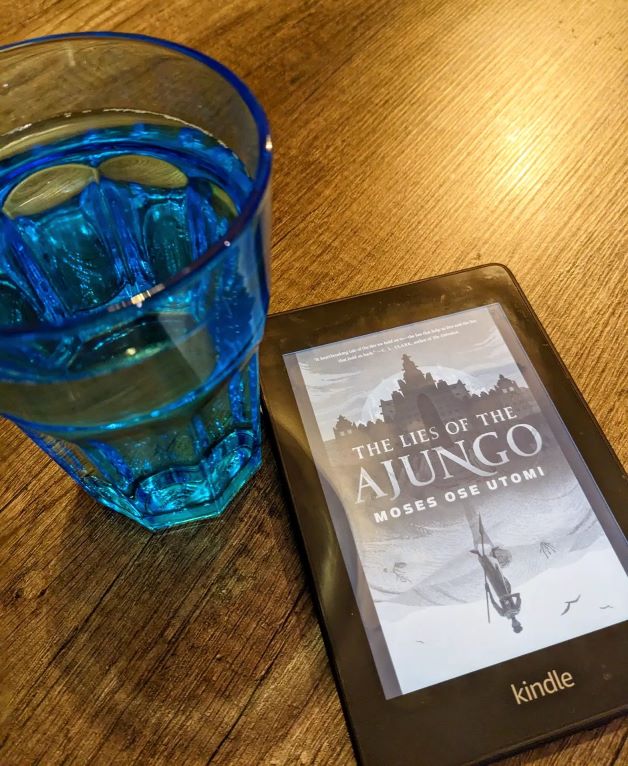
[REVIEW] The Lies of the Ajungo, by Moses Ose Utomi

(Buy this book here)

There is no water in the City of Lies.

Let me make this easy. 5 stars, ten out of ten, gold medal, everybody go buy and read this now.

Why are you still here? Fine, let me explain…

This short, sweet West Africa-inspired fairy tale is my second favorite 2023 read so far, nipping hard at the heels of the wonder that is Shubeik Lubeik. (Readers, take note; my two favorite reads of the year so far are both African fantasies!) The first five pages let me know I was in for something great–so great, in fact, that I rationed the remaining 107 pages over the next two weeks. I didn’t want it to end, even from the beginning.

The story focuses on Tutu, a brave boy living in a grim place. His city, the City of Lies, is in a permanent state of drought, and in order to get a survival pittance of water from the cruel, wealthy Ajungo Empire, a sacrifice must be made–the tongues of the City’s adults. Days before he reaches the age where Ajungo soldiers will cut out his tongue and leave him mutilated and speechless, Tutu decides to go on a quest for water and finally save his city, his people, and his beloved Mama.

Like all good quests do, this one has companions–badass aunties, mysterious blind men, and a camel called Shokolokobangoshe. (No, really.) There are epic highs, tearful lows, personal transformations, incredible fight scenes, and chilling foes–although not always where you’d expect them to be.

At its heart, this is a fairy tale and a hero’s journey, so please put away your overly literal fanperson judging hats and sneering spectacles in order to enjoy this. Utomi does an excellent job of setting out a simple story and seasoning it thoroughly with world-building details and ever-heightening stakes, creating a really satisfying read. My only complaint is that it’s too short–but apparently there are sequels coming.

A lake of drinking water to The Lies of the Ajungo.

(Beautiful people, this is one of those books I recommend buying without reservation. If you agreed with me on other favorites, go and snag this one from the Equal Opportunity Bookshop. Remember that anything you buy there from a link here will result in a commission being paid. Thanks for visiting, peace, and go read something good!)

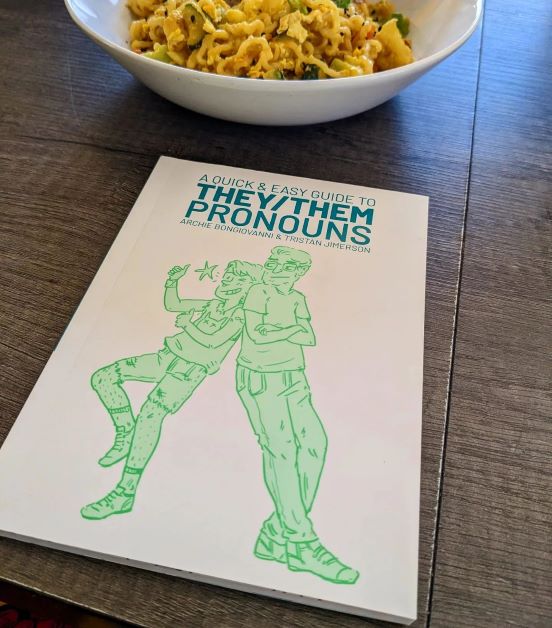
[Review]A Quick And Easy Guide To They/Them Pronouns, by Tristan Jimerson and Archie Bongiovanni

(Buy this book here)

This book is exactly what the title says it is. Archie and their cis friend Tristan put together a quick and simple graphic novel explaining what they/them pronouns are, how they’re used, and why we should use them. They take a really empathetic, gracious approach to this, with sections aimed at confused cisgender folk and at non-binary people trying to deal with being the target of that confusion. Everybody’s feelings and experiences are acknowledged here, but this is a book meant to teach us all how to graciously use correct language for everyone, and it’s very clearly and simply explained.

I think if I were a different person I’d tell you a schmoopy story here about the non-binary and genderqueer folk in my life and how I learned to use their pronouns sob and keep trying even though I get it wrong sometimes sob because I’m an ally sob sob.

Yeah, nah. I mean, I do have genderqueer friends and fam that I love dearly and even though I get the concept, we’ve all been raised in the binary and I do get pronouns and gendered language wrong sometimes. I picked up this book partly out of curiosity and partly out of a desire to potentially learn something that will help me do better. It was helpful, in a “they/them” 101 kind of way.

But I’m not an ally. I’m an accomplice. I’m not interested in making other people’s experiences about myself, but I’m very invested in helping people live their best lives as their #ownnormal, and bust down wrong and/or oppressive conventions any which way I can, barring driving the getaway car. (And that’s only because I don’t drive.) I also want other folk to do the same, if they can.

And that said–does anybody want this book? I don’t need to keep it, it’s a very good primer, and I get the sense it might be helpful to a fellow reader out there. Leave a comment explaining why you want this book, and I’ll pick somebody by the end of the week and send it to them, postage paid, no strings attached.

One more note before I finish this review; while this book does a great job of exploring language outside of the gender binary, it doesn’t acknowledge different cultural modes of gender or culturally diverse gendered language at all. On the one hand, I’m grateful–we don’t need two (apparently) white American folks out here trying to explain two-spirits, muxes, or sistergirls. But I’d be very interested in and would totally buy a book by artists of those cultures explaining these things.

Proper language and a wheelie in the getaway car to A Quick And Easy Guide To They/Them Pronouns

(Beautiful people! I hope you learned a little something from this review, because I learned a little something from this book. If you’re interested in more books by nonbinary and other gender diverse writers, go click around in the Equal Opportunity Bookshop and find something good to read. If you do, be aware that any purchases made on that site from links you find here will result in a commission being paid to yours truly. Peace!)

[REVIEW] La Bastarda, By Trifonia Melibea Obono, translated by Lawrence Schimel

(Buy this book here.)

This is the first book by a woman from Equatorial Guinea ever translated into English. It follows Okomo, a orphaned teen living in her grandparents house in a traditional village. With her mother dead and her father absent, she only has her favorite uncle to turn to when she begins to understand that she has no desire to make her grandparent’s wishes come true by marrying and having children. Unfortunately, her uncle lives in near exile for the crime of being a “man-woman” although Okomo’s developing desires lead her to wonder if she might be a “woman-man”.

Before reading this, I only knew two real things about Equatorial Guinea; it’s the only Spanish-speaking African nation and this book is banned there. The latter tells me more about the country than the actual book does, in some ways. Okomo isn’t all that unusual of a character. She’s like a lot of girls in books; orphaned, dreamy, smart and underappreciated. At times the book just seems to be her wandering around quietly observing her village and being villified for her parent’s sins. Sexuality is discussed frankly but not graphically, and so are violence and injustice. It’s a spare, quick portrait of a life in rural Central Africa–only about 100 pages long.

Okomo wanders, she thinks, she challenges expectations, and then SUDDEN LESBIAN ORGY (not a joke) and everything changes. The rest of the book is a maelstrom of dodging harm, searching for answers, and characters figuring out who they really are and accepting themselves as best as they can within the cultural strictures they know. It may seem that I’m speaking lightly of a story of injustice, but it doesn’t read that way at all. Something in Okomo, a certain quiet stubbornness, lets you know from the first that she’ll make it through to the end. This book, and its characters, accept that homophobia is real and dangerous but choose to exist openly and happily anyway. As you know, #ownnormal is my jam, so I enjoyed this. I was very intrigued by the perspective and story from a place and culture I know nothing about.

Freedom to wear short hair, no makeup, and kiss her girlfriend in public to La Bastarda.

(This book was a nice surprise. I like reading things that are very different to my own life and experience without being performative or didactic, and this fit the bill. If you also like reading that sort of book, check out the Equal Opportunity Bookshop or click around this blog. For legal reasons, I have to tell you that anything you buy from a link you find on this site results in a commission being paid to us. So buy! Buy everything! (or not). Whatever you do, have a great day and go read something good. Peace!)

[REVIEW]Linghun, by Ai Jiang

(BUY THIS BOOK)

Linghun is a Mandarin word that can be translated as spirit or soul.

It’s also the title of Canadian-Chinese writer Ai Jiang’s new novella. Fittingly, it’s about a place called HOME, where families impoverish themselves in order to call the spirits of their beloved dead back into their lives. Wenqi’s there because her parents can’t let her favored older brother go, even though she’s now older than he’ll ever be. Liam doesn’t care about his never-born sister, but that doesn’t stop his scheming parents from using him in their plans to bring her back. Sad, lonely Mrs. may hold the key to the entire neighborhood, but she’s too consumed with lifetimes-old grief to really know.

Bringing folks back from the other side never goes well in stories, and this one is no exception. A lot goes wrong in HOME, on both a micro- and meta-level. Refreshingly, it’s not always the things you’d expect. The conflict always comes from a place you weren’t expecting, and the world-building darts off into dystopia and gothic horror at times and the scares are more existential than visceral. There are a lot of different types of horror crammed into this brief book, but it works.

Linghun isn’t always clear. Its resolution kind of lingers, unfulfilled but still final. But grief is like that too, and ultimately, that’s what this is a book about. The madness and horror that lie behind guilty, unresolved grief may not give you jump scares, but they’re deeply unsettling, especially when they return in unexpected ways, or when others refuse to allow you to heal. Grief is almost never neatly handled, and Linghun’s trailing ending reminds us that unchecked grief can drag even the most well-intentioned of people into a living death themselves.

A good dinner, forgiveness, and some closure to Linghun.

Big thanks to the author for sending an advance copy of this book. It debuts on April 4th, 2023! Congratulations!

(Beautiful people, fellow readers, I know that it’s too much to wish that none of you are grieving so instead I’ll hope that your grief is tempered with joyful memories of the people and places you miss. Thank you for reading, and if you want more diverse books for diverse readers, click around the site or visit the Equal Opportunity Bookshop. Reminder; if you buy from our bookshop, we get paid. Not very much, which is kind of alright because there is no “we”, this site is all the work of one very solo Black lady with a bunch of other jobs who should probably go to bed in a minute , but every click and purchase is appreciated and helps me buy more books. Now, go read something good! Peace!)

[REVIEW] Repairing Play: A Black Phenomenology, by Aaron Trammell

(Buy this book here)

One person’s game can be another’s torment.

Aaron Trammell is a professor of informatics and the editor of Analog Game Studies. He puts this background to good use in this book, analyzing what play really means in a racialized context and a racist society. He pulls from theory, philosophy, cultural wisdom, and pop knowledge and then takes us a step further and starts to sketch a framework for repairing the concept of play entirely. For those who have experienced torment that gave someone else joy, this is a crucial, healing thing to think about. I wish the concept was elaborated on further in the book, but the peeks we get are interesting. The general idea is that by embracing the pain that play can bring, we can reclaim pleasure and social meaning for ourselves.

It’s impossible to live in America with two good eyes and a brain and not notice the constant commodification and consumption of humanity, especially Black people’s humanity. While this book may seem deceptively light on praxis, there’s something so essentially good about rethinking how we are consumed by other’s play–a grim allusion to the party atmosphere recounted in historical accounts of some lynchings comes to mind–and reclaiming it all for ourselves consciously.

That said, when I think of Black play, I think of double dutch. Hot Peas and Butter. Hopscotch. Dodgeball, jacks, roller skating, cheerleading dances, endless games of tetherball, and whatever the heck we used to do on our bikes for 18 hours a day every summer. None of that is in this book. While there’s a lot of talk of Black people being objects of play and our need to reclaim ourselves through play, there’s not much mention of how we already have. I feel like discussing existing Black traditions of play as well as game theory would have made this a fuller, more meaningful read. I’ve been pointed toward the work of Kyra Gaunt, specifically The Games Black Girls Play, as a good place to find those discussions.

Still, this book oiled up my creaky, spring-seeking thoughts, taught me some things, and reminded me to see myself as a member of a community, not a hustling commodity. It also reminded me to go shopping for roller skates.

A round of cat’s cradle and a game of freeze tag to Repairing Play.

(Fellow readers! I haven’t read academic non-fiction in a while but this was a good book to bring me back into the fold. For more non-fiction gems, check out the Equal Opportunity Bookshop . Remember that any purchases you make at that link will result in a commission being paid to this site. They will go into this blogger’s roller skate fund. Now, go read something good! Peace!)