[REVIEW] The Cutting Season, by Attica Locke

(Buy this book at the Equal Opportunity Bookshop)

I know I keep saying that thrillers and mysteries are really #notmygenre, but books like this and Razorblade Tears are really trying to change my mind. (Notice that both of these books are blackity-Black. Representation matters!)

Caren Gray is the general manager of the historic Louisiana plantation Belle Vie. She’s also a direct descendant of the enslaved Africans who built its wealth. Now the heirs to that ill-gotten fortune are Caren’s bosses, and she and her young daughter are creating a home steeped in an uncomfortable history on the grounds, a stone’s throw away from the old slave cabins.

That is, until a young Guatemalan cane worker is found dead on the property. What seems to be a senseless tragedy is actually linked to the history of the plantation and the people who lay claim to it, past and present. Economic injustice and human exploitation from the past interweave with the ambitions of the present, and one death points to another, with jarring ramifications across generations.

This book was published in 2012, but it’s still startlingly relevant now. Without giving too many spoilers, much of the plot hinges on revisionist history and narrative control for political reasons, and boy, doesn’t that sound familiar? When this book was written, the USA was still immersed in the hope and idealism of the Obama years but there’s a simmering hurt in this book embodied through Caren that almost feels a bit prescient now.

I’m not giving a lot of details because one of the pleasures of the thriller genre is unwrapping all of the details as you read, and I don’t want to deprive anyone of that. I can say, however, that this book is very well-written. The prose is atmospheric and builds up a slow, uneasy suspense without sacrificing beautiful imagery or wordplay like a lot of thrillers do. (At least, according to my stereotypes of the genre, which admittedly may be a bit unfair.)

This was a rare summer read for me–enjoyable, easy, but also very thought-provoking and immersive.

Accurate records and true justice to The Cutting Season.

(Fellow readers, this book is one of the reasons you should be reading the backlist, which is something I should really write a whole post about. I’m glad I discovered it. If you’re looking for this book or more like it, consider perusing the Equal Opportunity Bookshop, which has two great features; a)it’s not Amazon and b)if you purchase anything from this site’s Bookshop link, we get a little affiliate kickback. Whatever you do, go read something good! Peace!)

[BOOK REVIEW] The Call-Out, by Cat Fitzpatrick

(Buy this book here)

This is a polite comedy of manners set in modern-day queer New York, about 6 women(5 of whom are trans), written entirely in rhyming verse, formatted like an old school LiveJournal blog.

That’s a lot of concept for a 168-page book, and to its credit, it mostly works. Once you get a handle on the character names and the cheeky “look at me I’m LIT-ra-ture!” tone, this is a very clever, readable book.

The title refers to the way we handle moral transgression in community, and the book lampoons the self-righteousness that has become the calling card of call-out culture. One of the characters does something very awkward, thoughtless, uncomfortable, and badly executed–but is it a shunning transgression, or just a stupid misunderstanding? The fallout–and the callout–ruin friendships and fracture community, but also expose the ugliest and most annoying parts of people who see themselves as righteous helpers or objective observers.

Unfortunately, that’s where it loses me a bit. I hesitate to call the characters unlikable –after all, that’s kind of the point–but these women are all really childish and sloppy and unkind. Nobody in this book is good company. It makes for good drama and sometimes good humor, but bad moral fabling. There needs to be at least ONE decent person here, and we don’t get that. Also, one of the problems with call-out culture is its tedium, and that doesn’t change as much as I hoped when fictionalized.

Between this and a few other books I’ve read by trans women set in New York (most notably Detransition, Baby), I’ve come to realize that maybe there’s something really distinctly liminal and volatile and fragile about transgender women’s culture(at least the white girl version) that I’m really not capable of understanding entirely. I still enjoy reading about it, because I appreciate any depiction of #ownnormal life. However, I’m noticing that in these white trans books the tradeoff for full, self-referenced depictions of transness is…very weirdly built women of color. There are two Asian women in this book, and the way they’re depicted had me rolling my eyes a bit, especially the passivity of the Japanese-American woman. I need to read some trans women of color, because this book definitely did them a disservice.

I can’t say I loved this but I did appreciate its cleverness and viewpoint.

Maturity and real honesty to The Call-Out.

(Beautiful people, fellow readers! This is one of the books I like sharing because even though it wasn’t my favorite, it may very well be one of yours. If you want to read more books by trans women, check out my (diverse) booklist. If you’re looking for diverse books in general, check out the Equal Opportunity Bookshop, but remember–any books you purchase there from a link you find here will result in a commission being paid and me buying more books and maintaining this site. It’s capitalism, but…the useful kind, I guess? Before I get myself into some sort of trouble continuing the previous thought, I’d like to say thanks for visiting, and peace! Now go read something good!)

[LAST WEEK IN BOOKS]Biracials, Book Bans, and Billionaires

Look what I’ve had time to do for the first time in ages!

Diverse book news is still thinning on the ground, but because this is reality and not a trend, here’s some links to keep us all up to date;

  • The first one is entirely selfish–I’ve updated the About Me page of this site to include a little bit more about my life as a writer, including a little bibliography of my work(with links!). If you’re curious about what I write outside of reviews and rants, go take a look. [Equal Opportunity Reader]
  • Poet Leila Chatti, a biracial Tunisian-American writer who grew up in a religiously mixed home, has a very thoughtful take on writing while biracial that I learned quite a lot from. [Ploughshares]
  • Jay-Z has donated half a million dollars to fund legal aid for teachers, librarians, and academics facing problems due to book bans. Good for him. [Black Enterprise]
  • Speaking of book bans, I bought what may be the coolest anti-ban shirt ever from friend and online entrepreneur Crafty Kita. It’s the image for this post, and I love it. Also, suck it, book banners. [Crafty Kita]
  • I’ve written before about how reading poetry by justice-impacted people has made me examine my empathy voids. Haitian-American poet Enzo Silon Surin is not, as far as I’m aware, formerly incarcerated, but his new collection examines the social frameworks that make this such a common distress in the Black American community. He elaborates on it all very gracefully in this interview. [The Common]
  • The gamification aspect of Goodreads, Storygraph, and algorithmic sites and apps in general has never bothered me overmuch but I do have concerns for people who’ve had these things all their lives. Turns out they do too. [Shondaland]
  • The Diverse Book Awards longlist is out and…wow. Y’all, I’m slipping, because I haven’t read a single one of these books. To the #tbr they go! [Locus]
  • Henrietta Lacks, immortalized both biologically and literarily, has finally gotten her due. Her family has received financial compensation for the billions of dollars pharmaceutical company Thermo Fisher Scientific has made since 1951, when they harvested Ms. Lacks’ cervical cancer cells. [AP News]
  • Okay, last one–remember all the kerfluffle about Simon and Schuster potentially being bought by Penguin Random House and becoming an enormous Frankenpublisher with even fewer opportunities for fairness and creativity and many more avenues for exploitation and the constant flattening of diversity? Turns out that after that was struck down, Simon and Schuster has still been acquired…by a private equity firm that owns, among other things, Safeway, ToysRUs, and most of the band OneRepublic’s catalog. This will be…interesting. [Wall Street Journal]

That’s it for this week, fellow readers. As always, thanks for reading and if you want to throw a little support this way to keep the blog’s lights on(and enable more of these news posts) please visit the Equal Opportunity Bookshop, where every purchase earns us(me) a little change. Peace! Now go read something good!

[REVIEW] You Had Me At Hola, by Alexis Daria

(Buy this book here.)

Jasmine Lin Rodriguez is an up-and-coming starlet looking to cement her rising career and recover from a bout of bad publicity after being dumped by her rockstar boyfriend. Ashton Suarez is a veteran telenovela heartthrob trying to break into the English language market while keeping his private life hidden from the public. When the two are cast as leads on a new Netflix drama, sparks fly after a very chilly start.

The plot of this book is–ok, listen. I don’t know how many times I’ve said this, but we all know that romance novels all have essentially the same plot, right? Y’all know exactly what happens so I won’t bore you with the play by play here. But I will say that it’s nice to have a story about Hollywood actors that isn’t just a long list of brand names and famous people nonsense. Jasmine and Ashton both have person-next-door charm and they’re genuinely sweet with each other and their communities once the initial misunderstandings have passed. The book also revels in Latinx #ownnormal and interestingly, Jasmine has a Filipina mom but an otherwise Puerto Rican family, which is explored well and comfortably.

I’ve been reading romance novels for decades now, and it’s interesting to see how my perspectives on these stories have grown and changed over the years. The obligatory third act fight and potential breakup is often caused by a lie but in this book, it’s a whopper, despite being a lie of omission, not deceit. Teenage me would have sighed and simpered over Jasmine’s devoted true love and forgiveness but middle-aged me is like “He didn’t tell you WHAT?!? Girl, no! Next!” The resolution of the lie is ok but the fact that it’s there at all annoyed me a bit, and I wanted Jasmine to squeeze Ashton a little more.

In contrast to the plot point lie, the spice level in this book is remarkably grown and I have to say, I like how this book managed to be fairly realistic about grown folk sex without sacrificing any of the heat.

Lumpia con gandules and a smack on the hand for lying to You Had Me At Hola.

(Beautiful people, fellow readers, lovers –thanks for reading! For more diverse romances, check out this booklist on the Equal Opportunity Bookshop page. I really need to update and create some new booklists, but until then, please be aware that if you buy anything from a link you find on this page, I’ll earn a commission. In the meantime, I hope you’re well loved and told the truth wherever you are. Now peace! Go read something good!)

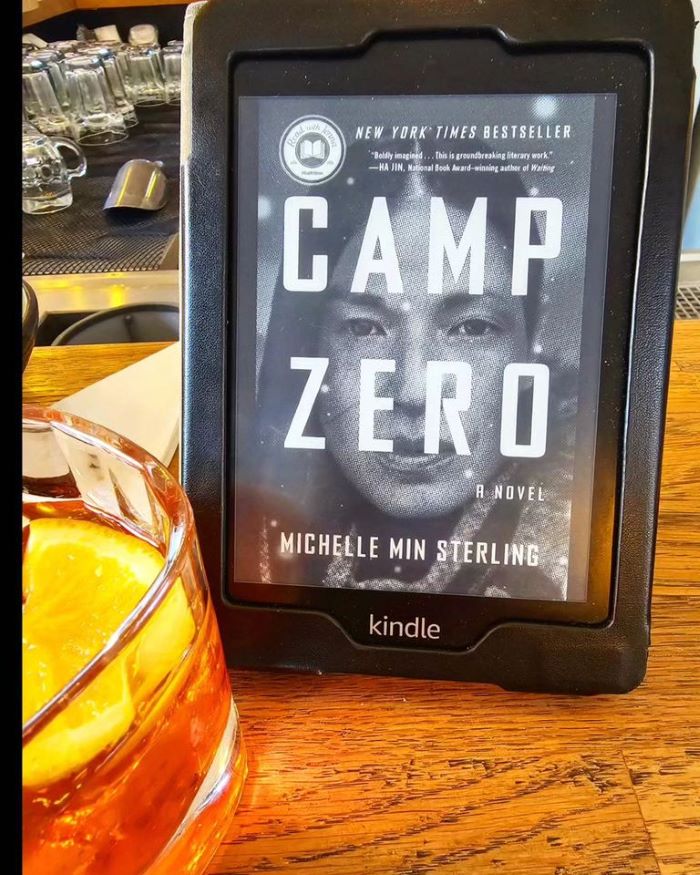
[REVIEW] Camp Zero, by Michelle Min Sterling

(Buy this book here.)

Mixed feelings, thy name is Camp Zero.

The writing is beautiful and tight. Sterling has clearly studied the craft in depth and the book has a technical precision to it that’s really admirable. There were many times in this book when I read a sentence and thought “wow, that’s a beautiful/sharp/moving way to say that”.

The plot is interesting. In a climate-change ravaged near future, sex worker Rose is sent to Canada’s Camp Zero by a former patron to keep an eye on the head architect. He thinks he’s building a school, a haven away from extreme weather patterns. The odd behavior of the camp employees, including the school’s new professor Grant, points to something far more sinister. Meanwhile, an unnamed narrator occasionally details a creepy story of a remote military outpost that may or may not be connected to it all.

It’s hard to take modern eco-fiction seriously once you’ve read Octavia Butler’s Parables, I think. Rehashing points made by forward thinkers in the late 90s only highlights how little imagination and motivation we currently have as a society when it comes to finding solutions for the troubled future we’ve created for ourselves. This book wants to be an interrogation of climate change’s impact on society, but instead, it just wallows in the same self-centered doom that got us here to begin with.

Also, I was bored or annoyed by a lot of the tropes and character cliches in this, including;

  • Mixed Asian/white protagonist as exoticized sex worker trying to rescue her poor refugee mother
  • Sad rich white boy who treats women hatefully tries to redeem himself through teaching the poors and pretending he doesn’t have money
  • Angry sort-of-feminist scientists who rob and murder men but it’s okay because all men are creeps
  • Random white girl indulging in literal savagery, but it’s okay because she’s special
  • Weird white fetish-ridden billionaire is actually smart and desirable instead of just weird
  • Only one Black person in the future, who has no purpose outside of being described as Black at the beginning of the book and never mentioned again
  • Also no Indigenous folks, even though this clearly takes place on their (ironically) acknowledged land.

sigh

There are a lot of places where the writing shines past these things, but overall the book is just a bit socially oblivious, which is the exact opposite of what it’s trying to be. Add that to the tumbledown ending and the overall effect is one of “girl, I guess.”

Hope and optimism to Camp Zero.

(Beautiful people! This dystopia didn’t have enough imagination for me, but if you want to check out a list of diverse dystopias that go far beyond the limitations of our present inequal reality, check out this booklist at the Equal Opportunity Bookshop. Any purchase made from a link you find on this site will result in a commission being paid, which I use to buy more books that I then review in the hopes of getting you to buy more books. It’s a beautiful life cycle. In the meantime, whether or not you click a link, go and read something good. Peace!)

[REVIEW] Elite Capture, by Olúfémi O. Táíwò

(Buy this book here.)

I think at this point we all realize that this idea many millennials have been fed of working really hard, socially climbing, and getting into powerful rooms and important tables to make changes is more or less a pipe dream. It’s not that it isn’t possible, it’s just that it’s not always an effective strategy for real and lasting change. In other words, working to become a decision-maker often isn’t what it’s cracked up to be.

Aside from the inefficiency, there’s also the frustration. While you’re working hard to gain access to elite spaces and the power they bring, other people are allowed to casually walk in the room with a few loud, dumb ideas and thrive. You’re exhausted and out of your comfort zone, while they’re complicit and entitled. This is not a recipe for success. The social pressures of gaining class levels and fitting in to higher education spaces may inadvertently rob you of your authentic voice. The pressure of being “the only one” may even be used to get you to speak out on behalf of communities you don’t even know just so that someone will.

None of this is ideal, and if you think about it, it means that there’s a much more important question to ask than “how do we gain power”. It’s “how do we change power?”, which is what Táíwò asks in this book.

In one small, dense volume (only 5 chapters), he draws on examples from the US, Cape Verde, and Brazil to break down how the politics of identity have been used and misused to reinforce existing power, rather than empower everyone. There’s a lot of discussion of what’s wrong and how it got that way, but fortunately, it doesn’t stop there. There’s also a lot of discussion of what needs to change and some excellent examples of how the commodification of elitism has been called out and tackled head-on in history in several places. How things could change–as in, step by step solution possibilities–is not discussed quite as expansively (although there’s some great info about Flint, Michigan) but I feel like that’s another book entirely–and I hope Táíwò writes it.

The writing starts out pretty dry but picks up the pace quickly once it gets into recounting examples and steps away from foundational theory. Táíwò also stays away from jargon and jingoism and those tired-ass meme racial justice talking points that have taken over the world to make “allies” feel correct, which is a relief. This is real work, not commodification of activism or progressive political and social stances.

Even if you’re not a big non-fiction reader, this book is worth a read if you’re working towards a shift in position, class or access to power–or if you’re uncomfortable with what’s expected of you to maintain the class, position, or access to power that you were bequeathed. At least check out the excerpt of it in Boston Review.

Fuller equity and a better ideological house with good theoretical and practical roommates to Elite Capture.

(Beautiful people! Thanks for reading. I try and balance my political/social non-fiction reviews with plenty of fiction on this site for a variety of reasons, but if you want to see more of my non-fiction recommendations, check out my Ten For The Times booklist. Also check out the other lists on offer in the Equal Opportuity Bookshop. Just remember that if you buy anything there using a link you find here, I earn a commission–which I promptly use to buy more books. Peace! Now, go and read something good!)

[REVIEW] Yellowface, by R.F. Kuang

(Buy this book here.)

I got a little tired of being the last blogger on the internet who hadn’t read this book, so I finally picked up a copy and packed it in my carry-on for an overnight flight.

I had to sleep. I knew I had to sleep. I still stayed up and finished this whole book and showed up in Frankfurt Airport (a.k.a. air transit purgatory) seriously grumpy and sleep-deprived.

Yellowface is quite a departure for R.F. Kuang. It’s literary fiction–almost a thriller–and she’s known for her fantasy novels, like the Poppy War series(I previously reviewed The Poppy War and The Dragon Republic in all their bone-breaking life-taking glory) and the alternate Oxford takedown of colonialism with word magic, Babel. But when everything an author writes is a best-seller, departures and experimentation are encouraged so, Yellowface is a literary novel criticizing the publishing industry.

I think what fascinates me about this book is its audacity. It lays bare what those of us who pay close attention to the world of books and writers already know; behind the scenes, commercial publishing is skewed towards whiteness, and often white femininity. This book dives into the nasty spaces behind the scenes. Everyone’s an ally, yet acclaimed writers who aren’t white collect marginal advances compared to their unknown, whiter, more “marketable” counterparts. High-profile writers of color are creatively marginalized into expected narratives. Cultural pain and authenticity are reduced to entertaining commodities. Jealousy, loneliness, and competition mar creativity and connection. Yellowface pulls very few punches and kills quite a lot of self-righteous industry darlings.

And it does it all by working very hard to try and make you empathize with June Hayward, who may be the most Casually Awful White Woman In The World. June witnesses her frenemy, impossibly cool Asian author Athena Liu, die in a freak accident. Somehow Athena’s work in progress finds its way into June’s possession and after revising it to her taste, she passes it off as her own and brands herself as vaguely Asian to market it. The resulting roller coaster of guilt, accusations, and dirty deals feels scarily realistic and grimy.

It’s a light but complex read–Kuang can still write her ass off and that’s on full display here. The ending was a bit pat for me, but the nuance infused into the characters was fascinating. Everyone’s awful, but everyone’s sad, too. Sometimes the people who create beautiful things are living deeply isolated, envious lives. Sometimes your friends really can’t be trusted–even after death.

I don’t even know what to give Yellowface. Discomfort? Useless DEI training? A support group?

(Beautiful people, this book is a trip. I’ve read very little like it but I hope more is coming. For more diverse books for diverse readers, please check out the Equal Opportunity Bookshop, where we earn a commission for any books you purchase through our links. By ‘we’, I mean me, and since I have books to read, I’ll end today’s note here. Peace! Now go read something good!)

[REVIEW] When Stars Are Scattered, by Omar Mohammed and Victoria Jamieson

(Buy this book here)

Take a look at that book cover for a moment. It’s cute, right? Two little button-nosed Black boys taking in the night sky without a care in the world, right?

Not quite. Omar and Hassan are Somalians living in a refugee camp in Kenya. Their parents are presumed dead and their guardian is an elderly refugee who’s lost her family as well. Hassan is developmentally disabled and requires a lot of care. Omar, though bright, struggles to go to school while feeling so deeply(and solely) responsible for what remains of his family. His main hope is that his UN application for asylum will be accepted–but that’s a long and stressful process with many unexpected pitfalls.

This cutely illustrated graphic novel is based on the real-life experiences of Mohammed, who arrived in Dadaab refugee camp when he was 4 and was resettled in Arizona when he was 19. It’s an honest portrayal of a refugee childhood and as you’d expect, life in a camp can be quite harsh.

It can also be quite beautiful, and that’s what makes this book such a work of art. Displacement and tragedy do not disrupt the human need for deep bonds of friendship, love, and community. Like any other kid, Omar has a best friend, crushes, and a school bully. He feuds with his brother and takes his growing pains out on his guardian Fatuma. He plays after school, studies for tests, and tests his boundaries. He’s a very normal, imperfect kid growing up as best as he can, which is what makes the specters of hunger, displacement, abandonment, injustice, and being at the endless mercy of politics and policy seem all the worse. Omar really could be any kid–but he isn’t. He’s a refugee, and that means that all of this normality is filtered through stifled circumstances. Given his lack of mobility and resources, the focus of his life is entirely on his relationships, and how they thrive and grow even in such terrible circumstances.

I started this book not really knowing what it was about. By the time I got to the ending– built around a poem by a very special woman that Mohamed was wise and loyal to include–I was in tears. The heart of Dadaab camp is beating on every page of this book, and it feels like an honor to have felt its rhythm.

Plenty of goat feed, more space for girls in school, and peace to When Stars Are Scattered.

INTERESTING UPDATE: I’ve never thought of graphic novels lending themselves particularly well to the audiobook format, but apparently, they do! For a review of how this book plays out in audio, check out fellow blogger Empish J Thomas’ review.

(Fellow readers and beautiful people – this is a book I recommend buying, not just borrowing. This has been a year of graphic novels for me, it seems–and this book is my second favorite of the year so far, right after Shubeik Lubeik. For more graphic novels by diverse writers and artists, check out the Great Graphic Novels booklist at the Equal Opportunity Bookshop. We have an affiliate relationship with Bookshop and will get a commission if you buy anything from a link on this page. Now, go read something good! Peace!)

[REVIEW] Gender Queer: A Memoir, by Maia Kobabe

(Buy this book here.)

I’m back after a bit of unexpected hiatus. It’s Pride Month, and while I read queer stories whenever I want and not just in certain months, I think now is a good time to talk about this book.

(I do have a sensitivity issue/unpopular opinion about some things in these pages, and because I wished I had had a content warning, I’ll put those thoughts at the end of the review as an FYI.)

Gender Queer is the most challenged book of 2021 and 2022. If you search the weird parts of the internet for “books that should be banned” this one is at the top of a lot of lists.

And I kinda get why. When it comes to the gender spectrum, non-binary-ness was harder than I thought it would be for me to understand. I sit so comfortably within my half of the gender binary l (internally, anyway–there’s a different conversation about gender presentation and how Black women are often perceived) that when the idea of being nonbinary was first explained to me, I wasn’t a jerk about it but I did feel pretty uncomfortable contemplating the idea because I just didn’t get it.

A version of that discomfort must have been what Kobabe( who uses the Spivak pronouns e, em and eir) felt, growing up in a world that demanded a gender expression and presentation that e just didn’t get and didn’t want to. Gender Queer is a well-told graphic novelization about eir experiences figuring out life, love, and expression as neither man nor woman, but a very different, very whole person.

There’s a lot here, and it’s all very frank, although not all that graphic–discussions of awkward puberty, discovering one’s asexuality through exploring sexual situations, family responses, and medical prejudice and insensitivity. There are illustrations of naked bodies, gross hygiene situations, and a few instances of body fluids, but it all comes across as quite clinical, not erotic or filthy, which has been a common accusation.

This is a vulnerable, candid memoir. It’s introspective, informative, and challenges norms that many people never really have to think about, drawn in a soft, sweet, accessible way. I can totally see why it gets censored and banned. I also think it should absolutely not be. It’s rare to find a book about anyone that uses storytelling so deftly to show us a person, living their life normally despite how challenging that may be at times.

But I do have some issues with it and one of them, at least, needs to be behind a big ol’ CONTENT WARNING.

First, and not content-warning worthy, is that this book exhibits an utter lack of intersectionality, which I tiredly feel isn’t even something worth criticizing white American writers for anymore because it’s just American culture in some places if we’re being honest. At a few points, Kobabe lists all the books e’s read over the past year and these are the white-lady-est lists ever–and a bunch of manga. Yikes. This isn’t a criticism so much as a sad cultural truth, and I’m pointing it out because I feel that some Black, Brown, Asian, etc. genderqueer fam might want to know this before they get frustrated on the overwhelming whiteness of Kobabe’s world.

Second–and here comes the content warning– my real issue is that some of the situations presented as part of Kobabe’s childhood memories come across to me as clear neglect. They just aren’t called that because eir family is white, well-educated and ‘earthy’. Early pages depict em and eir childhood friends peeing in the yard because there are no toilets available. Later, there are instances of a clear lack of access to hygiene products and knowledge about hygiene as the author gets deep into puberty. Also, Kobabe didn’t learn to read until e was 11, which is not neglect, exactly due to eir dyslexia, but when presented along with everything else, is upsetting.

Listen. This is a blog for diverse folk. Fellow readers, you and I both know that if Kobabe was brown and/or poor this would be a very different memoir and eir parents would not be presented as saints and pioneers at all. There’s also the issue of the author’s (IMO) experiences of neglect being conflated with eir gender expression, and that is concerning. In no way do eir negative experiences or interpretations of them invalidate eir gender journey and I’m not challenging their non-binary-ness. However, connecting neglect with gender realization is edging into the same territory in which creepy Christians are constantly trying to stake a claim that gender difference and queerness are caused by pathology or family dysfunction. Again–I’m not questioning the validity of eir gender, only expressing concern about eir depictions of child neglect and how blithely they’re shared, as though the problem is gender, not neglect.

Frankly, I think it’s really weird that amidst all of the dicussions and reviews of this book–good, bad and unhinged–I’ve never seen a content warning or even acknowledgement of the (admittedly brief) scenes of neglect. I may be way off base here but this seems like quite the living room pachyderm to me and I almost put the book down because of it. I’m glad I didn’t, but you may feel differently and so I’m sharing here.

That said–I’m glad I read this. It’s a good book that needs to be available in libraries, schools, and bookstores for young people to read, but there are some things included that perhaps the author didn’t intend.

Affirmation and fanfic to Gender Queer.

(Beautiful people, fellow readers, welcome back to the blog. It’s been a while but I’m glad to see you here. Thanks for reading, and if you want to read more books about gender diverse and queer people, check out the Equal Opportunity Bookshop, specifically our booklists on Trans Experiences, LGBTQIA+ Reads, and Books By Trans Women. Remember, we’re a Bookshop affiliate and any purchases you make at those links means we make a little bit of pocket change. Now, go read something good! Peace!)

[REVIEW] Garlic and the Vampire, by Bree Paulsen

(Buy this book here.)

Sometimes, we need books that are sweeping, epic, and deep. Other times, we need books that are so cute that we want to pinch the pages and give them candy.

Garlic and The Vampire is definitely the latter. This middle-grade graphic novel focuses on anxious little Garlic, one of the many enchanted vegetables that tend Witch Agnes’ garden. When a vampire moves into the nearby woods, the nervous veggies insist that despite her own fear and worry, Garlic be the one to drive him out–after all, she’s got an advantage. 😉

This book is cute and lovely without being too syrupy-sweet. It’s written for kids, but the story is fun for everyone. It’s well-illustrated and never gets too dark or heavy. The supporting cast is interesting, too, especially loyal Carrot and Celery, the town jerk.

I could see this being a nice gift for a particularly anxious kid who hasn’t yet realized that the rest of the world isn’t actually staring at them waiting for them to mess up. It’s a nice refresher for adults who need to scrub their work brains with something that isn’t too taxing but still carries a certain amount of resonant emotional truth.

This was a nice Friday night read that put a smile on my face and gave me a much-needed breather from a much more taxing read.

Brave actions and unexpected friendship to Garlic and The Vampire.

(Beautiful people, they don’t all have to be deep. Sometimes they just have to be nice. To find more diverse books that are deep and nice, check out the Equal Opportunity Bookshop, where I’ve curated a bunch of booklists to help us all find books that remind us we are our #ownnormal. Remember that it’s an affiliate shop, so I get paid a commission for any books you buy at that link. Thanks in advance for your purchases! Now, go read something good! Peace!)