[Hear Me Out] The Television Adaptation of Min Jin Lee’s Pachinko Wasn’t Made For Me–And I’m Both Glad and Worried

(This is an edited version of a post from the Equal Opportunity Facebook page. To buy the book the series is based on, click here.)

Thanks to a kind and generous soul in The Black & Asian Alliance Network, I now have an Apple TV account and have been watching the series adaptation of Min Jin Lee’s epic generational saga, Pachinko. I read the book back in the days before I started this blog, so I haven’t talked about it much here even thought it’s a personal favorite. I loved reading it, loved the keyhole view into the lives of the Korean diaspora, and loved the idea of a generational saga shared from an Asian-American perspective, especially since in the US the hardships of Asian immigrants are often hidden under a blanket of model minority success.

As a long-term foreign resident of South Korea (nine years and I miss it often) who actually went to the trouble of learning the language and getting involved, if not integrated, into the local culture, there were some small points of confusion for me in the original book. It’s not my place to dissect them, but this post from Ask A Korean highlights them all, plus quite a few that I was too ignorant to notice. Despite that, I still liked the book and shared it with quite a few friends.

So, with all of this in mind, I was eager to see what the highly anticipated, high-budget adaptation of the book would do with the Baek family and all of their tribulations and triumphs.

I have a lot of thoughts.

Pachinko is beautiful…

The first is that this is a beautifully shot, well-cast, well-produced show that is well worth watching. (The book is worth a read, too. I can’t say that enough.) It’s about a Korean family displaced by Japanese occupation of the peninsula and their struggles to succeed in Japan and later, the US, and it does a very good job of establishing all of these places. I feel very present while watching this–it’s a very sensory show.

Read the book first…

The second thought is that I’m glad I read the book first. It’s plotted chronologically, but the show is not. I’m not sure how well the asynchronous timelines of the series hang together for those unfamiliar with the storyline.

The casting is great…

As far as casting, I’m thoroughly enjoying Youn Yuh-jung’s performance as elder Sunja.(I first saw her in the film Minari, another Korean diaspora story.) Although I wasn’t crazy about Jin Ha as Solomon at first, I warmed up to him very quickly. I’m not at all impressed with Jimmi Simpson’s unnecessary inclusion as the obligatory goofy-yet-mean-spirited white businessman who needs to have Asia explained to him. (I appreciate that actor generally but every time he opens his mouth in the show I want to yell at him to go back to his country.)

Edit: at the time of this writing, I hadn’t watched the final three episodes of the series and wow. Soji Arai as adult Mosazu(Sunja’s son) and Kim Min-ha as young Sunja also deserve kudos for their performances. But hands down, one of the best and most moving performances in the series is given by former teen heartthrob Lee Min Ho, especially in the “Chapter Seven” episode, which depicts the events of the 1923 earthquake in Yokohama, Japan, and the resulting persecution of Koreans in the aftermath.)

America is still too racist for this…

All of this brings me to a final thought. While this is a watershed moment for Asians(specifically Koreans) in acting, writing, directing, and media the public response to it has been pretty tepid. It’s a good show based on a good book but the ratings have been low. I suspect it’s partly fallen victim to the same prejudice that many Asian-American people deal with in the real world — it’s too Asian for “mainstream” America and too American for Asian markets.

That said, it’s not intended for those markets, entirely. There’s a commitment to language (the dialogue is almost entirely in Korean and Japanese with English subtitles) and a proud refusal to veer into areas of fetish or orientalization that makes this great storytelling and art, but probably also triggers some people’s latent prejudices towards Asian people. This series looks like Asia. It sounds like Asia. To me, it seems very much like it is (with the exception of Jimmi Thompson’s crowbarred appearances) for the Korean diaspora.

As a Black American with a Korea connection, I appreciate the show a lot despite the fact that generational epics of triumphing over oppression are nothing new, culturally speaking. Pachinko has been compared to Roots in scope and tone, and while it’s not a perfect comparison, it does make a certain sense. These are American stories from recent history that need to be told, remembered, and celebrated. As much as I’m enjoying the show, it’s a love letter that isn’t addressed to me and I’m glad. Some people, however, will have a huge problem with that.

But it gets a little deeper than that.

Several times I’ve overheard white Americans telling Koreans that the show is good, but they don’t know about Korean-Japanese history and don’t see why it’s important or interesting because in their opinion, there’s no reason to think about “things from the past”. To my surprise, some Koreans agree with that sentiment. Verbally, at least.

To say that this shocks me is an understatement.

One of my big blind spots, and a blind spot for some of you as well, is how deeply some people want to downplay and water down history either in the name of progress and assimilation or because they don’t think it applies to them. I forget that the average person’s empathy gap when it comes to other cultures and countries–and even our own diasporas–is pretty big.

I’m not sure that Pachinko can bridge that, quite yet.

But I really hope I’m wrong.

Highly recommend watching this.

(Beautiful people! Thanks for reading! If you’d like to read Pachinko or another novel about Americans of East Asian heritage, check out this booklist on the Equal Opportunity Bookshop. In fact, check out the whole shop, and please note that we have affiliate relationships with Bookshop and other sites. If you buy anything from a link you find here, we get a little kickback, which is used to buy more books, which means I write more reviews and the cycle continues…

Peace! Go read something good!)

[Reading Challenge] Arab-American Heritage Month

Did y’all know that April is Arab-American Heritage Month?

I definitely didn’t. Apparently, it was only made official last year, although it’s been celebrated since 2017.

One of my favorite things about curating this bookish space on the internet is that I get to learn things and illuminate my blind spots publicly, sharing what I find with all of you. As it turns out, Arab-America is a big one for me.


I didn’t know many people of Arab heritage until I left the US and went to the UK. Embarrassingly enough, I can only recall reading one book by an Arab-American author before, which was Hisham D. Aidi’s excellent exploration of music in Islamic youth culture, Rebel Music.

So, that’s the April challenge. Let’s try to read something by an Arab-American. Bonus challenge–try to make it something joyous and lively, not just a war/oppression tale.

I’m way out of my area of knowledge here so I have nothing to really recommend. I did put together a very general booklist to get us started. I’ll probably start with Etaf Rum’s Palestinian-American generational epic, A Woman Is No Man because I’ve had a copy for ages.

But other than that? This is a month where we’re going to be doing some learning together, I think.

Anyone got any recommendations for good books by Arab-Americans? What are you reading for this challenge?

(Click here for a list of books by Arab-American authors. Remember that we have Bookshop affiliate space, so if you buy from this link, we get a little change. Peace!)

[REVIEW] Legendborn, by Tracy Deonn

(Click here to buy this book.)

Me, last year when Bookstagram blew up with 5-star reviews on a YA book about a Black girl who is somehow involved in Arthurian legends: That is a really stupid idea. No way I’m reading it.

Me, now, after reading that book: crackhead scratch WHERE’S THE NEXT BOOK? GIVE IT TO MEEEEEE….!

There’s nothing I like more than being proven wrong by brilliance, and this book is brilliant. It’s also done a bit wrong by its blurbs. If this was just the Knights of the Round Table with a Black lead, I’d have hated it. But it’s much more than that. The real story is…well, let me explain it from a personal angle.

Recently I did a DNA test and discovered, among other things, that I have significantly more European ancestry than I wanted or expected. My feelings about it are complicated, in a way that I also didn’t want or expect. My African and Indigenous ancestors are points of reverence, wisdom, and strength. My European ancestry? It’s a given that my recent Euro connections were not inspirations. They were very probably brutal oppressors at worst, and apathetic cowards at best. As a result, my life and lineage are inextricably tied to not only strength and survival but pain and cruel, thoughtless power.

This is the story that Legendborn tells, too. Bree, an early college student, is forced to face not only present reality, but her own ancestry–all of it. Her mother’s death seems to have brought on special abilities, which gets her wrapped up in the workings of a campus secret society who just happen to be the good ol’ boy stateside descendants of the Knights of the Round Table. No surprise here, but they’re the nutty descendants of former slaveowners with a fixation on racial purity and former glory. As much as I love the old stories, I hate Arthurian legend, mostly because the logical progression of them is exactly what’s presented here.

While there’s magic and monsters and sweet romance aplenty, the real story here is about looking all of your past in the face so you can choose which cycles to break and which to continue. It all forms a very clever commentary on the things that Black people must do to balance the dismantling of systemically racist structures while also acknowledging how deeply we are also connected to them, albeit unwillingly.

I’m being all deep and serious but this is also a wildly good, fun story. I spoke out loud to this book a half dozen times and cheered at the best parts.

I should have read this last year like the cool kids. I wish I could go back and read it for the first time again. 5 stars and a scabbard for Excalibur to Legendborn.

(Beautiful people! It’s not every day I write about a book I unequivocally recommend for not only reading, but buying if you can. If you believe me, consider purchasing from the Equal Opportunity Bookshop. Full disclosure, we get a commission from any purchases you make at that link, which is what keeps new books piling up on the nightstand as the good Lord intended. Peace!)

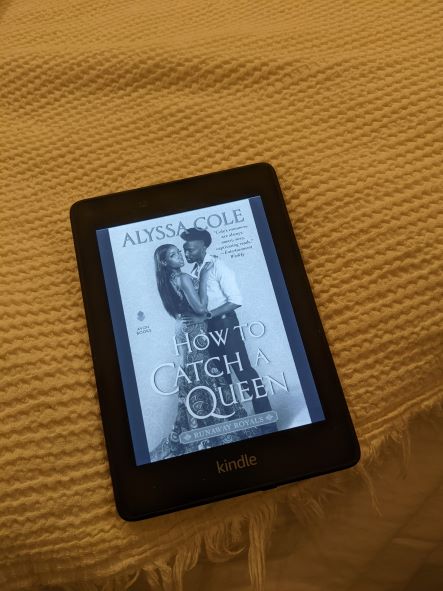
[REVIEW]How To Catch A Queen, by Alyssa Cole

(Buy this book!)

Black. Royals. In. Love.

Let me say that again, y’all.

Black.

ROYAL.

Romance!

That’s it. That’s the whole review. Go read the book.

Okay, fine. As much as I wish that was the whole review, it’s not. As much as I wanted to adore this tale of stern King Sanyu finding and wooing his One True Queen Shanti, it soured for me at a few points. Full disclosure; I went in to this biased and happy because I enjoyed Alyssa Cole’s sci-fi romance The A.I. Who Loved Me so much. I have developed an unreasonable soft spot for this author, so any criticism is definitely genuine.

Overall, the book is a lot of fun. It’s your standard romance novel with high steam levels and fun characters, so there’s not much to quibble with there. It’s an arranged marriage plot too, if that’s your thing. It is emphatically not my thing but I actually like the way it was introduced here, with a nod to modernity. There’s a little bit of adventure and politicking to keep things moving and the setting and side characters do what they’re there to do.

The thing that kept this from being a 5-star read for me is this: Sanyu, the male lead is not only king of a mean, misogynistic kingdom in need of a feminine facelift, but also king of the jerks. He’s prickly, emotionally stunted, and chooses toxicity again and again, despite having the power and intelligence to do better. There are very well-presented, well-written reasons for all of that, but I wanted his queen Shanti to pack it up and run for the hills after every plot twist.

Speaking of Shanti, she’s extremely likable–smart, fun, and politically engaged. There’s a depth and sweetness to her that romance heroines don’t often get, and as I said to a group of students the other day, only Black women write other Black women so sweetly, in any genre.

I realize that Sanyu’s emotional issues will probably strike a real chord with some readers because they’re true to life and well-handled. In fact, in some ways the book is a master class in patience, reconciliation, and the constant forgiveness that is a part of love.

But I’m already doing all of that constantly in my real life, so I want a little more manic pixie dream boy and a little less rough, gruff and dangerous in my romantic fantasies, ok?

Four stars and please Lord a good marriage counselor for How To Catch A Queen.

(Beautiful people, you know the drill. Something something legal reasons, something something affiliate, something something Bookshop, something something commission. Got it? Good. Now go read some Black romance, or be in one yourself. Peace!)

[READING CHALLENGE] Read All The Women

whew This is extremely late.

Things have been busy offline for me lately, but instead of boring you with that, let’s just jump into a reading challenge for what remains of this month.

March brings spring, flowers, and a month-long celebration of women’s history for us to read through.

There’s a lot I want to articulate about women’s history, my own sense of being a woman, and the deep sense of enjoyment I derive from my own femininity.

But instead of spotlighting my own thoughts and experiences, I’d like to challenge us all to read the work of women who are often marginalized and excluded even within our own sister circles. For the month of March, try to read a book by a trans woman, a disabled woman, a neuroatypical woman, or a BIPOC woman over 65(aka an elder).

I’m not sure what I’m going to read just yet. I’ve been reading much more slowly than usual these days, but I hope I’ll get back into my usual groove soon. Still, I’m finding that it’s easier to find books about these women than by them, which is interesting. I just heard about S.T. Lynn’s Cinder Ella, which reimagines the fairy tale as a romance starring a Black trans girl. I may actually finally read Akwaeze Emezi’s Pet, especially now that the prequel has been released and is burning up #bookstagram.

As far as books by disabled or neuroatypical women, this is my chance to read autistic author Helen Hoang‘s romance novels. Maybe I’ll read Keah Brown’s memoir about being a Black woman with cerebral palsy, entitled The Pretty One.

For a book by an elder Black, Indigenous, or of color woman, I might check out the latest Nikki Giovanni collection, Make Me Rain. Bombay-born author Thrity Umrigar just turned 71, and just released a novel about interreligious couples called Honor. And I’ve been saying I’m going to read something by legendary Anishinaabe writer Louise Erdrich for literally years now. She’s 71, I own about 4 of her books and have never read more than a chapter so maybe now’s the time.

What will you read, beautiful people?

(This blog has affiliate relationships with Bookshop, so if you click on the links and buy books, we get a commission. It keeps the page shiny and bright. Thanks for reading, and peace! )

[REVIEW] The Chiffon Trenches, by Andre Leon Talley

(Buy this book here.)

I was a very casual fan of the iconic fashion editor Andre Leon Talley. I remember seeing him on television shows in the 90s and early 2000s and being struck by his grandiosity. I also noticed him because even then I had a laser eye for #ownnormal fam living their biggest and best lives in worlds that liked to pretend they didn’t exist. I was sad to hear of his passing, and even sadder to find out that despite all the media memorials, the man essentially died penniless and alone despite his iconic status. Talley had a presence, and when he left I wished I had known more about him.

This may seem like an odd choice for a Valentine’s Day post during a month where I’m trying to encourage everyone to #readBlacklove. But what is this, if not a love letter to an industry? It’s a glitzy, name-dropping memoir of Talley’s rise from unpaid intern fresh from rural North Carolina to the first Black creative director at Vogue. He goes into gleeful, materialistic detail about the time he spent with fashion elites such as Karl Lagerfeld, Anna Wintour, and Manolo Blahnik. He’s also very candid about his sexuality and binge eating struggles. He doesn’t forget where he comes from, but his memories don’t linger there. Instead, they’re wrapped around encyclopedic recollections of who was wearing what and how it mattered in the backstage drama.

Talley’s memories definitely show status and privilege, but they also make it clear that he loved haute couture with every fiber of his being and never quite stopped being amazed that he was part of it. Perhaps the only thing he loved more, if you believe this book, were the people who created fashion. It’s like a who’s who of loving little anecdotes about the fashion community, made all the more poignant by Talley’s transparency about his difficulty with close relationships.

That makes it an even bigger shame that hindsight and Talley’s own rueful awareness shed doubt on how much he was loved back. As a reader, I learned from his love and loneliness equally.

4 stars and a pair of custom made Manolo Blahniks to The Chiffon Trenches

[REVIEW] Fledgling, by Octavia Butler

(Buy this book here.)

*Content warning*

Not every written word ages well. Every author has something in their catalog that gives readers of the future the ick. Sometimes it’s the whole catalog. If they’re lucky, it’s just one book or part of a book.

Octavia Butler got lucky.

Fledgling has been called Butler’s vampire novel, and that’s not wrong. The book is about vampires, but stays pretty far away from the usual cliches. Instead of an impossibly sexy and immoral huntress, our title vampire is Shori, a compassionate 53-year-old vampire with amnesia trying to solve a mystery. Someone has been trying to kill her and her family, and they’ve nearly succeeded. Shori is the only one left, and her life depends on relearning her people’s ways and figuring out who wants her dead, and why.

Of course, she is a vampire, which means she has to build a community of human blood donors who are sexually and emotionally connected to her. Some of the best scenes in the book are the little life vignettes that Shori shares with her young human harem. Butler wrote diverse communities well, and this book is no exception.

All in all, this sounds like a good story, right?

But what if I tell you that despite being 53 and not human, Shori resembles a 10-year-old Black girl?

Yeah. Ick.

I’ve had some awkward conversations about this book focused on either pedophilia or hypersexualization of Black girls. TBH, I think both of those takes are getting it wrong. Shori’s story is not about her appearance. It’s about alienation, of waking up powerful but not knowing why, of being in danger for reasons you can’t remember that shouldn’t matter. It’s a story where racism is so strong that other taboos are ignored in favor of false purity. It’s about being more than you seem, but still being seen as less than you are. It’s about the fear of Black bodies, and how to some people, they are never acceptable, right or wrong. It is not about pedophilia or hypersexuality.

The Grande Dame of science fiction could never be so basic.

Still, if you’re a reader with an intense visual imagination, there are probably some scenes you’ll want to skim past.

Four stars to Fledgling

(To be honest, fellow readers, one of the things I appreciate most about La Butler is that her imagination was so expansive and unfettered that it didn’t really matter that not everything she wrote was a slam dunk, but was completely unlike everything else in the library. To read more of her work, check out my Butlerian booklist. To support this site and help me buy more books and write more reviews, check out the Equal Opportunity Bookshop(now in Black!) For legal reasons I have to tell you that we have affiliate relationships with Bookshop and if you purchase anything from them via a link you find on this site, we’ll earn a commission. It keeps our creative juices flowing and is always appreciated. Peace!)

[READING CHALLENGE] February Reading Challenge: Black Love

(Check out the booklist here.)

Is it February already?

Last month I challenged all you beautiful people to read a memoir by someone really different than you.(Hit the comments with what you read!) This time I’d like to challenge you to read one of my favorite literary things because this month is too perfect not to.

I’m a big fan of reading #BlackLove and #BlackJoy and what better time to do it than February? After all, it’s #BlackHistoryMonth AND #ValentinesDay! So this month, my challenge to you is to read a book that features Black people in love. Any Black people, any kind of love, any kind of book. Just find some Black people loving somebody and join the challenge!

I’ll probably catch up on romance novels–I’ve been meaning to read the Brown sisters series for ages and now might be the time. But I realize that romance isn’t everybody’s genre so this challenge is open to any book, as long as there are Black folks in love in it. I might also finally crack open the copy of The Prophets I got ages ago, because while it’s not a romance, it’s definitely got a love story in its center. There are a lot of books that fit the bill for this month’s challenge–what do you think you’ll read?

If you’re not sure what to read for this month’s challenge, I’ve made a booklist over in the Equal Opportunity Bookshop. We do have an affiliate relationship with Bookshop, so if you make a purchase after clicking any links on this website, we’ll earn a commission. (Which, just so you know, immediately goes towards buying more books. It’s the circle of bookworm life.)

Comment here or on Instagram with what you plan to read this month. Peace !

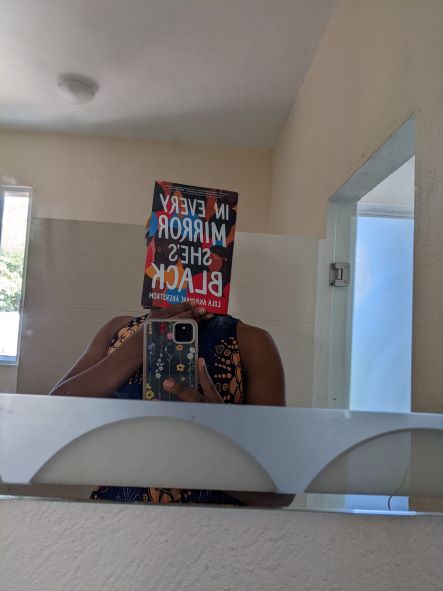
[Review] In Every Mirror She’s Black, by Lola Akimade Akerstrom

(Buy this book at Bookshop)

It feels like it’s been 935 years since the last time I wrote a book review but I couldn’t let any more time go by without telling y’all about this one.

Work, weddings and war. I lived abroad in 2 different countries over 15 years and I heard this constantly. The three W’s are the main reasons that any adult lives in a foreign country long term– you have a job opportunity, you fall in love with a local, or you’ve been displaced(or created) by war.

In Every Mirror She’s Black gives us an example of each. Muna is a Somalian refugee, Kemi a first-generation Nigerian-American with a high-powered job, and Brittany a Jamaican-American model who catches the eye of one of Sweden’s most eligible bachelors. All three women find themselves navigating life as foreigners in Stockholm. They’re not friends–how could they be, with nothing in common but being Black in Scandinavia?–but their paths cross and recross in surprising ways.

I won’t spoil the story for you except to say there’s a lot of high drama and unexpected twists. I will say that in this book I feel weirdly seen. It’s not only because of the exploration of what life abroad is like for Black women, although that part of the book is very accurate and made me laugh out loud a few times. (If you know a Black lady expat, send her some hair products, food, and pants that fit. Just trust me.) It’s also because this is a book about the emotional journeys of three very different Black women who have nothing in common except the alienation that a racist world foists onto us.

I appreciate that the author doesn’t do what you’d expect with this story. There’s no sassy sisterhood, no luxury shopping montage, no triumphant “that’s why racists suck” speech at the end. It’s just three sistahs doing their best to make it and feeling what they feel very authentically along the way. As a result, the ending of the book had me in my own feelings for days afterward.

Honestly, I don’t know when the last time a book made me feel so seen and understood was. Five stars and a polite request to get out of my emotional business to In Every Mirror She’s Black

(Beautiful people, fellow readers, Black women who travel the world feeling our feelings and everybody else–welcome! Thanks for visiting my little blog, and thanks for reading the review. If you’re interested in more booklists and reviews, stick around! Also, please check out the Equal Opportunity Bookshop if you get a chance. Full disclosure–any purchases you make at that link(or any other on this site) will result in a commission being paid because we have affiliate relationships. Peace! )

[REVIEW] Too Much Soul, by Cindy Wilson

(Buy this book here.)

It’s January 19th. I’ve read 6 books so far in 2022.

I’ve reviewed one.

This year has been MAD so far, y’all. How are you doing?

Moving on to a review, I suggested this book as part of my January Equal Opportunity Reading Challenge and all I have to say is…can y’all forgive me?

So this is Cindy Wilson. She was adopted as a baby from South Korea into a conservative Black American Southern family. She seems like a very lovely person and I really enjoy the interviews she’s done with various Youtubers–in fact, that’s how I found this book.

Her story is unusual, and her willingness to share that story should be applauded, first and foremost. But there’s something I’ve learned from reading memoirs — interesting experiences don’t make interesting people. The way that Wilson’s story is presented in this book makes it seem disorganized and kind of shallow. She skims the surface of her cultural experiences but her race is almost used as a gimmick. We’re supposed to ooh and ahh at her stories of going to Black churches, an HBCU and competing on mostly Black cheerleading squads just because she did those things while being physically Asian, but aside from describing some racist incidents and parroting some very simple “we are all human” race talk there’s not a lot of deep reflection.

Speaking of church though–there is SO much religion in this book. There are passages that read almost like altar calls in every section and while the intentions behind them are clearly sweet, they’re so aggressively non-sequitur that they just sound a bit fake. We get it–you believe in Jesus. But what does that mean, exactly, outside of boilerplate church speeches?

Then again, there is something nice about how run-of-the-mill this is. There really is nothing weird about being Asian or being in a Black family, and I did appreciate the normality of it all. Clearly the author is entirely immersed in Black culture–at the time of the book she hadn’t even been back to Korea since her adoption. Cindy Wilson is a culturally Black woman who is racially Asian. It’s just that this book makes it seems like she belongs to the most basic variant of Black culture and I wanted more.

I wanted to love this, I really did, but it didn’t hit. FWIW, Wilson’s interviews about her experiences on YouTube are much better and more depthy, and I highly recommend watching them.

Two stars and some seasoning to Too Much Soul

(Greetings beautiful people! How’s your 2022! Quick reminder as usual–this blog has affiliate relationships with sites like Bookshop and if you click any of the links here and make a purchase, I’ll receive a commission. I usually use it to buy more books. Peace, fellow readers, and go read something good!)