[REVIEW] Crazy As Hell: The Best Little Guide To Black History, by Hoke S Glover III and V. Efua Prince

(Buy this book)

Black Americans are simultaneously unlikely and affirming, resilient and fragile, cautious and crazy. It’s that last dichotomy that this little book of historical vignettes of Blackness in America delves into. Instead of taking refuge in respectability and uprightness, the authors highlight how much of Black history and its makers are absolutely batshit insane–even when they seemed respectable. Appropriately, the categories and featured players here (Harriet Tubman! Nat Turner! Bill…Cosby??? Uh…deadbeat dads?) seem a bit all over the place in a whiplash-inducing way. But there’s a method to the madness here, I think. Glover and Prince highlight Blackness in truth, not in myth, including the warts and bruises as well as the triumphs and prides. In light of the continued propagandization of US history (and the annoying flock of White academics trying to salvage their pride by coming up with a historical reverse draw gotcha for every point of cultural criticism that originates in Black communities) this is important work. We’re unlikely, imperfect, and crazy as hell–but we’re still here, and managing to be beautiful and innovative a lot of the time, too.

This is meant to be a primer text, and that’s reinforced by the lists of resources at the end of each section. This book will give you homework and lots of it, from foundational texts and some unexpected gems. As a bonus, this is clearly aimed at Black people looking to learn more, which gives it a little more depth, humor, and cultural value than a lot of racial justice history primers tend to have.

This is worth a look if you want to learn more about Black American history in all its glory and insanity.

Therapy and loving acceptance to Crazy As Hell.

[REVIEW]A Treasury of African-American Christmas Stories, edited by Bettye Collier-Thomas

(Buy this book here.)

While most Decembers I re-read Dickens’ A Christmas Carol, this year I had the good fortune to work on a stage production of Scrooge’s adventures as an audio describer(more info on what that means soon). That means I also had the bad fortune to hear, read, and see my favorite Christmas story a half-dozen times in rapid succession, and you know what? I just can’t deal with any more of Tiny Tim’s false positivity this year. Little man, there are sarcastic ghosts in your city. Save the blessings for another day.

Instead, I got into this anthology, which gathers short holiday writings by Black Americans originally published between 1880 and 1953. Some are from writers as well-known as W.E.B. Dubois and Langston Hughes and others from figures less noted but just as important, like Mary Jeness and Augustus M Hodges.

Most of the stories are slices-of-life, religious reflections, or moral fables. That, plus the fact that all of them are pre-Civil Rights, makes this more of a historical record than a celebratory collection. It’s still fascinating to read because of the constant reminders of how young Black American culture is and how quickly it evolves. The first time I picked this up, I was startled by how many things these writers mention that I’d either never heard of or thought of, like Chinquapin trees, open market cooked chitlin sellers, and all sorts of social clubs and societies that were founded to try and fill in the social care and access gaps created by segregation. It’s also heartening to see just how early Black writers were casually challenging religious Euro-normativity and outlining class consciousness and radical politics. The moralizing and religiosity gives “trapped with the most senile elder after service because you can’t find your mama” at times, but overall, these works are well-chosen and sweetly written.

Nothing here is quite as iconic as the Cratchit’s baby boy, but what is, really? These stories of Black Christmases past are still precious, and God bless them, every one.

Merry Christmas, fellow readers. A happy, restful, meaningful day to you all.

(So it’s Boxing Day, not December 25th. Christmas is a season, after all, fellow readers. Thanks for reading and for being here all 2024, and here’s to more reading a reviewing in 2025. If you’re looking for something to get you started on next year’s reading challenge early, do check out the Equal Opportunity Bookshop–just remember that we get paid a commission for every purchase. Read something good, and have a happy holiday! Peace!)

[REVIEW] The Collected Poetry of Nikki Giovanni, by Nikki Giovanni

(This should be on your bookshelf if it isn’t already. Find it here.)

we all start/as a speck/nobody notices us/but some may hope/we’re there

When I was small, I stumbled upon a poem that made me feel like I was 10 feet tall. It gave me pride in my African ancestors, pride in being Black and growing up to be the kind of Black woman the poem described. It reminded me that I am bad, and that was actually a very good thing.

diamonds are mined…oil is discovered/gold is found…but thoughts are uncovered

In middle school, I sometimes wished I was a poet. The existence of the poets I loved–Angelou, Jordan, Clifton, Brooks, Sanchez, and of course Giovanni–affirmed and baffled me. I could not, at the time, imagine a world where anyone at all cared about what I thought or felt. I obsessively longed for a world where someone cared about what I thought and felt. Religion filled some of the need. Words filled the rest, including a poem that called to “poets wrapped in loneliness”. I felt as though I’d found a member of my own tribe, someone I’d never meet but knew me just the same.

I am cotton candy on a rainy day/the unrealized dream of an idea unborn

I met Nikki Giovanni once, many years ago. It was brief, but she was generous. I did not know yet that I was a real writer too, only that I wanted to be. I was shy, tongue-tied, in awe. She was peppery, blunt and so, so smart. She shone the way that I hoped to. She looked us all in the eye and didn’t demure–she owned who she was, what she meant, and what she had written. Her brain was all the way on, but so was her heart. I was reminded that poets may be lonely, but Ms Nikki, at least, was so hip even her errors were correct. Her presence illuminated the trail her words had blazed for Black women and girls.

I went from the crowd seeking you/I went from the crowd seeking me/I went from the crowd forever

This isn’t really a review, but y’all knew it wasn’t going to be. Rest in peace and power, Ms Nikki. You meant so much to so many of us, and you are already dearly missed. We treasure the words you left us.

a poem is pure energy/horizontally contained/between the mind/of the poet and the ear of the reader

(Nikki Giovanni was born on June 7, 1943 and passed away on December 9, 2024. I am so sad she’s gone, and so grateful for all the word and thought and presence she left us with. Get some Giovanni poems on your bookshelf if you don’t already have them, fellow readers. If you buy them from my links, I’ll earn a commission, but that’s not what’s important here–Giovanni is an essential American poet, and you should read her, stat. Thanks for reading. Peace!)

[REVIEW] Somebody’s Dilemma, by Joshua Valentine

(Buy this book directly from the author here.)

It’s 2347, and Earth is a polluted, barren wasteland. Exploratory research robots roam, collecting information and sending repetitive transmissions while they prepare to resurrect the human race more than 200 years after its extinction, using carefully banked embryos.

Jacey-One is the first of the new humans, raised in the dispassionate emotional image of his mechanical ‘mother’. On his 18th birthday, he’s asked to do something confusing. His reaction catalyzes strange and catastrophic interactions with other remnants of humanity.

I feel like this self-published novel will have a special place in the hearts of readers who grew up on 70s sci-fi dystopia(Logan’s Run or The Omega Man) and psychosexual shock horror films(Butcher, Baker, Nightmare Maker or The Green Inferno) I’m admittedly only into the former, so while not everything here resonated with me emotionally, I appreciate what the author’s done and how deliberately crafted Jacey-One’s voice and world are. There are big themes and clear visual concepts being laid out here, mostly having to do with religion and sexuality. Joshua Valentine is a drag artist as well as an author, so unsuprisingly there’s a tinge of classic camp to this as well, the kind that Susan Sontag used words like artifice and vulgarity to analyze, eventually deciding the whole gross display was based in a love for human nature despite itself.

Speaking of vulgarity–this book doesn’t shy away from extremity. It’s deliberate, not gratuitous, but be aware–this book has graphic depictions of violence, torture, cannibalism, scatology, and a lot of sexual encounters of dubious consent. The shock value is high, and it’s a lot to take in.

In the wake of book bans and global hard turns to the right, work like this is important. It’s lurid and shocking, but there’s a rhyme and reason to it, and I revel in artist freedom, even when it doesn’t result in the beauty and joy I usually resonate with. I appreciate the daring it takes to unapologetically push boundaries for artistic reasons, and the tenacity it takes to put the work into the world on one’s own.

A better world and better mother to Somebody’s Dilemma.

Also, big gratitude to the author/artist for sending me a copy of the novel, as well as a great shirt and stickers. Apologies that this took so long, and keep writing!

(Beautiful people! Welcome back to reviews and such–I think I’m back in the saddle again. If you want to read more books by gay and queer authors, check out this booklist curated by a friend of mine or just generally peruse the Equal Opportunity Bookshop. Remember that any purchase you make there from a link here results in a little commission being paid, so thanks in advance for reading and visiting, and hope you’re reading something good. Peace!)

[HEAR ME OUT] Season 2 of Interview With The Vampire Gets Everything Perfectly Wrong

Sometime in 2022, I told you all about how much I liked the first three episodes of the series reboot of the Anne Rice classic Interview With The Vampire. I told you how good the acting, the writing, and the thematic choices in the new show seemed to be, fangirled a bit over lead actors Sam Reid and Jacob Anderson, but reserved my final judgment for after I saw what the series did with child vampire Claudia, now envisioned as a middle-teens Black girl from a poor parish of New Orleans. Claudia was introduced properly in episode 4 of the show’s first season, which I dutifully watched and then…said nothing about. I told y’all to watch the show, enthused about it, mentioned that I might have a quibble here and there, and then never shared my thoughts on it again.

That is because I was busy watching the show. Not just once, mind you. I’ve watched the entire first season of Interview With The Vampire at least three times in all of its meticulous, enraptured entirety.

From what you may have gathered from my intermittent postings on this blog, I am a professional Busy Person. I have a regular day job, lots of freelance work, a fledgling writing career, this blog, and a remarkably neglected social life. I generally don’t have the time or the inclination to watch anything more than once, not even a TikTok.

But I sat and watched each episode of this show many times, without multitasking, riveted to the screen, turning over the dialogue and stylistic choices in my mind, entirely absorbed and mesmerized. The first season of Interview With the Vampire was good, y’all. And while I went into season 2 with a lot of trepidation about how Claudia’s inevitable storyline would play out on screen now that she’s a (literally)adultified Black girl, I finally finished it last week and y’all…

it’s better.

I’ve only had time to watch it all the way through twice but trust me, more viewings are coming. This is one of the best shows streaming right now. The story, performances, and production are incredible. I haven’t been excited to sit and watch each new episode of a weekly show for a very long time.

The thing that intrigues me most isn’t what the show does right, although there’s plenty of brilliance on display here. It’s how it takes the negative aspects of the story, its history, and its universe and makes them work. There are so many things perfectly wrong with this reimagining of Anne Rice’s Vampire Chronicles, and I’m going to jump right in, assuming you, too, are a fan and have some familiarity with the material. Beware of spoilers as we dive straight in…

Anne Rice’s Books Weren’t All That Good

Let’s get this one out of the way first. I tried my best to work through Anne Rice’s Vampire Chronicles in high school. I read them back then because I read everything I could get my hands on, but I didn’t really get the hype. Even at 16, there was nothing cute to me about a whiny plantation vampire letting his narcissistic boyfriend move in and gleefully eat up the enslaved. I understand now that the book was a wonder of emotional exploration, homoeroticism, and Southern gothic horror fiction. I get that it said things about grief and masculinity and relationships that many people found enormously resonant. Anecdotally, every artsy bisexual man I’ve ever met seems to have a very special relationship with these books and I respect the vibe.

But I read them while being Black and female in 1997. L.A. Banks’ Vampire Huntress series was still a few years away, but I already knew there had to be something a little more authentic to my developing worldview than the eternally toxic mess that was Louis and Lestat. All Interview With the Vampire did was make me write terrible anti-fanfiction about Marie Laveau sealing Louis’ sniveling ass up in the Tomb of the Unknown Slave forever and ever, amen.

It didn’t help that when I finally got to The Vampire Lestat, it turned out to be essentially the same story retold from a point of view that I found very off-putting. While subsequent books do have different plots and characters, the themes seemed to be the same. By the time I got to Queen of the Damned, I’d also discovered the soap opera novels of gay Black writer E. Lynn Harris, which meant that a bunch of idealized gay white European vampires sitting around proclaiming how pale and erotically sexless they all were then throwing massive temper tantrums really weren’t that interesting anymore.

I realized and respected the cultural impact of the books, though. Just because I don’t love something doesn’t make it unimportant(take note, some of you), so I would still check in and read a few pages every time a new entry in the series was released, out of sheer zeitgeist curiosity. While it seemed to be going in a direction too campy to take seriously (Vampires fighting aliens in Atlantis? Girl, I guess so…), I definitely understood that Anne Rice scribbled so that monster romance could laser print. Years later, when I was eight books deep into Kelly Armstrong’s Women of the Otherworld series, I remember thinking that the chick-lit supernatural romantic megaverses of the 90s and early 2000s owed a debt to Rice. The monster romance boom right now does, too. Quiet as it’s kept, so does the rash of gay male romances written by women and AFAB authors. She started a movement, and my stubborn dislike of the books makes no difference.

But then the show came along and made me genuinely wonder if I might have been wrong all along–not about the impact of the books, but my own good taste. Before watching 2022’s Louis swagger through a NOLA brothel with a sword cane, nothing could have convinced me to revisit Anne Rice’s books. While watching the show, I recognized a lot of material from the book that I had dismissed out of hand because the way it was presented in print annoyed me so much. But I found myself enjoying those things so much in the show that I’ve now picked up copies of Interview With The Vampire, The Vampire Lestat, and Queen of the Damned. Heaven only knows when I’ll have time to read them, but I want to. Not because I think I’ll like them any better, but because I love the show and want to love it more. Despite all of the changes made for the sake of the series, there’s still a clear reverence for the source material that I don’t have but now want to understand.

If that’s not the definition of a show being better than the book I don’t know what is. But that said…

Everybody’s Supposed To Be White, Right?

Someday soon, I’m going to sit and write about the differences between colorblind casting and culturally corrective casting, and what that means when adapting stories with fraught racial and social histories. Until then, here’s the Cliffs Notes: colorblind casting is a nice idea, but it only works in certain stories and even then, you have to carefully consider optics, power dynamics within the story, and the fact that no matter how hard certain people want to pretend, there is no such thing as a culturally neutral property. Whether or not you like it, race is often linked with culture, even if it isn’t in stereotypical or even expected ways. (For an example of colorblind casting gone recently, horribly wrong, look no further than the new Alien: Romulus film.)

Culturally corrective casting, on the other hand, accepts that culture exists, that race connects to it, and that changing the race of a person in an established story often changes the way that they are expressed within the created world. It may not change what characters do, but it will add more shades of meaning to their interactions, their power dynamics, or their conversations. It may not change the motivations of the characters but it will impact how they move through the world of the story, and give the actors different freedoms in how they choose to portray them. Sometimes, culturally corrective casting doesn’t necessarily change the race or culture of characters–it simply gives characters who were marginalized in the first telling of the story more agency and cultural prominence in the retelling. (I first thought of this while watching Wes Anderson’s adaptation of the Roald Dahl short Poison, which is a great example of how shifting the lens of an old story can explain its former relevance to a world that has progressed past it.)

Anne Rice’s work, and frankly that of a lot of White American women, has an uncomfortable fascination with Confederate, slave-owning, and colonial vampires. This makes parts of modern vampire novels bizarre at best and unpalatable at worst. In the original Vampire Chronicles, nearly everybody is a European nobleman, a privileged prodigy, or in the case of Louis, a literal colonizer (born in France, raised on a wealthy Louisiana plantation). While there’s nothing really wrong with that–people like that existed–the audience willing to engage fully with that story is rightfully limited because of how flattened the context is. At best, vampire myths allow their creators to explore monstrosity, both perceived and innate. They help us explore the social tension between refinement and crudity. They help us navigate the spaces between what our desires demand we take and what our social obligations demand we give.

But the OG Vampire Chronicles do none of that, really, at least not in any substantive way that looks beyond narrow conceptions of the self. Nearly every vampire character in the Vampire Chronicle novels is a monster to someone else, and every one of them is tortured by an external social monster, if you look at them all in the context of the larger historical and cultural worlds they inhabit. However, Rice keeps all of her characters so small and self-absorbed that they never really seem to understand that the world outside of themselves exists for any reason outside of their own emotion. While this self-centeredness is arguably a part of vampire lore, it doesn’t make for particularly expansive stories in the long run.

Identity, for many of us, is not entirely an internal matter. It’s also a matter of external perception, legal rights and recognition, and social hierarchy. What’s missing from the written Vampire Chronicles is a real understanding of what it’s like to be other, despite how you may feel about yourself. Materially, Rice’s vampires stay or become unchallenged first-class citizens of their world. Their otherness is just lip service. Maybe this is why young me, and probably many others, could never really get into them.

The TV show faces this head-on by making Louis, who is not only our main character but the mouthpiece of the story and the audience’s viewpoint in the past, Black. It changes the story’s starting point from 1791 to 1910, giving the worldbuilding a 119-year facelift and shedding light on an underwritten bit of Black American NOLA history. (Everybody knows what Black folks were doing in 1865,1945, 1964, and 1993. But ask someone who isn’t Black what was going on in 1912 or really any other year and prepare to be blinded by the blankness of their face.)

Making Louis a Black Creole man turns the neat trick of making his family, friends, and most of his social circle Black as well. Not only is he Black, but he’s queer in a deeply homophobic period, partnered with men who are not Black in deeply racist contexts. The intersections of Louis’ identity change the power dynamics of his relationships, and make his vampire powers and limitations all the more poignant and terrifying. But they don’t change him. Louis is still moody, gloomy and impulsive, but those traits garner very different reactions in different bodies. A Black vampire’s personal revenge against racism may vindicate him, but destroy his community. A Black man can come to terms with his sexuality more fully when everyone who judges him for it eventually dies, while his partners endure. Becoming a real monster means something very different when you are already perceived as a monstrous human being. The depth of this alone was enough to lock me in to the first season.

Season 2 does us one better by moving our two Black vampires to Europe, where racial dynamics for Black Americans are less hostile, segregation is a distant worry, and any story they tell about their origins is accepted, if not believed. For most of the season, they revel in the relative freedom. (Imagine being an immortal blood-drinking being and still being tickled by the ability to just be.) But there are different nuances within the racial dynamics of postwar Europe, and staying true to the precedent set by season one, season 2 dives a bit deeper, giving us a Southeast Asian Armand played by the incredible Assad Zaman.

I’m not going to pretend I have the expertise or understanding to speak on the way he’s written from a cultural perspective, but I’ll say two things; I really loved his performance, and it’s about damn time somebody acknowledged that logically, in any cadre of immortal beings from ancient, cultured civilizations, some of them are going to be from places other than Western Europe. History did not begin in France, and there’s no reason for every other creature of the night to be from there either. I’m usually not a stickler for historical accuracy in the fantastic, but I always found it irritating when supernatural stories comply with the colonial lie that nobody on Earth was doing anything of artistic or cultural value worth preserving until the Renaissance began. Armand, as well as the mostly unsensational addition of a few Vietnamese vampires in supporting roles, is at least a nod to the fact that history is older than Europe and diversity and migration have always been a fact of human history, not partisan politics.

Speaking of sensationalism, though…

Claudia Doesn’t Work.

But she was never going to, and that’s part of the point.

Claudia, the child vampire turned by Louis and Lestat to try and save their struggling relationship, is portrayed by a Black actress in both seasons of the show. It doesn’t work. Nobody’s saying it, but Claudia’s storyline, while not terrible, is consistently the worst part of the show. This is because there’s no real empathy expressed anywhere for Claudia and before we go any farther here–as a defiantly happy Black lady, it was very hard to watch both Bailey Bass and Delainey Hayles in this role. Their performances are shrill, aggressive, cartoonish takes on the nuanced existence of Black American women, their NOLA accents were not good, and Hayles, in particular, is giving us short angry adult rather than teenaged vampire.

Claudia is the worst part of this show and a terrible portrayal of Black girlhood. Yet somehow, I didn’t slam my laptop shut the first time she yowls for “Unka Les and Dadday Lou”. I kept watching her even though I knew a terribly unfair and traumatic death was coming for her. I stuck with her even though I cringed at all the things the show gets wrong about her.

Here’s why: one of the things the series adaptation of Interview With the Vampire does well is highlight the inner lives, complex relationships, and social presence of queer men, laced around monstrous metaphor. Part of that presence is misogyny. Even more specifically, misogynoir.

Name one reason why Lestat is initially shitty to Claudia that has to do with her, not with his own frustrations elsewhere. Explain why the Theatre des Vampires feel so justified in making her role in their show a constant redux of her pain? Explain why Louis, so valiant in his memories of Claudia, sometimes also seems more than willing to throw her under the bus until he realizes he might go, too? It’s not that the men of the show aren’t nasty to each other, because they are. It’s that they’re toxic to each other for personal reasons. Claudia catches hell largely because nobody bothers getting to know her. She has the misfortune of being more than and different to the perceived roles she was made to fill. She’s not a doll, a toy, or a perfect daughter–she’s a full-fledged vampire with her own desires and goals. She refuses to stay secondary or disappear, and that makes her an inconvenience and a threat. Claudia is treated badly because she’s not living up to anyone’s idealization of her, not because of who she actually is.

The neglect of Claudia as a character is part of the point of her presence. Queer men are just as socialized into misogyny as straight ones, although it manifests in different ways and is often not reckoned with honestly. It’s not lost on me that in a show that explicitly explores the nature of viewpoint and memory, Claudia is retrospectively seen mostly as an emotional wild card. When you think about it, it’s clear that what she wants–a sense of her own history, a life partner, a little respect– isn’t actually unreasonable, but that’s not how she’s portrayed. Claudia’s needs are never met, her emotions are disregarded, and her thoughts aren’t taken seriously until she’s gone–and even then, the most painful truths shared in her diaries are ripped away and sanitized for the sake of Louis’ memories. Claudia, poorly presented as she is, is a textbook case of a woman seen only in terms of how well she stays under the control of men(no matter how well-intentioned). That she starts out as and always looks like a little girl is easily one of the creepiest things in a show full of literal blood and guts.

I’m not saying that Louis and Lestat don’t care for her–they clearly do. Louis’ revenge episode is a thrill, and I’d be lying if I didn’t admit that she deserves a fair few of the jabs her parents throw back at her when the family relationships start to sour. I’m not saying that I expect Black women to always be portrayed as perfect angels, powerful divas, or cosseted princesses–in fact, I don’t want that. I’m not even saying that Claudia isn’t a complex character. She very clearly is, although in a way that speaks more to the curious outsider observation of Black women than our actual lived experience. I’m just saying that Claudia is a character seen entirely through the lens of imperfect memory and self-serving perception, and the result is a pretty critical commentary on how our main (male) characters view women and girls.

I don’t have enough room here to talk about all of the things I felt while watching Claudia march towards her inevitable doom in season 2 of this show. I will say this, though–sometimes things can be gotten so wrong that they turn out right. I don’t love the choice to portray Claudia as a ball of endless snarling rage and pisstivity, all hair-trigger temper, obscure demands, and poor choices, but there’s something vindicating in seeing Delainey Hayles make that choice, knowing that in reality, this is not something a Black woman in that time could have gotten away with for so long. It’s harrowing to watch her almost get away with having a reasonable emotional response to her circumstances, again and again. It’s devastating to see her exist as fully as she dares, only to be ripped down from a painful, unwanted pedestal without even the luxury of truly being known or understood by those who claimed to love her best.

It doesn’t work. But at the same time, it makes a statement that I found cathartic, if not pleasant.

And to be fair, Claudia, in all her unfairly portrayed unlikability, leads us to our last point…

Who Would Want To Be This Kind of Vampire?

Well, we already are, and ultimately, that’s what makes this show great.

At my big age, I’ve been in relationships, situationships, hateships, and unrequited love. I’ve felt deep, learned a lot, and as a result, I can see myself a little bit in almost all of the major characters except Armand (what is his deal?). I understand being vivacious, intense, misunderstood, and self-centered like Lestat. I understand being alienated, self-loathing, victimized and self-centered like Louis. I understand being neglected, idealized, and discarded like Claudia. I definitely understand being smart, jaded, and regretful like Daniel. I can almost understand being an insanely jealous doormat like Armand(seriously, what is his deal?).

Deep down, this show is about relationships, and all of the things that make them difficult. People remember things differently, make difficult choices, and carry their trauma forward even when they’re trying to make new lives. People love, but imperfectly, and the resulting dissatisfaction can warp even the best of intentions. External factors, like race, class, and gender can also intrude, sometimes overshadowing personality and character. Ultimately, love–whether platonic, romantic, familial, or any of the other types– can sometimes wind up feeling like a tug of war between incredible luck and impossible odds. Sometimes, love just isn’t enough. And sometimes, love isn’t what you thought it was.

But even if the memories of family, friends, and lovers are so painful that you have to lie to yourself to make them bearable, they’re still worth remembering.

Come for the vampires, stay for the philosophy.

There’s much more I could say about this show, but instead of prattling on, I’m going to go re-watch a few bits. You should too, and then you should go and hug someone(preferably without biting their neck or saying something evisceratingly cruel and personal while you do it).

Peace, beautiful people. Go and watch something good.

(Aaaand before I go, I have to quickly tell you that this blog has an affiliate relationship with Bookshop and anything you buy from a link here means we get paid a commission. Thanks for reading!)

[Last While In Books] Nobels, BIPOC, and Reviews

Hello, fellow readers. Pay no attention to the time between this post and the last. These aren’t the reviews you’re looking for. There is no hiatus in Ba Sing Se.

There is, however, diverse and bookish news to share so without further ado…

  • American writer Sue Monk Kidd, whose feminist theology book The Dance of the Dissident Daughter holds a special place in my heart and in my personal liberation, has been diagnosed with Parkinson’s disease. I’m surprised I haven’t seen more people talking about this–I found out through her social media. Thankfully, her prognosis is relatively positive. [Instagram]
  • There are many reasons I’ve been absent from this blog for so long–life be life-ing, y’all–but one of those reasons is cooler than all the other ones. Since July, I’ve been a staff reviewer at Lightspeed Magazine. I’ll still be posting plenty of reviews here, but once a month I’ll be dishing about an upcoming spec-fic book in an award-winning magazine in the presence of actual greats. *squee* So far I’ve talked about African epic fantasy, middle-grade urban folkloric coming of age, and Sabaa Tahir’s long-awaited follow up to her Ember in Ashes series. Check me out over there when you have a moment. [Lightspeed]
  • Despite their necessity, I’m kind of over reading deep statistical dives into the state of BIPOC presence in US publishing. Unfortunately, it seems the industry is beginning to feel the same way. I’m starting to see all white booklists in major publications like it was the bad old days again. A few folk are still out here fighting the good fight, however, like writer Emily Jiang, who’s done a great job delving into diverse speculative fiction for SFWA. Spoiler alert: things are getting better, slowly. [SFWA]
  • Things may be improving in US speculative fiction publishing, but UK children’s publishing still needs some help. Apparently most British children’s books with Black main characters are actually written by white authors. [The Guardian]
  • Han Kang won the Nobel Prize in Literature. Predictably, society is either rapturous or vitriolic in response. Go Un and Hwank Sok-yong are probably somewhere munching on their own livers. Personally, I think it was well-deserved, for Human Acts if nothing else. [Hankyoreh, Nobel Institute]
  • Senegalese writer Mohamed Mbougar Sarr is already being touted as a future Nobel winner. Instead of linking you to all the critics telling you why he’s great, I’ll direct you to his short story Ami Police so you can begin to form your own opinions. [The New York Review]

There are, as always, many more things happening in the world of diverse books, but for now I’ll leave it there. For more books and to show this blog a little support, please visit the Equal Opportunity Bookshop. Now, go read something good! Peace!

[REVIEW] The Truth According To Ember, by Danica Nava

(Buy this book here.)

Before I begin, let’s all please clap a little for this, the very first romance novel about Indigenous people by an Indigenous writer published by a traditional publisher.

Then, let’s all boo those publishers for depriving us all of something so good for so long.

And then, let’s clap again because Danica Nava put her whole heart into this book and it’s an absolute joy.

Now that we’ve all gotten our cardio in, here’s the plot: Ember is poor but ambitious. She’s also a liar, even marking her ethnicity as “white” on a job application instead of mixed Chickasaw and Choctaw. Somehow this gets her hired at one of Oklahoma City’s wealthiest accounting firms. Enter Danuwoa–the hot Cherokee IT guy at the firm, who is authentic and honest in a way that challenges Ember without her realizing it. Sparks fly, and this is where I tell you that romance plots are familiar, so you know what happens here–dates, awkward family introductions, spicy sessions, misunderstandings, a third act breakup, and a big reconciliation.

But often, what makes or breaks a good romance novel isn’t what happens but who it happens to. These characters and their world are really warm and embracing. There’s so much #ownnormal here: casual inclusion of family members with Down Syndrome, vivid understanding of poverty and the shame and fragile pride that go with it, and acceptance of the fact that when your auntie calls you to come out to dinner, you go, even if it’s a long drive, you’ve had a bad week, and you really don’t want to make up with your younger brother.

Also, let’s be frank– lots of romance novels feature Indigenous characters. Most are interracial romances written by white authors, and therefore really weird, if not outright–is there a word like Orientalist, but for Indigenous people? Because yeah, that. It is such a breath of fresh air to read about two normal modern Indigenous people falling in love without calling upon the Power of Heart, or whatever. In fact, there’s a hilarious subplot lampooning that nonsense, and lots of little nods to culture for culture, not for fetish.

Guess all that’s left to say is I hope we get a lot more books like this, from Nava and other Indigenous romantics.

Honest fame and global popularity to The Truth According To Ember.

(Fellow readers! Back when I first started this site, I wrote a piece about my embarrassing obsession with a book called Brave Heart back in the day, which I later made private because oh, the cringe that younger me inspired. Comment if you want me to make that post public again. Also, check out this booklist of work by Indigenous people, and don’t forget that any purchases you make in the Equal Opportunity Bookshop result in a commission being earned and moar books! Moar reading! Moar reviews! And also, apparently, moar old meme references. Thanks for visiting, beautiful people. Now, go read something good! Peace!)

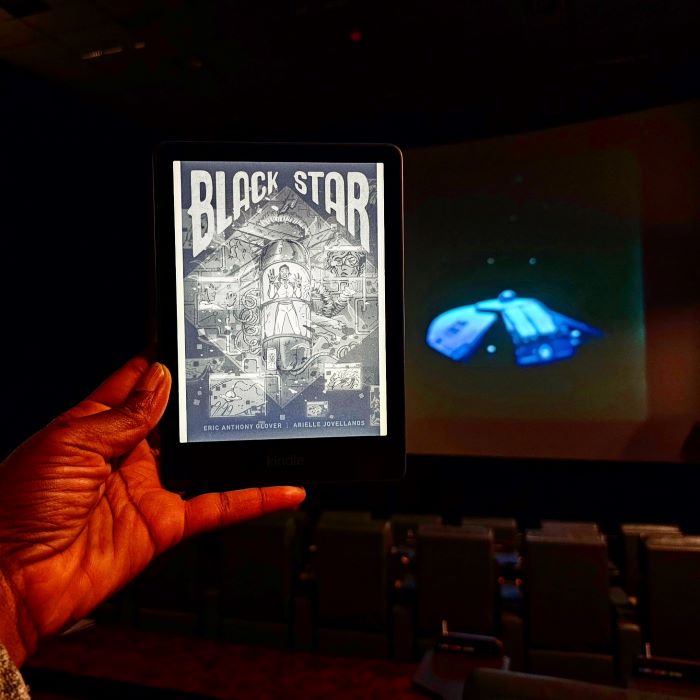
[REVIEW] Black Star, written by Eric Glover, drawn by Arielle Jovellanos

(Buy this book here.)

I’ve had a remarkably pleasant year in reading, by which I mean I’ve liked almost everything I’ve read. If I haven’t liked it, I’ve understood it, so my reviews in 2024 have all been pretty positive, although mildly so. Everything’s been good, but nothing’s really knocked my socks off. (Let’s ignore The Idea of You for the moment.)

That is, until Black Star. While reading this space adventure comic, I said, out loud, several times, “Why haven’t I heard of this before? It’s so good!”

Not only is it good, it’s deceptively simple. This is a very straightforward, one episode space action story about a research ship that crash lands on the planet where the botanical samples they’re in search of are found. The crash results in the fiery destruction of the ship and the death of nearly all of the crew, leaving Harper North alone to trek across a hostile planet to the lone one-person rescue shuttle, finding the flowers her crew mates died for along the way.

It’s too bad that the only other survivor of the crash wants North dead and the shuttle for herself.

This is a survival story, a grudge match, and a list of moral quandaries, assisted by good characters, great graphics, and really inventive use of a spaceship AI. There’s something classic in this book’s story-first approach, as well as the depictions of the characters–all women, mostly of color, some queer, all drawn with loving detail. (North’s survivalist struggle fro is almost its own character.) This matters entirely but also doesn’t matter at all, because at no point does the comic act like it could ever be abnormal for a spaceship to have an all-female crew–I feel funny even pointing it out because it’s so natural in-story.

The story is straightforward but the choices and relationships it presents are messy, leading to an ending that hearkens back to old-school sci-fi film downers. (This makes sense, as this was originally a screenplay.) I wasn’t expecting quite that resolution, which pissed me off while also making perfect sense.

I had a great time reading this and don’t know why I haven’t heard more about it. Good travel weather and REVENGE!!! to Black Star.

(Fellow readers! My end of summer energy has been flagging a bit, but never fear–it’s because I’m planning to ramp up the blogging a bit more this fall. Cross your fingers for me, and remember if you want to browse through a few curated lists of diverse books for diverse readers check out the Equal Opportunity Bookshop. Just remember that anything you buy there earns us a little kickback. If you, like me, have too many books already but still want to chip in to keep these internet lights on, feel free to click on an ad or buy me a cup of coffee. Whatever you do, you have my thanks. Now, go read something good! Peace!)

[REVIEW] The Eyes Are The Best Part, by Monika Kim

[You can buy this book here.]

This book is so gross.

It’s also creepy, unsettling, and really really smart.

Ji-Won is a college freshman living at home with her younger sister Ji-Hyun and their fragile, anxious Umma(mother), a first-generation Korean immigrant who works in a grocery store. Ji-won’s father has recently left the family for another woman, thinning their meager lifestyle out even more. The stress of school, new friendships, her parent’s divorce and the pressure to become successful enough to put an end to the family struggles have Ji-won living on a razor’s edge of tension…and then along comes George.

George is one of those white guys–the basic boy who lived in an Asian country for a year or two, met all the wrong people, learned all the wrong lessons and came back a thoroughly disgusting man, claiming to be an expert in the culture, the language, and the women. If you’re Asian, Asian-adjacent, or spent time in Asia and ran across large groups of Westerners, you know a George. He’s boorish, insensitive, unloveable, and unselfconsciously racist–but he’s also Umma’s new boyfriend. Predictably, George adds nothing of value to the family, and the sisters hate seeing their Umma labor to please him, filling a stereotypical role for unstereotypical reasons. His only redeeming feature is his bright blue eyes…which Ji-Won dreams of eating.

Yes, eating. Literally. A craving to crunch on blue eyeballs slowly overtakes Ji-Won, warping reality and coloring her interactions with classmates, strangers, and family. I won’t tell you more, both to avoid spoilers and out of a sense of propriety.

Stories exploring the nature of reality seem to be having a moment, and Korea and its diaspora have long had a lock on body horror tales. Both are executed very well here, and intersect in a dozen well-timed ways that amp up the suspense quite a bit. On top of that, this book is smart, nuanced, and really honest about an experience that is often mined for trauma or novelty. It explores familiar tropes about Korean women and criticizes fetish, in ways that both empower and villainize the characters(and nearly everyone sucks in this book, to be clear) but also allow them to breathe and be highly individual. It also keeps you on the edge of your seat, waiting for the inevitable, horrible conclusion.

Above all, it’s really really gross!

Protective eyewear and omg ALL OF THE THERAPY to The Eyes Are the Best Part.

(Fellow readers, this book didn’t quite give me nightmares but it’ll be a while before I eat soft squishy round foods again. If you’re interested in this or other books about East Asian-American experiences, check out this booklist. For a general place to find diverse books for diverse readers, check out the Equal Opportunity Bookshop. Just remember that any purchases you make there result in a small commission being earned for This Blogger’s Book Fund. Now, go and read something good! Peace!)

[REVIEW] The Book of Disappearance, by Ibtisam Azem, translated by Sinan Antoon

(Buy this book.)

One day Alaa’s beloved grandmother gets up, takes a bath, puts on a lovely dress and headscarf, spritzes on her favorite perfume, sits on a public bench overlooking her native Jaffa (also called Tel Aviv), and dies.

Heartbroken, Alaa begins to journal his memories of her, and the memories she shared of life as a young woman in Palestine before and after occupation. In doing so he grapples with his own Palestinian identity and his place in the wider world.

Then he and every other Arab in the country suddenly disappear. Desks, homes, prisons, farms and refugee camps suddenly stand empty, with only still-steaming coffee cups, old journals, and angry Israeli customers and employers left to show anyone was ever there at all.

When Alaa’s Jewish best friend Ariel finds his grandmother’s remembrance journal and is suddenly confronted with all the things that couldn’t be said(or heard), he learns that he didn’t know his friend as well as he thought. He’s also not as liberal as he thought. His resulting attempts to make journalistic sense of the Disappearance only lead to more confusion.

This is one of those times when just telling you the plot of the book is almost a review on its own, but I’ll also say this–the writing in this book beautifully blends literary style with speculative elements. (Oddly, there’s a scene near the end that reminded me of Yellowface, but much, much worse.) It bounces around a bit, but in a way that ultimately makes sense and adds to the sense of disorientation this book requires to get you to push through to the ending.

And that ending! I cried, a lot. It’s current events. It’s recent history. It’s entirely fictional, yet entirely true. It’s devastatingly indicting, and left me grieving for all of the dissappearances happening now. I couldn’t write about it at first because I was too busy tearing up at the thought of revisiting it. It’s a lot. But it’s entirely necessary.

October 7th was nearly 300 days ago. This book was published in 2014.

A cease-fire and atonement to The Book of Disappearance.

(Fellow readers, it’s rare that I read a book that affects me so much that I well up thinking about it. This is a shockingly relevant, sad, meaningful book that has been so for the past 10 years–and yet somehow, nothing has changed. I could say a lot more, but just go read this. It’s empathy technology at its finest, and its worst. If you want to read more diverse books by Arab writers, check out the Equal Opportunity Bookshop. Don’t forget that we have an affiliate relationship with Bookshop, and any purchase you make there from a link you find here results in a commission being paid. Wherever you buy your books, be sure to read something good! Peace!)