This year has been MAD so far, y’all. How are you doing?
Moving on to a review, I suggested this book as part of my January Equal Opportunity Reading Challenge and all I have to say is…can y’all forgive me?
So this is Cindy Wilson. She was adopted as a baby from South Korea into a conservative Black American Southern family. She seems like a very lovely person and I really enjoy the interviews she’s done with various Youtubers–in fact, that’s how I found this book.
Her story is unusual, and her willingness to share that story should be applauded, first and foremost. But there’s something I’ve learned from reading memoirs — interesting experiences don’t make interesting people. The way that Wilson’s story is presented in this book makes it seem disorganized and kind of shallow. She skims the surface of her cultural experiences but her race is almost used as a gimmick. We’re supposed to ooh and ahh at her stories of going to Black churches, an HBCU and competing on mostly Black cheerleading squads just because she did those things while being physically Asian, but aside from describing some racist incidents and parroting some very simple “we are all human” race talk there’s not a lot of deep reflection.
Speaking of church though–there is SO much religion in this book. There are passages that read almost like altar calls in every section and while the intentions behind them are clearly sweet, they’re so aggressively non-sequitur that they just sound a bit fake. We get it–you believe in Jesus. But what does that mean, exactly, outside of boilerplate church speeches?
Then again, there is something nice about how run-of-the-mill this is. There really is nothing weird about being Asian or being in a Black family, and I did appreciate the normality of it all. Clearly the author is entirely immersed in Black culture–at the time of the book she hadn’t even been back to Korea since her adoption. Cindy Wilson is a culturally Black woman who is racially Asian. It’s just that this book makes it seems like she belongs to the most basic variant of Black culture and I wanted more.
I wanted to love this, I really did, but it didn’t hit. FWIW, Wilson’s interviews about her experiences on YouTube are much better and more depthy, and I highly recommend watching them.
(Greetings beautiful people! How’s your 2022! Quick reminder as usual–this blog has affiliate relationships with sites likeBookshopandif you click any of the links here and make a purchase, I’ll receive a commission. I usually use it to buy more books. Peace, fellow readers, and go read something good!)
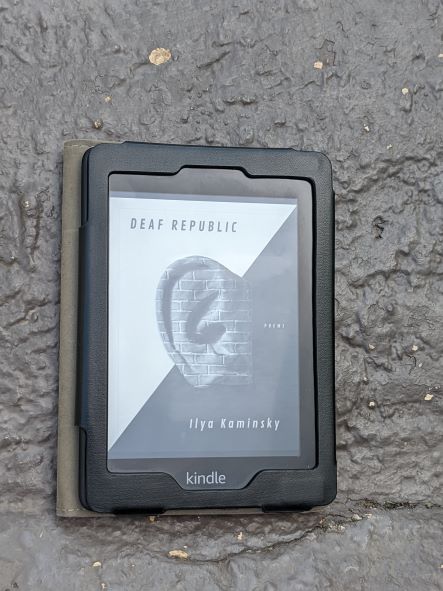
So you know that adage, the one that says something like if a book doesn’t grab you in the first few pages then don’t read it, it doesn’t have anything to say or it isn’t well-written? I never pay attention to it. And I’m glad I don’t, because if I did I never would have read this.
There’s a lot of things I could say about this collection–it’s award-winning, highly critically acclaimed, and Kaminsky is apparently a luminary of some note in poetry circles. But to be completely honest, none of those things are ever interesting to me. What did interest me was the exploration of deafness as protest and the promise of a poetry collection with an over-arching story, and how the poems themselves made me feel.
The first few poems in this collection are technically brilliant and heartfelt. They also made me roll my eyes because — ugh. More misery as art? More pessimism and unnuanced human ugliness and general white dude dread projected onto the whole of human experience? I mean, c’mon, more depression poetry? Sad disability poetry? War poetry, written at a time like this? Even coming from a Ukranian-American poet I wasn’t into it.
But then I got to the last poem and thought–oh. OH. I was so wrong. I was so wrong I felt a little ashamed, and had to examine a bit of an empathy void within myself I didn’t know I had(a lot of good poetry does that to me). I realized that this story–of a village that goes deaf in protest during a war, and the painfully short lives of its embattled, occupied citizens, who all seem to die as soon as we get attached to them–is broader than it seems. It’s tied to a specific time and place and viewpoint, but the underlying cry, to protest, to live and love and protect each other even in the face of suffering and oppression, is a universal one. (Side note: Apparently the poet is also hard-of-hearing himself, which adds an extra level of dimension to this work.)
It’s a grim, gritty read full of sorrow and shock(I gasped out loud at a few stunning lines), but it made me think and feel and shift my thoughts around looking for any rotten spots on the ones that have been stored for too long.
(Beautiful people!Welcome to the first review of the year! There’s more to come of course–if you enjoyed this one, take a lookat this list of some of my other poetry favorites. Remember that any clicks/purchases that start from this blog will result in a commission being paid, and it’s how I buy more books and write more books. If you don’t like poetry but still made it this far, go ahead and check out the rest of the Equal Opportunity Bookshop. Whatever you do, be sure to go read something good! Peace!)
So I’ve been asked before why I don’t start a book club.
My answer is usually “ugh, I hate book clubs,” which is not entirely true, but also not entirely untrue.
But I (obviously) do like talking about books and want to add a lil more community to this diverse reading on the internet life, so I thought I’d do a monthly reading challenge instead. I don’t want to tell folks what to read. I want to inspire you to go find diverse books you love, and this is the best way I can think to do it.
Here’s how it’ll work: every month I’ll give you three suggestions built around a theme. If you’re inspired, read something that fits and then let’s chat about it in a big wrap up post at the end of the month.
Or not. I can’t tell you what to do. I got this idea like 10 minutes ago(a lie meant to cover up my lack of graphic design expertise) so we’ll have to feel it out together. 😜
This month’s theme is memoirs. I feel like pandemic life has made it increasingly hard for us all to relate to the real stories of people very different to us and the internet echo chamber has made it easy to only read stories of people like us. So let’s challenge ourselves to read the true story of someone very unlike us, and see what we find there.
The prompts are:
A memoir by someone you’ve never heard of before.
OR
A memoir in translation
OR
A memoir by someone really different from you.
What are you thinking of reading? I’ll probably read either Cindy Wilson’s Too Much Soul or Misshna Wolf’s I’m Down. One is about a Korean transracial adoptee in a Black American family (a very different experience), the other is about a white woman who grew up in a Black community( very different to me AND I’ve never heard of her before).
If you’re really stuck for something to read I’ve made a booklist, but the usual disclosure applies; I have an affiliate relationship with Bookshop and if you purchase something from there using a link you got from here, I’ll be paid a commission.
Tell me what you’re reading in the comments!
(Beautiful people! I managed to work my usual P.S. notifications into the text of the blog this time so uh…peace! Go read something good!)
2021 is over in four days, fellow readers. I have been wearing the same pajamas since Christmas day, drunk twice my body weight in hot chocolate and watched every movie from my childhood on a reality-bending loop. Let’s dispense with the pleasantries and get into the links so that we can all get back to the important business of being lost in the pleasantly fuzzy time between Christmas and New Year’s.
First off, hey look! Up in the top of the post! It’s not a bird! It’s not a plane! It’s just me, and I’m teaching a class in March about Black women in spec-fic. Sign up for it–I’m working hard on materials and reading for it, and would love to see you there. [Midnight & Indigo]
What on earth are these? LitHub has put together a list of dreadful book covers on classic reprints and…ugh. Get a load of those Dorian Grays. [LitHub]
BookRiot has released their addictive free book tracking spreadsheet. I’ve used it two years in a row and LOVE it. With a little editing, you can customize it to datafy all of your reading. Trust me, it’s more fun than it sounds. [Book Riot]
I said this was a quickie, and I meant it, fellow readers. If I can crawl out of the bottom of this cocoa cup I hope to do an end of year wrap up post–watch this space.
Here’s hoping you have a wonderful, safe, and well-celebrated transition from 2021 to 2022, everyone.
So this is not the Christmas post I had originally intended. I had this whole thoughtful post/review about Charles Dickens’s A Christmas Carol planned out for today.
I was going to tell you about how I re-read it every year at Christmastime, and how I have large chunks of it basically memorized as a result. I was going to tell you about how much I love the way Dickens uses descriptive language in the book, and how surprised I was to see that the numerous film and television adaptations are, for the most part, really just putting the words and story directly on the screen. I was going to explain how it’s not really Christmas for me until Scrooge tells Marley he’s more gravy than grave, and Tiny Tim blesses everybody.
Then I was going to go into this whole thing about how A Christmas Carol is a rare true classic, bound to a very specific time and place and cultural context yet somehow so universal that you can (and people have) tell the same story with the same characters in entirely different contexts and it still works. A Christmas Carol is decidedly English, Christian, Londoner, and was originally written in response to the horrible child labor and exploitation Dickens personally witnessed in his lifetime. Yet, whether by luck, intention, or the very rare gift of being able to mind his own business, Dickens managed to write a book in 1843 that portrays disability kindly, is not only sympathetic to but empowering for poor people, shows loving community-based spirituality, and doesn’t contain any of the racialized language that was widely accepted at the time. All that, and it has ghosts, a surprising amount of humor, and one of the best main character arcs of all time. It’s truly a Christmas miracle of a book.
Yeah. I was going to do a post about all that, but I cooked this epic meal and ate it all in my Christmas pajamas and have just been lazing about in front of movie musicals, video chatting with my people since then–so I was just too tired to write it all out and post it.
So I guess it’ll just have to wait until next year.
Hope you’re having a lovely Christmas if you celebrate, and a great weekend if you don’t, beautiful people. Peace!
(Merry Christmas, fellow readers! That’s all for today.)
Eleven-year old Raisin Stackhouse loves Prince, her younger sisters, and history. She’s a responsible kid who does odd jobs for neighbors in her South Carolina tourist town, so when Effie Pfluggins, the church secretary, calls her over to help clean graves in the town’s old cemetery she agrees. The cemetery holds the remains of the town’s Black residents going all the way back to slavery, and some of the stories Miz Effie has to tell get her and Raisin a little more attention than they bargained for.
Despite its cemetery scenes, this book is not a ghost story. Instead, it’s about how important oral history is to American communities, and how easily the truth can be twisted if people forget their real history. It’s also about a close-knit Black community in a small coastal town, and how rejuvenating it is for them to rediscover their history–the good AND the bad.
This book was written in the ’80s but it still has a lot to say about listening to the stories elders share with us and remembering history now. I first read this as a kid and it got me so interested in family history that I walked around with a pen and notebook annoying everyone for an entire summer.
But…this book was written in the ’80s. It’s a bit dated. Hilarious references to jheri curls and jelly shoes are on every other page. Those are fun but mores have changed and it shows. Raisin and her friends are a lot more free-range than any kid is now. One of Raisin’s middle-school friends has a very inappropriate crush on an older kid–things like that were talked about very different 40 years ago than they are now, and that subplot is extremely uncomfortable to read in 2021.
YA and middle grade were very different genres back in the day, and one thing I like about this is how unprocessed it is. The plot’s a little sloppy, there are all kinds of side stories, the narrative is sometimes a little too authentic, and Raisin-as-narrator is smart, but not precocious and far from perfect. The book is a little raggedy around the edges and probably wouldn’t be published now. It’s not slick and commercial enough. Shame, since it’s also got a great story, realistic characters, and a joyous ending.
I love this book, for both its joys and imperfections. 5 stars and a genealogy chart to The Secret of Gumbo Grove.
(Fellow readers, beautiful people, and assorted trolls–happy Winter Holiday Week! You may have already celebrated, you may have a holiday coming up, or you may not celebrate at all. Whatever you do, I hope you find yourself, at some point, curled up with a good book and surrounded by love.
If you want to see a list of other YA novels I love despite myself, click here. Also, this is the part where for legal reasons I must remind you that this blog has affliate relationships with sites like Bookshop and if you click and purchase anything from a link on this site, a commission is earned–and then I go buy more books. Merry Christmas, y’all. Peace!)
You may have noticed things have been a bit sparse around here lately. I haven’t posted on the blog since November, and whileFacebook, Instagram and TikTok have been ticking along steadily, to be honest, I haven’t been posting with my usual joie de vivre.
There’s a couple of reasons for this, but the biggest one is that I simply find the internet at Christmas exhausting.
I know I seem like a bit of a Grinch, but it seems like as soon as mid-November hits, every presence on the web is trying to sell you something, convince you of an ideology, or otherwise promote their thing. Every bookstore wants you to take advantage of their free shipping, every e-mail has a Christmas shopping hook and every influencer is sponsored by something red and green and sparkly and acquirable for the low, low price of something ending with 99. Even people who aren’t overtly trying to sell you something don’t hesitate to remind you that the holidays are a special time and you should think about giving to charity A or think about believing in ideology B and so on and so forth.
It’s a lot, and I just don’t like it. I don’t want to participate in it. I get a bit in my head about certain things anyway, and part of my extreme distaste this year is because this is my first year back in the USA for Christmas in over a decade. I forgot how full-on and (frankly) fake American Christmas can be. The reverse culture shock plus the relentless Christmas promotional free-for-all are just entirely overwhelming.
Since I haven’t been able to figure out how to navigate the internet without inadvertently adding to the beg-a-thon, I’m just kind of opting out, for the most part. I’ll talk about my yearly read of A Christmas Carol and a few other things, but I’d rather just pop back up full force and feeling it in January to brighten the book talk room when we all have the post-holiday blues.
So I’m here, but kind of underwater.
With all that said, let’s get into some bookish news from the last few weeks.
Anne Rice passed away. I’m not even sure what to say–she’s been such a presence in the world of books for such a long time. She was 80 years old, and the tributes and memoriams are pouring in, rightfully. [CNN]
Book banning controversies are still plaguing much of the USA. I honestly am having a hard time wrapping my head around this, and many other things that seem to have become acceptable in post-Trump America. Without getting too deeply into my own thoughts right now, I’d like to share this roundup of authors sharing their thoughts on this situation. [ABC News, NCAC]
The TRIAL!
Amazon Prime’s series adaptation of The Wheel Of Time is well and truly underway. My feelings are that the show is very pretty to look at, and the diversity makes more sense than that of any fantasy series I’ve ever seen on film before, but the show itself bears little resemblance to the books. I feel like I’m watching a high budget extended fan fic adaptation. Still, I plan to keep watching. Will you? [Amazon Prime]
I lived in Manchester for some years, and I really loved the way that diversity was often brought into the arts and entertainment scene there. The city government has recently started an initiative called See Myself In Books, which promotes diverse literature in schools and libraries. The most interesting thing about the program, for me, is that the preliminary research showed that white children felt just as underrepresented as BAME children in books. It just goes to show that diversity is natural and that even the status quo doesn’t serve the people it claims to. [Manchester City Council]
Last week, the whole internet was horrified by the news that the convicted man at the center of Alice Sebold’s best-selling memoir Lucky, was in fact wrongfully convicted. This, of course, means that he was wrongfully identified by Sebold. While I’m in no way attempting to negate any of the horror of the assault she suffered, I do remember reading bits of that book in a college lit class and thinking that her description of the process of identifying her attacker sounded a bit suspect. I’m not the only one asking questions–a lot of people who read the memoir are asking why this wasn’t caught sooner? [The Cut]
Okay, one final news story and it’s a Christmas-y one. Read Brightly has put together a gorgeous list of children’s books celebrating all kinds of winter holidays that is well worth checking out, fellow readers. [Read Brightly]
That’s it for this week’s semi-regular roundup of diverse bookish news, folks. I hope you’re prepping well for your winter holidays and surrounding yourself with love, peace, and joy.
Also, I hope you’re not buying anything you don’t need or want. Notice I’m eschewing the usual affiliate links and end pitch for this blog post. Don’t fall for the Christmas sale hype!
I’ve done a little bit of work around the subject of decolonization. I’ve contributed to papers, taught class units, and read a lot of writing from Africa, Asia and Indigenous Oceania on the subject.
Yet it never really dawned on me that the academic convention is to frame colonization from the point of view of the colonizers, not the formerly colonized.
Consider my mind blown.
This book, meant to be a primer on the topic of decolonization, is firmly in the colonizer camp. It starts by positing the American Revolutionary war as a decolonial war–which it was, but it was simultaneously an act of colonization and that isn’t explored at all. From there, the book mostly skims the surface of decolonial and anti-colonial movements after WWI and WWII. It covers a lot of ground, both geographically and ideologically, but overall, it’s way too sympathetic to colonial powers. For example–the old chestnut of colonized people somehow not being capable of self-government is trotted out in a few different jackets, but the only explicit mention of the human rights atrocities that often accompanied colony-building is a brief mention of Japanese activity in Southeast Asia, as though Belgium and Britain and Russia never existed. There’s also virtually no discussion of the economic consequences of colonization for liberated polities, but confusingly there’s a lot of discussion of the post-colonial nation state without really getting into the artificial borders and balkanization imposed by colonial powers, at least not satisfactorily.
As a primer this is thorough, but very misleading. 2 stars and a bottom-up curriculum to this Very Short Introduction.
Oh and happy Thanksgiving to those who celebrate. Happy Gratitude Day, Family Hangout Day , or just….Thursday to the rest. Peace!
(This blog has affiliate relationships with Bookshop and if you purchase anything there from a link you find here, a commission will be earned. Peace!)
After the last update involving phone carnage(which has since been solved…grudgingly) this week’s quickie diverse book info roundup is a more mixed bag than usual, fellow readers.
Let’s start with this great list of diverse comics from Cultured Vultures. It includes all sorts of genres and points of representation, from the Count of Monte Cristo in space to bureacracy in the Indian afterlife to Korean androids as adoption metaphors. It’s a great list and you should definitely check it out. [Cultured Vultures]
This is actually old news now, but DC Comics is reviving their Milestone imprint, which is where we got classic Black comic characters like Static. The revival includes a development program for Black comic artists and writers, a new anthology, and maybe a few movies in the works. [Bleeding Cool]
Asian diasporas are having a moment in literature and film right now, and rightfully so. The Margins has been running an Asian flash writing series for over a year now, and LitHub has thoughtfully provided us all with a retrospective conversation with five of the writers involved. [LitHub]
I stumbled across a copy of the short story collection Who’s Irish in a library many years ago and at the time, it was one of my favorite reads. I was delighted to find out last week that Gish Jen is still writing, and reading her own short stories aloud for The New Yorker. Not a spoiler: it involves fraught Chinese mother-daughter dynamics. [The New Yorker]
Speaking of fraught Asian family dynamics, Kim Thúy’s new novel Em is getting an huge amount of positive press and reviews. I admittedly haven’t read much by the Vietnamese-Canadian writer, but apparently this book manages to pack the story of a displaced, estranged Vietnamese family within the larger story of French colonization and the Vietnam War, leading into a refugee tale. It sounds incredible, and I’m looking forward to getting my hands on a copy. [Asian Review of Books]
That’s it for this week, fellow readers. As always, find all these books and more in the Equal Opportunity Bookshop, but remember we have an affiliate relationship and if you buy anything from link on this page, a commission will be paid. Have a good week and read something good! Peace!
Black boys are precious. Let me say that again. Black boys, and the men they grow into, are precious.
It happens to be International Men’s Day today. As a result, the internet is full of Things About Men, good, bad, political, personal, and all points in between. I find myself thinking about the men I know and love in my life. A lot of those men are Black. I have two brothers and three giant man cousins, all much younger than me, and I think often of what they were like as boys. (They were cute. It’s hard to believe, looking at them now.) I remember how difficult it was for them to become men in the present world, and can only guess at the cultural and social pressures they navigate trying to be good men. I know that it’s popular to poo on the patriarchy, and with good reason. (I’m a Black woman, so duh.) But a systemic problem is not the same as a personal deficiency.
In other words, I like men, I like Black men, and I think y’all are precious and deserve love and care and tenderness and appreciation without reservation. You also deserve to be heroes, which is something I didn’t realize is often lacking in books until recently. I was speaking to my brothers about Black heroines in fantasy and one of them pointed out that he couldn’t name a single fantasy novel with a Black man or boy as the hero.
I have to admit–he stumped me for a while, but I am the Equal Opportunity Reader, after all. I found some books and series that feature Black boys as the heroes. These Black boys save the day, get the girl, and have the big moments of awesome. All of these books are by Black men, and all of them include, love, happiness, #blackboyjoy and plenty of adventure.
Before I get started, I want to share the poem that inspired the title of this blog, by the brilliant Danez Smith. It’s called “Dinosaurs in the Hood” and the last lines always bring a smile and a sigh. You can find it, and other stereotype-defying, joy-bringing verses in his poetry collection Black Movie.
The only reason I want to make this is for the first scene anyway…
If you want to see all of the books I’m about to talk about in one easy place, check out the booklist here.
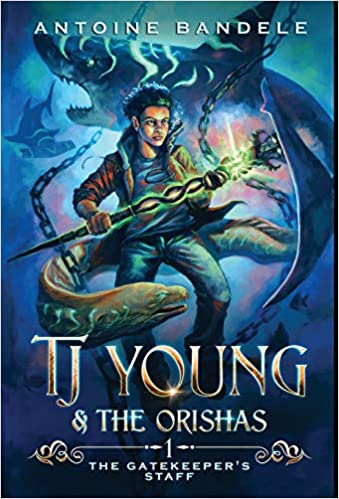
Is it okay if I start with my favorite book from this list? I’ve sung the praises of this on every possible platform and I’m not going to stop until the next book in the series comes out. (Then I’ll start hyping that one up!) TJ Young’s adventures are enormous fun, a wild mix of magic school, supernatural adventures and Afro-diasporic cultural play that ring every fantasy bell I possess. As a bonus, protagonist TJ is a really nice kid, the kind who rarely gets to be the hero in any kind of book, let alone a blackity-black YA fantasy. If you only read one book on this list, make sure it’s this one. Find it HERE.
I read and reviewed this pretty recently, and it was another pleasant surprise. It’s a great companion volume to TJ Young–it has similar magic school and supernatural themes, but adds in a hefty dollop of superhero shenanigans and a sprinkle of Yu-Gi-Oh. It’s another fun, joyous adventure that features a good kid with a gift that he’s not sure what to do with except help. While it’s not as polished as some of the other books on this list, I had a lot of fun reading it and kept thinking how much I would have loved to have a book like this when I was an elementary school nerd. Find it HERE.
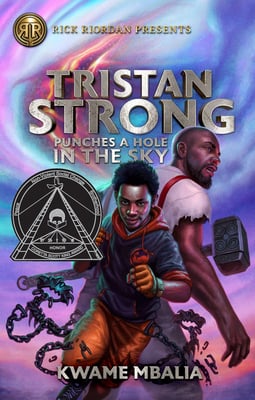
This is probably the most famous Black boy hero series on this list and the first one from a mainstream publisher. Chicago middle schooler Tristan accidentally gets himself embroiled in an otherworldly conflict that seems to involve every key figure of Black American mythology, from Anansi to Brer Rabbit to John Henry. It’s a remarkably culturally literate series packed with history, but instead of being preachy or teachy, it’s exciting, fun, and often hilarious. There are three books in the series, each with a very different story; Tristan Strong Punches a Hole In The Sky, Tristan Strong Destroys The World, and Tristan Strong Keeps Punching. Find them in my bookshop HERE.
This book is meant for much older kids and teens than the previous ones on this list, and it has a much more serious, far less fun tone. It’s a disturbing suburban ghost story, full of hauntings and depression and racist bullying. It also has a sweet first love subplot and a very epic hero showdown at the end. Jake is not my favorite main character on this list, but I appreciate his page presence because queer and neurodivergent Black boys need to have hero moments too. He has his fair share, and gets the guy, to boot. Find it HERE.
This book is thoroughly unlike the others on this list in that it’s written for adults and rather than being a straightforward adventure, it’s an extremely sweet and gloopy romance. However, it’s told from the perspective of high school senior Jack, who gets stuck in a time loop trying to save the college girl he fell in love with at first sight. It’s an adventure, there’s a science fiction element, and it’s also a romance written by a Black man, from the perspective of a Black boy. It’s complex, and that complexity earns it a spot here for the more mature readers. Find it HERE.
It’s not lost on me that all of the books on this list were released in the past two years. The current publishing diversity renaissance (long may it last!) has opened the gates wide for Black boy joy and adventure, and I hope we see a lot more Black boys as the hero in new books this year and for years to come.
(Beautiful people, we all need a hero sometimes. Hopefully, you find a good one in this list! To see other booklists by me, click HERE. To support this blog so I can make lots more random booklists, check out the Equal Opportunity BookshopThis blog has affiliate relationships with Bookshop so if you purchase anything there, a commission will be earned. I’ll probably just buy more books with it. It’s up to you if you want to enable my habit or not. While you’re deciding, make sure to read something good! Peace! )




 Peace!



 Equal Opportunity Reader