
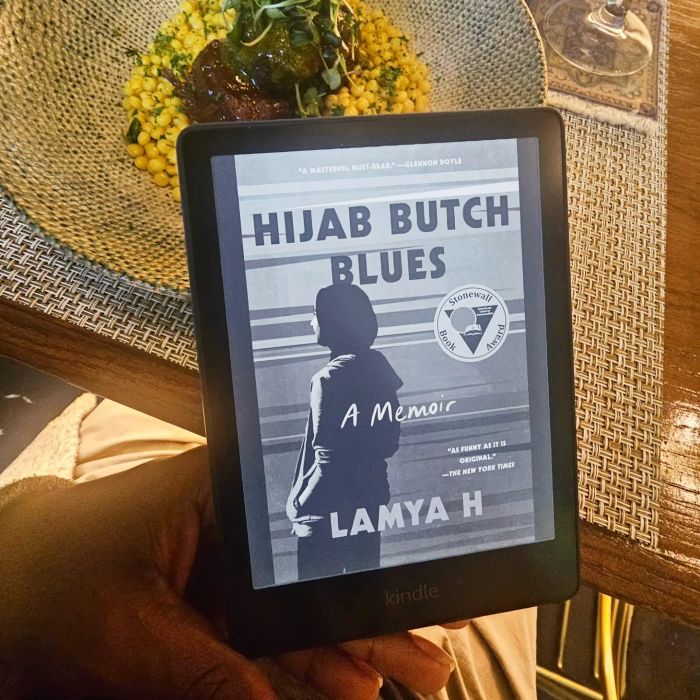
(Buy this book at Bookshop, please.)
Read time: 3 minutes
If it weren’t for religious devotion–specifically, deep study of the Quran while growing up South Asian in an Arab country and later being a hijabi immigrant in post-9/11 New York–Lamya H might never have fully realized her own queerness. Through careful examination of the Surah interspersed with identity-marking moments of her own life, this memoir explains how the author came to an understanding of what it means to be queer and religiously and culturally Muslim in the orthopraxy of life as well as in ideology and identity. This is a book about how someone is queer and Muslim in the nuts and bolts of life, not just the ideology.
I really wasn’t expecting this book to be as deeply theological as it is. I learned more about Islam from the heartfelt exegesis in this book than I did from years of interfaith meetings back when I worked for a multicultural church. (Long story.) Religion is very much the cornerstone of Lamya’s life, and the reverence with which she explains and connects key figures of Islam to her journey as a lifelong soul-searcher is incredible. She understands herself so clearly through scripture that there’s never really a question of if she can be both Muslim and queer, only a gracious, continuous examination of how. All of this is built on a foundation of religious practice in honest community. (The community building bits are predictably some of my favorite parts of the book.)
Along the way, Lamya also manages to learn how to navigate romance, family relationships, immigration woes, tenuous connections to nationality, and the psyop madness of grad school. She’s transparent about the realities of all of these things, but writes under a pseudonym and carefully elides a few potentially identifying details(no countries or institutions are directly named, for example.) The emotional and spiritual honesty shared here is enabled by a careful, protective privacy that I both understand and respect.
I finally picked up this book because I kept hearing wonderful things about the writing, which were all true. I was also genuinely curious how one can be both butch(masculine) and hijabi(heavily gendered in a feminine way). That question is never really answered directly, probably because Lamya is so focused on the spiritual side of things that there’s not much space for deep queer theory, too. Or perhaps
Continued strength on the deen to Hijab Butch Blues.
(Fellow readers, books like this are why I love reading. Something about sharing a very specific, nuanced life experience with the expectation that it will resonate with people both within and outside of that experience without overexplaining because we are all our #ownnormal, is my jam, and hopefully yours too. If you want more books like this, browse the site, I’ve been doing this for years. Or check out the Equal Opportunity Bookshop. Just be aware that anything you buy from a link on this site will earn us an affiliate kickback, which is used for chewing gum and bookmarks. Now, go and read something good. Peace!)

