[Hear Me Out] Wicked Is Kinda Bad, Actually

So I finally saw Wicked: For Good, the second installment of the film adaptation of the stage adaptation of the novel by Gregory Maguire, which is itself a gritty reboot of both Frank L. Baum’s Wizard of Oz novels and the 1939 MGM film.

I have a complicated relationship with all things Oz. I hated the 1939 MGM film as a child because even then, something about the place just struck me as fundamentally…off, despite the fascinating movie magic. I read many of the books but Oz was never one of my favorite fantasy worlds, despite how wacky and creative it was. It wasn’t until I saw the terrifying 1985 sequel Return to Oz that things began to make a little sense. When I found out, as an adult, that L. Frank Baum had written some literally screaming genocidally racist editorials (that modern-day fans are perpetually trying to excuse him for) some of the themes that always bothered me about his worldbuilding began to make more sense, in a way.

Then along came Gregory Maguire’s Wicked. I read it in my teens, liked the revisionist concept and its embrace of the psychological darkness lurking behind Oz, but ultimately found it a bit too nasty and mean in execution without ever really coalescing around its central concept enough to make the horrors in the text worth it.

When the stage show came along. I was fortunate to work at a theater that workshopped very early versions of it in the early 2000s. I remember being really furious at how all of the darkly rendered racial, political and cultural justice overtones of the book had been subverted in favor of a twee love triangle and some really basic pop songs. I especially hated how it whitewashed Fiyero, who was one of the more interesting book characters. I wanted some of the nastiness of the book to work its way into the musical–it would have been much more interesting if so.

Now we have the film adaptation. Two of them, in fact. And they’re alright, I guess?

Wicked and Wicked: For Good are still doing too much and not enough, just like the stage show, the book, and everything else built around the Oz concept except Return to Oz, in my opinion.

Let’s break it down a bit…but before I do, know that my guiding principle for engaging with folks on the internet is You Are Already Smart. I’m not here to tell you what to think, and I’m not even interested in trying to. This is not going to be a long tiresome exegesis in which I try to bludgeon home points about Wicked’s racial politics, literary themes, or whether or not the people who wrote it, star in it, or like it are good people. This is just a commentary post for folks who have experienced at least two iterations of this story(preferably the book and the movie). If I should happen to drop a few nuggets of intellect in between the jokes and strong opinions, then so be it. Don’t act a fool in the comments, because I’ll cry and then I’ll block you.

And so…

First, the Good Witch Stuff…

  • At first glance, both films look nice. They’re pretty, even when what’s being portayed is ugly. They have a plasticky, Barbie movie aesthetic that doesn’t thrill, but doesn’t offend, either.
  • Cynthia Erivo and Ariana Grande both sing and perform well.
  • The costumes are amazing. Great gowns. Beautiful gowns.
  • It’s nice to see how easy it can be to include accurate visual Blackness on film now, even when the film is not really about being Black. Um…can the flying monkeys microbraid? Cause how are Elphie’s edges always so fresh up under that hat?
  • I think that there is a large demographic of isolated little Black girls and other kids who are “different” in normative spaces who will get a lot out of this film.
  • The music is perfectly acceptable–even the new songs, which I’ve already forgotten.
  • It tries very hard to be about something, and expand on the original work’s themes in a relevant way.
  • If 72-year-old Jeff Goldblum tap-danced up to me in that green suit and crooned that I was a dark-eyed beauty, I’d have about 7 green babies for him.

The Bad Witch Less Pleasing…

  • Turning a two-hour stage show into TWO three-hour movies is an egregious cash grab.
  • Hearing folks say “Shiz” out loud 700 times makes the Naming Problem that the book had all the more evident.
  • Fiyero is still a dull, nerfed character outside of the books, despite being played by Jonathan Bailey.
  • The political and social overtones are also dull and the inclusion of a few scenes of talking Animals lean a little too heavily on viewers having the back story. If I hadn’t read the novel, I wouldn’t have gotten a lot out of their story until the second film, and that’s far too late.
  • Whatever statement Wicked is meant to make is drowned under so much pink, soft-focus syrup that it really just feels…weak. That’s not an anti-pink statement, I love pink. I don’t like using pink as a softener rather than as a statement.
  • Speaking of actors doing their best technical work, the performances are good but everyone feels like they’re in a different movie. This is especially apparent in any scene including Jeff Goldblum(for whom I would have far fewer green babies for by the time we get to the end of the second film). They’re all competent actors but you can tell he’s the only one here who specifically learned on and for the big screen back when there were still blockbusters. Also there’s a scene where they briefly digitally de-age him and it’s weird because we all know what Goldblum looked like when he was younger and it wasn’t like that.
  • I love Michelle Yeoh down and I totally get why Jon M. Chu would want a legacy Asian actress in the cast. (And also Bowen Yang, the most elderly college student in Oz). But there are legendary Asian grand dames who can sing, though. Faye Wong is still working. Margaret Cho can sing. Hell, so can Lucy Liu. Just sayin’.

The Absolutely Bonkers…

  • Let us have a moment of silence for all the busy parents who are going to be putting a copy of the gritty, pessimistic, decidedly adult novel Wicked under the tree for their 10-year olds this Christmas because the movie tie-in cover is pretty and Ariana Grande’s Nickelodeon shows still pop up on streaming platforms.
  • The dialogue in this is stunningly bad. Bilious, even. Even though the actors do their best, it can’t be saved in a lot of cases. Even the bits that were lifted straight from the stage show really should have been reworked for the film. For example:
    • Fiyero: You’re beautiful.
    • Elphaba: You don’t have to lie to me.
    • Fiyero: (Big moony eyes) It’s not a lie. It’s just a matter of seeing things in a different way.
    • Me, in the theater: (vomits profusely) WHO SAYS THAT? WHO WROTE THAT? I wish a white boy would say something like that to me in bed. He’d never see my face again, let alone any other part of me.
    • Elphaba: I truly feel Wicked™!
    • Me: (barfs)
  • Don’t even get me started on “Guh-linda”. Ariana Grande gives a great performance, but that character is absolutely terrifying. The fact that she’s presented as a sympathetic savior who made a few oopsies makes her all the more frightening. You and I both know that six months after the Disney-fied scene where all the animals come out to play, Glinda makes a hard right turn and becomes a worse autocrat than the Wizard ever was, bolstered by her frantic need to keep her secret magical incompetence from being discovered and her inevitable bitterness towards successful Animals. (The books had the guts to get into this at least a littlee bit.) I know that her heroic arc and the Disney ending are both from the stage show, but there were some rather thoughtful changes to the Animals storyline for the film and I don’t know why that same care wasn’t given to Glinda. It was really jarring to see that ending survive the film unvarnished, especially now that Elphaba is both Black-coded and actually Black. Seriously, Glinda is deeply, disturbingly, Missy Anne level triggering.
  • Also, why are they friends, anyway? None of the relationships in this movie feel connected or even interesting except Boq’s, and arguably that’s only because they’re all tragic. Everyone else’s interactions are just there to set up the songs. The film is very pretty and excellent on a technical level, but isn’t everything, these days? Every major studio film looks good, now. We’re in a golden age of craft, technical proficiency, and visual execution, even when the CGI is kind of bad. Where modern film suffers, though, is in exploration of themes, plots, and relationships. Wicked, unfortunately, doesn’t stand out from the pack in this. It’s big and expensive and ultimately, very emotionally dull.
  • Above all, the film never does a good job of convincing me why Elphaba, personally, would care about being involved in anything going on in this film, or why anyone actually responds to her the way they do. Y’all got talking Bears, tall Munchkins, and your land is ruled by an actual wizard. Why on earth would anybody care about someone being green? Furthermore, why wouldn’t that green person, who can do magic and is smart, beautiful, and has 4 octaves as well as green skin, spend so much time around people dumb enough to loathe her instead of just Wicked-ing out from the start? I know why, but I honestly just don’t think that’s a very interesting story anymore. There are other, different stories about that kind of person in that kind of place, and the quicker we get to telling them, the better.

Wicked and Wicked: For Good aren’t vying for spots on my favorite film lists, but they were still entertaining to think and talk about. I can see why people love them, but they didn’t do much for me.

Even if you do love the films, I still think you should refrain from getting anyone under the age of 15 a copy of the book, though. There are Tigers in there. Tigers doing unspeakable things. Somebody dies. There is no softening syrupy pink overlay. Don’t do it, no matter how much your little one begs.

(Fellow readers! This article is an amalgamation of all of the posts about Wicked I’ve made in the past year or so over on Facebook. I know, I know, nobody’s on Facebook anymore. I still am, though, and if you are, feel free to follow for diverse book talk in slightly more real-time format. If you prefer faceless books, check out the Equal Opportunity Bookshop, but be aware that any purchases you make there earns me a little affiliate kickback. Whatever you do, go and read something good! Peace!)

[REVIEW] On Tyranny, by Timothy Snyder

(Buy this book here.)

This book has been everywhere since last year’s election in the US–indie shops, TikTok diatribes, little free libraries and coffee shop share shelves with snarky messages inked on the cover.

Something about the idea of a little book of twenty short lessons on how to stem the tide of tyranny, based on historical precedent, seemed necessary but also somehow smug. Nice white people wave this at each other triumphantly while complaining about other white people. That’s usually a red flag.

But I read it anyway, and it’s not bad–simple, forceful, eminently quotable and much more hopeful about the average citizen’s ability to enact positive change than I’ve come to expect from pop-politics.

But Snyder’s only reference points for historical tyranny throughout the book seem to be Naziism and Sovietization, which is…narrow, to say the least. His academic specialty is European history, so that’s understandable, albeit disappointing. The brief anti-tyranny booklist in chapter 9, however, contains a long list of white Europeans and Americans of varying relevance–from J.K. Rowling and Philip Roth to Hannah Arendt and Vaclav Havel. No-one from the global south. No colonial tyranny. Way too much George Orwell. Understandable but also…no thanks.

So I went to Threads and asked the hive mind there to help me create a more global anti-tyranny booklist. A host of kind souls took me by the hand and led me down a rabbit hole, at the bottom of which was Snyder himself, being a blowhard crackpot at best and a white supremacist hypocrite at worst.

This is one of those times when I both wish I hadn’t looked up the author and am glad I did. Snyder’s super weird, y’all. He’s written that the Holocaust was somehow Hitler’s response to climate change. His takes on racism have an overcompensatory hysteria to them (like how that one overly sincere white person you know sounds just before saying something highly racist. Precise, heartfelt, and just around the corner from some ol’ BS.) To top it off, after writing a list of lessons on how to stop tyranny from happening in the US, Snyder and his family relocated to Canada. How do you write a book telling us all how to calmly, steadily, do the work and then leave?

In a vacuum this is a good starter text. The info seems good, if noticeably narrow. There’s nuggets of hope and clear calls to action. But there’s also a lack of depth, many missing perspectives, and the author seems to be having a day in the sun more for reactionary reasons than for what he’s actually about.

A giant grain of salt and a little global perspective to On Tyranny.

One more thing: here the list of anti-tyranny recommendations from myself and the good folks on Threads:

Human Acts, Han Kang

Nervous Conditions, Tsitsi Dangarembga

You Have Not Yet Been Defeated, Alaa Abd El-Fattah

How Democracies Die, Steven Levitsky and Daniel Ziblatt

Paradise of the Blind, Duong Thu Huong

The Prince of Mount Tahan, Islam Hani Muhammad

Babel, R.F. Kuang

Glory, NoViolet Buluwayo

Discourse on Colonialism, Aimé Césaire

Chain Gang All-Stars, Nana Kwame Adjei-Brenyah

All of these books can be found in a handy-dandy booklist here.

(Fellow readers! This is a good example of a book I didn’t like that still managed to teach me a lot. I’d still recommend it, but not as much as the books on the list that my Thriends helped me put together. Speaking of—I’m on Threads and Tiktok much more than any of the other socials these days, so if for some reason you have a burning desire for random snotty book thoughts from your favorite neighborhood diverse book reviewer, that’s where they are. In the meanwhile, I have to remind you for legal reasons that if you purchase anything from a link you find on this page or from the Equal Opportunity Bookshop, we’ll earn a small commission. Thanks for visiting! Now go read something good! Peace!)

[Last While In Books] Short Fiction, Actually

Read time: 3 minutes

Fellow readers! I had a short story published this week over at Strange Horizons. It’s called Palimpsest, and it’s a look at the silences that cause strain in close relationships and the hidden injustice of women not being deeply known by their own families. There’s also some climate change, (poorly understood) A.I., and a little bit of near-futurism, too.

Anyway, I’m pretty proud of it (I started writing it back in early 2023 and it took a lot of revisions to get right) and wanted to share it with y’all. But sharing it alerted me to the fact that I have been woefully neglecting my own short fiction reading lists, so I got back into them and found some really good stories in the virtual stacks.

As a result, this week instead of bookish news you get a short list of notable speculative short fiction and poetry that I enjoyed, and hope you will, too.

  • Speculative poetry is…not really my jam. Despite the fact that I’ve reviewed a collection of it before, a lot of it feels kind of like hearing a friend shout at me in a language I don’t know very well from several rooms over. It’s welcome and familiar and I feel like I should get what’s going on, but it doesn’t quite coalesce. I say all of that to say that Angela Liu’s poem “The Language of Fireflies”, published in Psychopomp, was absolutely enthralling and I loved the way the language spun such vivid images despite my understanding gap. [Psychopomp]
  • I tend to prefer a long, loving epic myself, but I notice an uptick in publications that specialize in flash fiction(usually under 1000 words) and drabbles(under 100 words). It’s hard to write something short, sweet, and coherent, but Nico Martinez Nocito hits us with all of that and a good creepy scare in the 100 word tale “Thirteen Hours”. Fun fact–the author gives us a whole story in 100 words, and I’ve gone through ninety-three to try to get you to read it. They do a better job, so check it out.[Rat Bag Lit]
  • Ruth Joffre’s Woodpecker, Warbler, Mussel, Thrush is simultaneously one of the most heartbreaking, timely, and creative things I’ve read this year. It’s climate change fiction with a fantasy feel. It also hit me in the gut and made me feel remarkably sad and remarkably appreciative of what we have now, as well. You should definitely read it, and as a bonus, there’s an audiobook version as well. [Podcastle]
  • When I finished reading A.L. Goldfuss’ “Drosera regina”, I literally shut my laptop, sat back in my seat and said “Ay, yooooooooo!”, out loud. It’s about a woman whose body operates much like a carnivorous plant. I’ll let you read the story to fully understand what that means, but as a woman who has always struggled with the heartbreaking and seemingly inverse relationship between male desire and male respect, this story is horrifying, yet resonant in so many ways. [Lightspeed]
  • Neon And Smoke is a brand new magazine specializing in half-genre/half-lit flash fiction. They’ve only got one issue out so far but there are some good stories on the TOC, including Xavier Cole’s “She Peels A Soul”. It’s a creepy little gremlin story set in the confines of a truly bad marriage, and I enjoyed it. [Neon And Smoke]
  • Let’s finish off this list with a classic–Naomi Kritzer’s “So Much Cooking”, which is all about cooking during quarantine caused by a deadly pandemic, told in the form of a blog. No, really. In case you’re wondering, it was written in 2015, and despite being enormously triggering now, is still a story I re-read often.[Clarkesworld]

That’s it for this update, beautiful people. There are no affiliate links on this page, and all of these stories are free to read, so enjoy and share with your friends. Now, go read something good(I just gave you a whole list!). Peace!

[REVIEW]Several People Are Typing, by Calvin Kasulke

(Buy this book here.)

Read time: 2 minutes

Gerald is trapped in his work Slack chat. Literally.

While his body sits dormant in his New York apartment, his consciousness has been fully uploaded to the worst thing about every remote job in America. If he doesn’t find a way out, he’ll be in danger of staying there forever. His attempts to convince his coworkers it’s not all an elaborate joke are only slightly more successful than his attempts to get them to care. Only the AI-powered Slackbot offers to help, as it slowly gains consciousness…if not a moral code.

This book is formatted as one long series of Slack messages, and I’d be lying if I said it wasn’t a little triggering at times. It’s also hilarious, cleverly skewering all of the passive-aggressive two-tongued dishonesty and pointless unproductive dialogue that fuels many modern middle-class workplaces. Gerald’s coworkers are all struggling with keeping the right facade for their career’s sake, some more successfully than others. The brutal truth of Gerald’s predicament brings out a variety of responses, from disbelief to mockery–but they all start with an awkward inability to really engage on a human level, made worse by distancing technology and respectability-driven corporate politics.

This was a fun read with a sweet romantic twist at the end and a lot of genuinely funny moments, but I can’t help but feel miserable about how realistically bleak and emotionally nihilistic Gerald’s workplace feels. I laughed a lot, I rolled my eyes at annoying coworkers and their annoying messages, and I enjoyed the story. But there’s a point in this book where a character gets done dirty in a really disturbing way and then is promptly forgotten about by everyone else. Amidst all the witty takes on corporate upspeak and Slack subchannel drama, that one dark moment stayed with me and tinged the book with a Monday morning layoff kind of darkness.

Free my girl Lydia.

Paid time off and full benefits to Several People Are Typing.

(Fellow readers; interesting trivia about the author of this book, Calvin Kasulke. In addition to being a self-described “transsexual menace”, he’s also an associate publisher at LitHub, one of my favorite bookish sites. Which means his name is on the email newsletters I get every week, and when I first saw it I had a bit of a deconstructed Spider-man meme moment as I held up my copy of the book to my email inbox like…ohhhhh. Cool!
Anyway, Happy Halloween and welcome to the holiday season, in the US anyway. If you click on any links in the post and buy a thing, I get paid a commission. If you want to peruse books in the Equal Opportunity Bookshop, same thing. Thanks for being here–now go read something good! Peace!)

[Last While In Books] Rest Well, Miss Major

Apparently it’s literary awards season in the bookish world, fellow readers. That certainly snuck up on me, as did autumn and the fact that 2026 is only three months away. This literary news round up will focus mostly on that, but first there’s some sad news to share.

  • Transgender activist Miss Major has passed away at the age 79. I reviewed her nuanced, insightful memoir-in-interviews, Miss Major Speaks, just last month. Rest well–I know she’ll be deeply missed by many. [Miss Major]
  • Tanqueray, the flashy former burlesque dancer whose viral turn on Humans of New York led to her life story being published, has also passed away, at the age of 81. I really don’t care for the moralistic tone Brandon Stanton took in his HONY post about her life, so I won’t link to that, or any of the lazily written obituaries that quote him extensively, here.

And now on to awards season.

  • The 2025 Nobel Prize in Literature has been awarded to Hungarian writer László Krasznahorkai. I’m not ashamed to admit I never heard of the guy before last week–the wonderful thing about being a reader is that there are always great “new” writers to discover. The Swedish Academy’s descriptions of his work make it sound quite dark and experimental. [Nobel Prize]
  • The National Book Award finalists have also been announced, and seem to still be reflective of diverse bookshelves and perspectives. [National Book Awards]
  • Last month the Booker Prize shortlist was also announced. Notable entries include Kiran Desai’s magical realism about Indians in America(she won back in 2006, as well) and Susan Choi’s novel reflecting her experiences of growing up Eurasian in the midwest. [NPR]

One more thing before we go…

  • Shirley Jackson Award winning author Zin E. Rocklyn is raising support to attend the Under the Volcano Guided Writer’s Residency next year. Slide a few dollars to her GoFundMe or buy a copy of her horror novella, Flowers For The Sea [GoFundMe]

And that’s the diverse bookish news from the last little while, fellow readers. If you buy a book from any of the links on this page, we’ll get paid a commission. If you want to buy a book that puts coins in my pockets, but none of the books featured here, check out the Equal Opportunity Bookshop. Now, go and read something good! Peace!

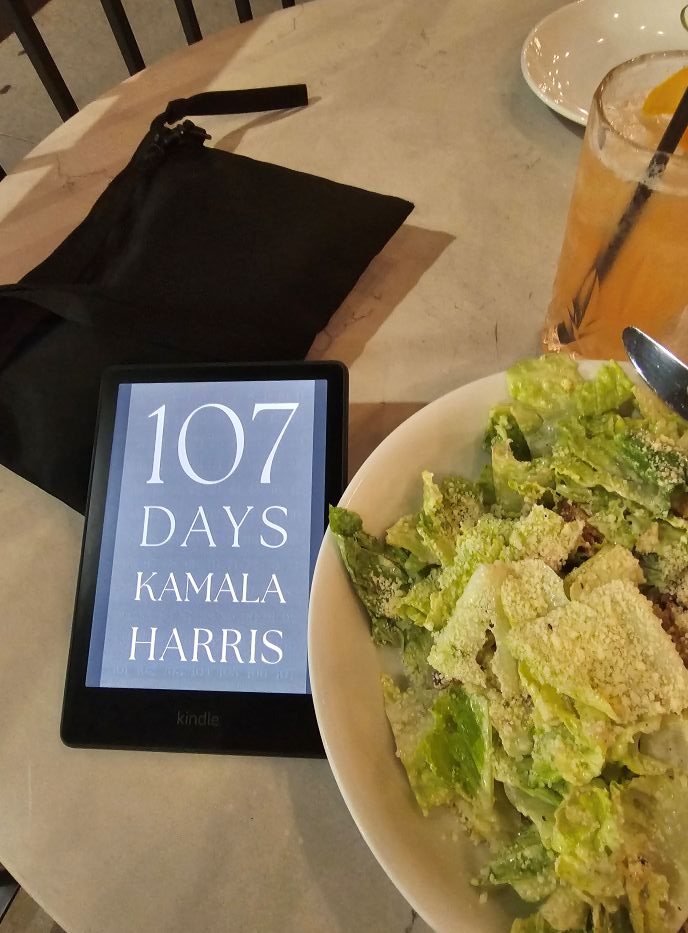
[REVIEW] 107 Days, by Kamala Harris

[Buy this book here]

Read time: 5 minutes

On July 21, 2024, Kamala Harris was informed that President Joe Biden was dropping out of the race, choosing not to seek re-election. With only 107 days until the vote, Harris accepted the support of the Democratic party and ran a frantic, flawed, and hopeful campaign opposite Donald J Trump. 

We all know how that turned out. 

Listen, endless navel-gazing takes on this are all over the internet. Everybody has something to say about Kamala Harris and her book, whether or not they’ve read it. I almost didn’t write this review because what could I possibly add to the political dissections and cultural critiques out there?

What I will say is this; like most American Democrats, Kamala Harris is really a diet Republican and that shows here. Much of this book is politicking after the fact. Her stances on Gaza and trans people are annoyingly vague and wrongly focused in a dangerous, deadly way. Her stance on gun ownership is surprisingly cogent. She’s surprisingly transparent about the mistakes she’s made, when she realizes them.  She name drops a lot of celebs and thanks a lot of people in her personal circles. She blows a lot of well-deserved smoke in Trump and Vance’s direction, and says extremely little about the Obamas. 

But memoirs are also about who a person is, not just what they do. And y’all…Kamala Harris is hurt. It’s etched in every page of this. At the heart of it all, Harris is a Black multiracial woman who worked hard, believed in the system, contributed to it, ascended through it and eventually became the best person available for the biggest job in her field. Yet she still lost to a foolish, immoral, underqualified convicted felon with a proven track record of failure, incompetence and dishonesty. Ultimately, that’s who most of America understood and related to. Kamala Harris, on the other hand, is still a target of suspicion, scorn, doubt, and impossible purity tests that no-one else in her position is required to pass. If you believe this book(and I do) Biden and his family also screwed her over behind the scenes, and it’s painful to see how she navigates acceptance of this with her obvious respect for the man and his office. It’s also disheartening to see that even as Vice President, Harris was subjected to all of the attendant micro- and macro- aggressions that every Black and Southeast Asian woman in America endures at work, only on a greater scale and under closer scrutiny. The election was a nasty, nasty wakeup call for Harris and much of America, and her literary tone is a bit groggy in the aftermath.

During the campaign, I mentioned on social media that I’d read J.D. Vance’s book, long before he grew a beard and lost whatever small shriveled semblance of a conscience he had prior to joining Trump’s ticket. Nobody cared. When I mentioned that I was reading this, though? Several people came directly for my neck, because apparently reading a book about a public figure means that a reader is a mindless adherent to that person’s political positions and actions, not trying to remain informed about the world and the powerful people within it. Several of those people were Black women. (I’m still pissed about this. I had to delete a whole paragraph of cussing before posting this review.)

And that’s what this book is about, really. Kamala Harris was, and is, expected by the American people to be perfect–not in order to hold office, not to make policy, not to give speeches, but just to be heard. Before the general public would acknowledge her expertise and experience, they demanded a purity of mind, record and ethnicity that nobody else in recent political history has had to produce. To become the president, Kamala would have had to be impossibly pristine.

Trump just had to want to win.

I have low expectations of politicians these days (and back in the day, too, if I’m being honest), and Kamala Harris doesn’t impress me in that arena. But I know she’d be a damn sight better than what we’re dealing with now. What I took from this memoir was not a sense of political superiority or partisan affirmation, or any political reassurances at all. Instead I received a reminder that this is still a country in which I, and people like me(and frankly much better than me) are expected to work very hard, aim very high, just to be allowed in rooms where everyone else is not much more capable or intelligent but is much more male and white. Then, we’re expected to serve everyone in the room tireless and perfectly, only to be crushed if we dare to aspire to the level that we’re capable of, the level that the tenets of our country pretend we can achieve.

You know what? I took this shit personally. If a centrist like VP Harris can break through the glass ceiling only to be encountered by white sheets and flaming crosses on the other side, what hope do I have?

But this is why I read lots of other books and stay firmly grounded in active reality, too.

A box of tissues, a sisterly hug, and a stank look in the direction of the White House over the past ten years to 107 Days.

(Okay so first of all, no I did not link to Hillbilly Elegy up there. All my book links go to the Equal Opportunity Bookshop, and my conscience will not let me make affiliate money off of a book like that. You should totally read the review I did link, though, and also read 107 Days if you want a better understanding of how broken US politics is and how neither side is equipped to seal the break. Guess it’s up to the people, but that’s another blog for another day. Thank you for being here, beautiful people. Now go read something good!)

[HEAR ME OUT] The Film Adaptation of Stephen King’s The Long Walk Travels Well Until the Last Two Minutes

[Buy the book this film is based on here]

Read time: 7 minutes

Last night, I saw the screen adaptation of Stephen King’s The Long Walk. While I read the book years ago, it’s one of those novels that I remember the plot and themes of, but not many of the deeper details. I knew what was coming and still cried all the way through this film. I’m also a bit scared of the social impact it may inadvertently have. I’ve picked up a new copy of the book to get into, but here I’m just going to give a quick rundown of my thoughts on the film and the one thing I remember quite clearly from the book–its ending. As a result, this post may not make much sense unless you’ve consumed both bits of media–and if you have, welcome!

Usually I’m impolite about spoilers, but this film came out less than a week ago and is incredibly popular so I’m going to talk around them this time. (Although we can talk straight through them in the comments, if you want.) Basically, the plot of both the movie and the book revolves around a economically failed, dystopic, bloodthirsty nation where one of the biggest aspirations is to be one of 50 boys in a competition to see who can walk the longest. The rules are simple–keep walking, no matter what, at a speed of 3 mph or more, until only one competitor is left. The consequences are deadly–stop moving or break a rule at any time and you’ll get a warning. Get three warnings and you’ll “get your ticket” and be executed by one of the soldiers keeping pace with the walk in a tank. The winner gets unimaginable riches and the granting of one wish, limited only by his imagination.

King initially wrote this when he was a teen himself as a commentary on the Vietnam War and what it was doing to a generation of neglected, angry young men who couldn’t see a future for themselves due to the state of the world. Young men in the USA and many other places seem to be at a similar psychological impasse in 2025. As a result, this is an even rougher watch than expected.

The young men in The Long Walk are doing their best to survive in a system that demands self-punishment, hopeless sacrifice, isolation and barbarity. Yet in the face of state-sanctioned toxic masculinity, some of them rebel. They form friendships and alliances. They help each other survive, even when it lessens their own chance of survival. They lift each other up and vow to carry each other’s legacies. Even though there’s no happy ending in sight, they walk towards their doom arm-in-arm, determined to become more than what their broken society dictates, if only for a moment.

The premise is unsettling, but most of the film is just walking and talking. In different hands, this could have gone horribly wrong, but the performances are what make this film. I often think about the emotional difficulties of being a man or teen boy right now, and fear the inevitability of the resulting turmoil being taken out on the lives and bodies of women. It’s interesting to see a bleak, sad, horrifically violent film about socialized masculinity that directs none of its vitriol towards women and all of it at patriarchal, authoritarian men. It’s lovely to see how sweet and charming some of these young men are, even in the midst of horror. David Jonsson, Cooper Hoffman, Ben Wang and Tut Nyuot all put in incredible work as the central group of Walkers–inspirational, steadfast, witty and sweet by turns. Jonsson is especially impressive, taking what could have been a pretty magical negro and making him a living breathing nuanced guy(with a very weird accent, but I don’t have the energy to stand on my Black-Brits-can’t-do-Black-American-accents soapbox right now.) Also, if you needed any more evidence that the whole world is topsy-turvy right now, the fact that Stephen King isn’t at fault for this near-magical negro should convince you. (In the book, Jonsson’s character Pete is described as a white kid. Any missteps are the fault of the casting director, here.) Even the more villainous boys aren’t without sympathy–they’re just young and dumb, in a situation where consequences far outweigh transgressions.

It’s a bleak, sad, horrifically violent film made with a lot of intention and impact. I hated what I was seeing while watching it, but thought it was doing a good job of being a social parable right up until the ending. For me, the last two minutes ruin the film. The book’s ending was bleak and ambiguous and meaningful. The amended story ending in the film is bleak, decisive and possibly very dangerous. Given the events in the US over the last week, I’m very surprised this was released without some sort of pre-show warning.

Again, I won’t spoil it for you but for me the penultimate scene ruined all of the foundations laid by a particular character throughout the film and unwittingly reinforced the lesson the bad guys were trying to teach. The film says something very different about all the proceeding violence and horror than the book does, but I don’t think the change is an improvement.

But that said, I get why the change was made. Many of us are past believing that kindness, love and community are effectives modes of living, thanks to the social changes of the post-pandemic years and a steadily darkening view of the world. If I was the age of the main characters depicted in this film, I might think that the ending of this film was modeling a just way of interacting with authoritarianism.

And that’s what worries me. It’s reasonable and justifiable, but not necessarily just. The ending is too pat, too binary, too spiteful, too unnuanced, and again–it undoes all of the groundwork built throughout the film for the last character left standing. It only makes a little sense as an individual act of story–but even then it’s one swift moment of vindication that seems to mean nothing to the larger world this movie goes to great pains to build despite taking place largely on one state highway. The ambiguous Aesop that King ended the original book with reappears too late in the film version to be useful or have any real meaning, and I left the theater feeling as though all the violence and death and sadness I’d been witnessing for hours meant absolutely nothing.

Then again, maybe that’s the point. Maybe that’s what will get people talking, and thinking, and reassessing their need for superiority–whether through physical violence, performative goodness, or other kinds of dominance–in terms of how helpful that actually is for positive social change.(In my opinion, it isn’t at all, despite how it feels)

There’s also the fact that, in a made-up dystopia where most of the details of the evil overlords’ beliefs are kept vague (although there is a subplot about books that make things much clearer if you’ve read the ones mentioned), almost anyone could watch this from their bubble and feel like it’s speaking to their side. If the wrong person of any political stance watches this, they’re going to pick up a message that I don’t think the filmmakers intended–I hope.

I guess I’m equal parts hopeful that The Long Walk will inspire good cultural conversations and worried that it will inspire horrible violence.

Reading the book again may not help, but it will give me something to do to pass the time while we all wait and see.

Thanks for reading, beautiful people. Coming back to the idea of good cultural conversation–I really want to hear what you think of this one. Share what you think in the comments, please.

(For legal reasons I have to tell you that purchasing something from a link on this blog means I get paid. Now, go and read something good! Peace!)

[REVIEW] Miss Major Speaks, by Miss Major Griffin Gracy and Toshio Meronek

(Buy this book here.)

It’s always weird when someone tries to use demographic as an emblem, rather than a descriptor of experience. It’s reductive and robs us of genuine relationships and the understanding our own history(because like it or not, marginalized history is everyone’s history.) It makes small, unremarkable people too big in our minds, and unique, expansive people too small.

Take, for example, Miss Major.

Miss Major is trans and queer.

She’s Black.

She was at Stonewall.

She was at the forefront of HIV/AIDS healthcare initiatives.

She’s an activist and organizer.

She’s justice-impacted.

A multiple-occasion mental health inpatient.

A personal friend of the late Frank “Big Black” Smith.

A biological parent.

A trans mother.

A tireless advocate for the rights of transgender women of color.

A former sex worker.

She also hates Pride.

She called herself nonbinary before the concept was codified into American identity politics.

She raised her kids in Utah.

Miss Major is all this and more, but if you’ve heard of her at all, she’s probably been flattened into simply a “Black trans activist”, deserving of only performative flowers or scorn.

What I love about this memoir, told in a series of remarkably chatty interviews conducted by journalist Toshio Meronek, is that it forces the reader’s understanding past that. Miss Major is an incredibly nuanced, richly experienced person, and to reduce her to only an emblem of trans experience or politics rather than an individual forced into that role because most of the world won’t let her live in peace, ignores everything that makes that emblematization both necessary and constricting.

Frustration at this comes through in the memoir, as well as pettiness, wobbly moral choices, self-development, politics, justice and most importantly, a lot of love for herself and her community. In between dropping bars of social and political wisdom, Miss Major shares her worst exploits, cusses out those who annoy her, and lays out the reality of her long life, including the unexpected parts.

Good wigs and restorative family time to Miss Major Speaks.

(Fellow readers! Welcome! I’m trying to figure out a schedule for this blog going forward that works with the rest of my life, so be prepared for weirdness. More than the usual, I mean. Also be prepared for great books! If you want to read more books by trans writers, check out this booklist. For more diverse books by diverse readers, check out the Equal Opportunity Bookshop. If you buy something there, we earn a commission.

[Last While In Books] I’m Still Here And So Are You

Fellow readers! I’m still here, but a lot is changing in Mel The Bookworm land. As a result time, contrary to the way I usually fill my personal schedule, is at a fleeting premium. Reviews and posts have been thin on the ground but one of the changes that’s happened lately means I have a little more time in the review bucket and I’m looking forward to posting more.

Another change is that I’m putting a little more time and attention into my writer bucket. It’s no secret that I write as well as read and review, but I’ve always downplayed that a bit for…well, a lot of reasons, really. None of them are important enough to explain now, but I’ve decided to be a little less skittish about sharing the writing that I do in the spaces that I’ve created to talk about diverse reads online. After all, I’m a part of the diversity, right?

That said, the first three items on this mega roundup of diverse bookish news are…about me. (Ugh. Cringe.)The rest are about the wide world of diverse books for diverse readers. The last few are opportunities to support work by writers doing big things. While I know this isn’t the type of economy that allows for much generosity and we’re all in the struggle, it’s still important to me to signal boost these artists as much as I can. Hope you enjoy them all!

  • My essay “How I Became My Own Fun Auntie” was published last week in Carefree, a publication for Black millennial woman. It’s a light, fun riff on how I turned out this way, and why I enjoy being who I am despite the siren song of respectability that’s followed me throughout most of my life. I may have slightly overrepresented how fun I actually am, though. [Carefree Magazine]
  • Interesting memories this week–August 29th, 2020, is the day I sold my very first piece of fiction, although it wasn’t published until October of this year. It’s a short story called Dragonflies, and it appeared in the Black women’s magazine midnight & indigo. (I’m seeing a trend here…are you?) There’s a backstory that goes with this that I shared a bit of on TikTok, but if you’d like to read the piece, find it here. [midnight&indigo]
  • I just got back from the Kimbilio Retreat for Black Writers! I was selected as one of 20 fellows and I’m pretty excited about what avenues this opens up. It’s a great organization and while I’m not sure if I’ll have time to do a long writeup about it all here, I did post about it on IG, if you want to know more. [Instagram]

And now to talk about the really interesting stuff:

  • Why is everybody so mad at Ocean Vuong? Seriously what did he do to have the literary world riding his ass the way they are? Write really beautiful prose? Be unapologetically Vietnamese-American and queer? Win awards? Usually I can see why the literati pile on a given writer even if I don’t agree, but this time I’m lost. I’m not the only one– Linda Caroll breaks down how this is a problem with the way we engage with literature, not just Ocean. [Hello, Writer!]
  • The Obamas are executive producing a series adaptation of S.A. Cosby’s novel All The Sinners Bleed. I wasn’t crazy about the Obama-produced adaptation of Rumaan Alam’s novel Leave The World Behind. I did like S.A. Cosby’s previous novel Razorblade Tears despite itself. Let’s see where this goes. [Book Riot]
  • Kamala Harris is releasing a memoir about her presidential campaign. I suppose it was inevitable. I feel exhausted just thinking about the emotions involved in writing and reading this. [AP News]
  • There are a few interesting anthologies coming out in the back half of 2025. This Queer Arab Family caught my eye recently. It’s a collection of work by eighteen queer Arab writers, flying in the face of stereotype, assumption, and marginalization. [Saqi Books]
  • Another book that’s caught my eye recently is Solitaria, a mother-daughter story that examines the realities of race and class in Brazil by Afro-Brazilian writer Eliana Alvez Cruz, translated from Portuguese. A particularly evocative excerpt is available to read online. [The Dial]
  • Burning Phoenix Press is also blessing all our eyeballs with Midnight Mystics, An Anthology of Fantasy Comics From Black Women later this year. I think there’s still time to pledge for Kickstarter perks, even though the project is already fully funded. [Kickstarter]
  • The 2025 Nommo Awards finalists have been announced by the African Speculative Fiction Society. Some excellent titles have made the cut, including Tlotlo Tsamaase’s Womb City and Tobi Ogundiran’s In The Shadow of the Fall. [African Speculative Fiction Society]
  • BIPOC-focused literary journal Kinsman Quarterly has announced the winners for both their Winds of Asia Awards and their Native Voices Awards. [Kinsman Quarterly]
  • Raising Mothers, a publication that amplifies the voices of “Black, Asian, Latine(x), Indigenous and other marginalized identities from the global majority to share their experiences and creative works, while also advocating for social justice and equity” with a special focus on motherhood, has just celebrated its 10-year anniversary. Go show them some love. [Raising Mothers]
  • Sonia Sulaiman, best known as the editor of the Palestinian speculative fiction anthology Thyme Travellers, is launching a new speculative literary magazine called Night Market. [Patreon]

And now for some writers doing big things in need of support:

  • Alex Jennings, author of the wild and wonderful The Ballad of Perilous Graves, is hard at work on his next novel and chronicling his life as a writer. Support him on Patreon.
  • The absolutely legendary Sheree Renee Thomas, editor of the seminal speculative fiction collections Dark Matter and Africa Risen, is undertaking an ancestral pilgrimage to Senegal and Burkina Faso. While there, she’ll also be presenting papers, researching, writing, and participating in service projects. Support her via GoFundMe.
  • Donyae Coles, author of the Afro-Gothic novel Midnight Rooms, has been quite transparent about how hard it has been for her to be a full-time writer, wife and mother on social media. There are a variety of ways to read and support her work here.
  • I mentioned Kimbilio above, and the lovely experience I had with them this year. Like many arts and culture organizations under the current discrimination administration, their NEA grant has been rescinded. This means they’re more reliant than ever on community support, which can be done via their website.

If you’d like to support this blog and the insomniac bookworm currently typing at you, the best way to do that is through likes, clicks, shares, and of course visiting the Equal Opportunity Bookshop, where every purchase puts a few affiliate dollars in my pocket and helps keeps the social media lights on. Clicking on links in this post will also help out. Thanks for visiting, internet friends and neighbors. Now, go read something good!

[REVIEW] Gaysians, by Mike Curato

(Buy this book here.)

AJ arrives in Seattle, fresh out of the closet and dreaming of art school and self-discovery. On his first venture into a gay bar, he spills a drink on drag queen K, who introduces him to John and Steven. The four of them (and a few others) become a found family that pulls together–and pulls apart.

I live in the sort of bubble where gay Asians aren’t at all unusual. What is unusual is depictions of Asian men with nuance and detail. John is a gamer–but he’s also a kinky bear, a transracial Korean adoptee with a Black mom and white dad, and has a big ol’ soft spot for his roommate. Steven is a twink who uses his body to get what he wants, morals be damned–but he’s also a really good nurse. AJ’s young and inexperienced, but also has a strong sense of self, sharp insight, and a streak of romantic showmanship. And K–well, like all the best drag queens, K must be seen to be truly appreciated. I won’t ruin her story for you–but it’s well worth the page turns.

Good graphic novels are always cleverly detailed, and so each chapter of Gaysians begins with an expression from a character’s heritage language–Japanese, Korean, Vietnamese or Tagalog. Color and paneling are used to flow seamlessly through time, space and emotion, from the neon lights of a sweaty nightclub to the gray doldrums of a depressed morning after. The art is the story, here, and the story is the art. The story itself isn’t particularly new, but I appreciate the way it contextualizes a lot of old tropes culturally.

Asian-American identity, from a Black vantage point, seems tricky. On the one hand, it’s a weird construct made more obviously artificial by the racism involved in lumping everyone with ancestry from the world’s largest continent into one marginalized category. On the other, it’s a powerful means of reclamation via solidarity, and–dare I say it?–an example of how America, at its best, does multiculturalism really well. Curato doesn’t shy away from the racial and cultural themes at all, and carries that honesty through into his portrayals of gayness, too. This book is saturated with gay culture and sexuality–and y’all know how I feel about #ownnormal. Love. It.

A simple latte order and appreciation of a happy ending to Gaysians.

(Fellow readers! Happy post-Pride! This is one of the most pleasant things I read this year, believe it or not. If you’re interested in other reads by gay, lesbian, bisexual and transgender authors, I have a booklist right here for ya. If you want to help us keep the lights on round these parts, visit the Equal Opportunity Bookshop and buy something–we get paid a commission for every purchase, affiliate-style. Now, go and read something good! Peace!)